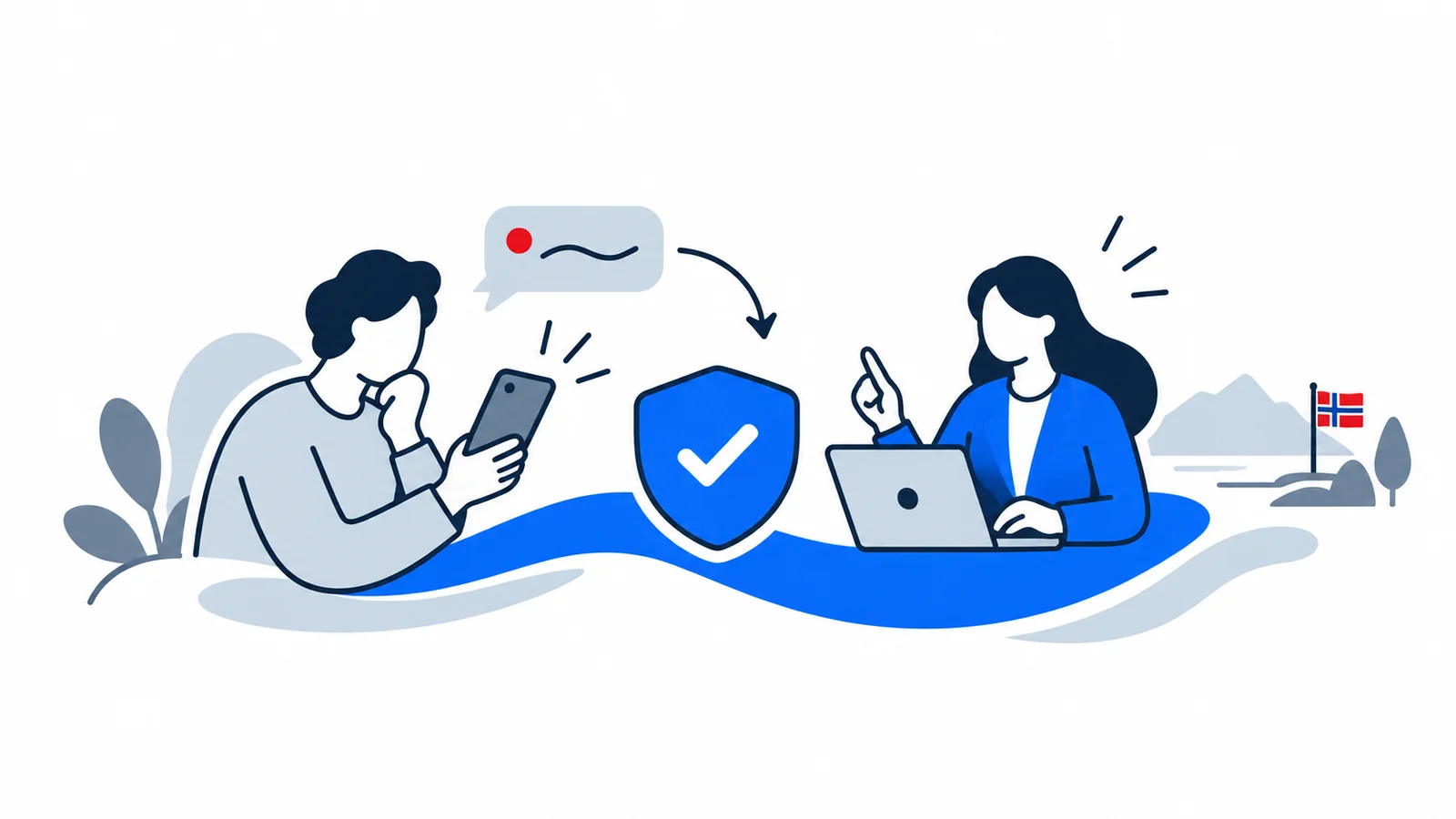

Fraud in Norway affects more and more people, but you can learn to recognize the tricks and stop them. Scammers rely on haste, fear, and trust. Remember one rule: no legitimate bank will ask you to log in with BankID (your electronic ID) to "stop" something.
What is fraud in Norway – and how do you recognize it?
Fraud in Norway means that someone tricks you into giving away money, codes, or personal information. You recognize it by three signs: you are contacted unexpectedly, there is urgency, and someone pressures you to act quickly.
Scammers use SMS, email, phone, and social media. They pretend to be your bank, the police, Posten, or someone you trust. Your codes in online banking and BankID are the keys they want. The goal is always the same: to get you to act fast, before you have time to think. If you are new to Norway, you are extra vulnerable, because scammers exploit the fact that the system is unfamiliar to you. But the rules are the same for everyone – and they are easy to learn.
The best protection is to stop and pause. If you are in doubt, hang up and call back to a number you find yourself. Developing healthy skepticism online is often called digital literacy, and it is your strongest defence.
The numbers give reason for hope. According to Finanstilsynet, which oversees the banks, 962 million NOK was defrauded in Norway in 2025. That is 265 million less than in 2024 – the first time losses have gone down. The banks also stopped fraud attempts worth around 1.5 billion NOK in the first half of 2025 alone.
The 7 most common tricks – and the sign that reveals each one
Here are the seven most common types of fraud in Norway. Under each type, there is one sign you can look for.
- Fake SMS messages and emails (phishing and smishing). "Your package is waiting at Posten," "you owe customs," or "your bank is blocked." Sign: the link does not go to the real address, like posten.no or your bank's website.
- Fake bank employee and BankID pressure. Someone calls, says your account is in danger, and asks you to log in with BankID "to stop" an attack. Sign: a real bank never asks for BankID codes or passwords. Read more in our deep dive about BankID fraud.
- Fake customer service and technical support. A window on your screen or a phone call says your PC is infected, and you must give them remote access. Sign: they contact you unexpectedly and want to control your computer.
- Romance fraud. A new "partner" online is warm and quick, but will never meet you. After a while, a problem appears – and a request for money. Sign: the person asks for money, but never meets you in real life.
- Purchase and sale fraud. On Finn or Facebook, a "buyer" will send you a payment link, or a "seller" demands an advance. Sign: they want to move the conversation away from the platform and send you a link. See how to shop safely when you buy and sell used items.
- Invoice and director fraud. You receive an invoice you do not recognize, or a "boss" asks you to pay quickly to a new account number. Sign: a changed account number and pressure to pay immediately. Always check the claim – our guide about debt collection explains what a real claim should contain.
- Investment fraud. You are promised high and "safe" returns on crypto, shares, or currency through a nice website. Sign: guaranteed high profit without risk does not exist – it is always fraud.
Manipulation fraud, where you trick yourself into paying, is growing fastest. Finanstilsynet particularly points to romance fraud and investment fraud. A common trick is "safe account" fraud: someone pretends to be from the bank and asks you to move your money to a "secure" account that is actually the scammer's.
How do you stop fraud that is happening right now?
If you have just given away money or codes, you must act immediately. Call your bank right away and ask them to stop the transfer and block your card and BankID.
Do it in this order:
- Call your bank immediately and ask them to stop the payment and block your card and BankID.
- Change your password on online banking, email, and BankID if you have shared codes.
- Report to the police by calling 02800, or online via politiet.no. Call 112 if it is an acute emergency.
- Keep evidence: screenshots, messages, receipts, and account numbers. The police will ask for this.
- Notify further your bank and insurance company.
If you are going to send money to family abroad, use known and safe channels – read more about sending money home from Norway. Scammers often pretend to be a money transfer company.
Who can help you?
Several public actors help you for free. The police receive reports at 02800 or at politiet.no, where you log in with your electronic ID and upload evidence.
Finanstilsynet maintains a public list of fake investment companies, called market warnings. Forbrukertilsynet, which protects consumer rights, helps you in cases about purchases, sales, and subscriptions. Your bank has its own teams against fraud and can stop many transfers if you call quickly. You do not need to be ashamed. Fraud affects people of all ages, and the more people who report it, the easier it becomes for the police to stop the scammers.
How to protect yourself against fraud in the future
The simplest rule is to never give away codes, passwords, or BankID to anyone who contacts you. Stop and pause, check the sender, and let some time pass before you act. Turn on alerts in your online banking so you see every payment right away. And never share a one-time code by SMS – it is only meant for you.
At SamfunnPrep, you can learn the rules of Norwegian society in simple language. In our tools you will find checklists and exercises that make you more confident when dealing with banks, public services, and fraud attempts.
Knowing the rights and rules of Norwegian society makes you safer against fraud – much of this is also part of the curriculum for the civics exam, which you can practice for free at SamfunnPrep.