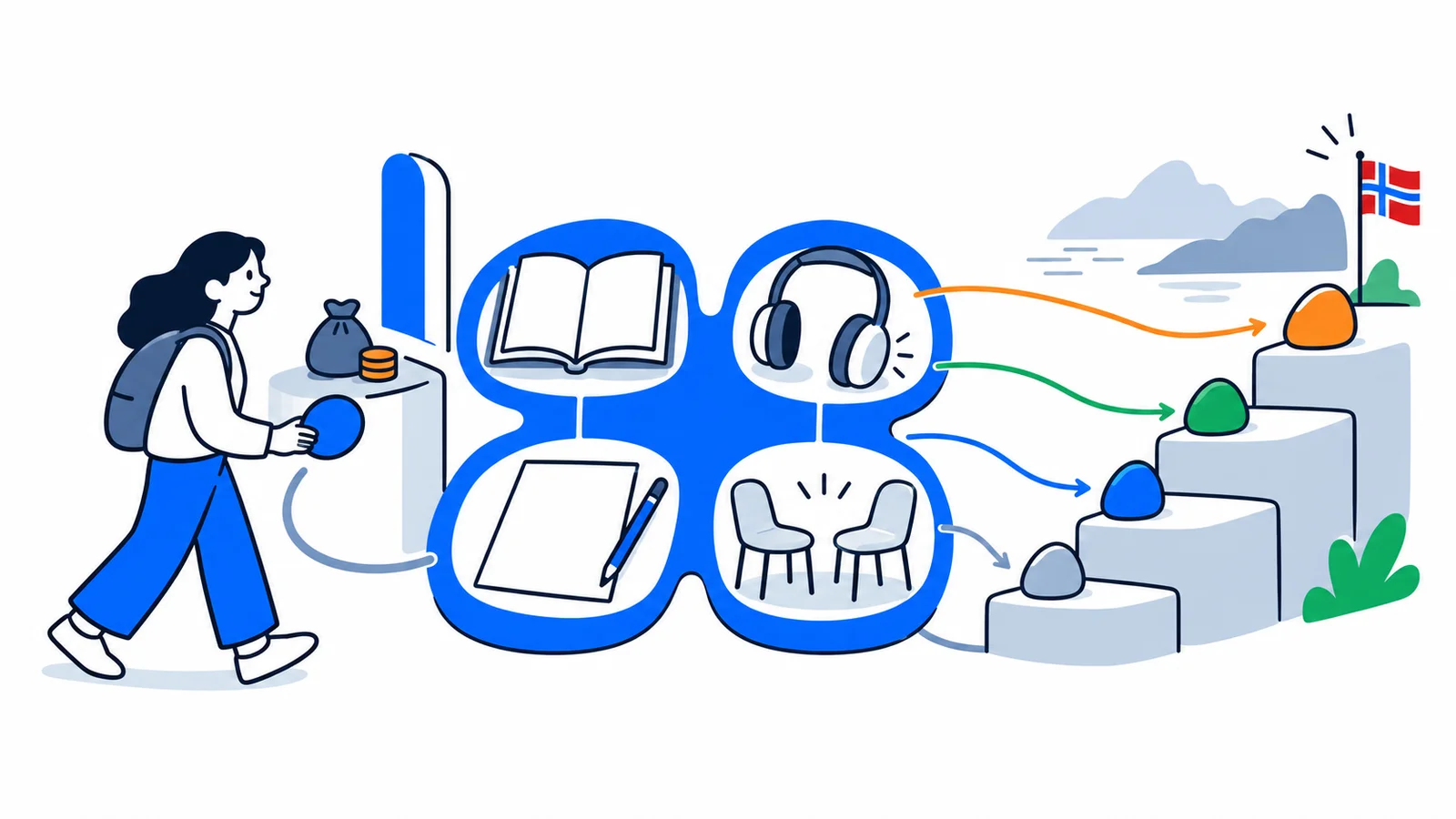
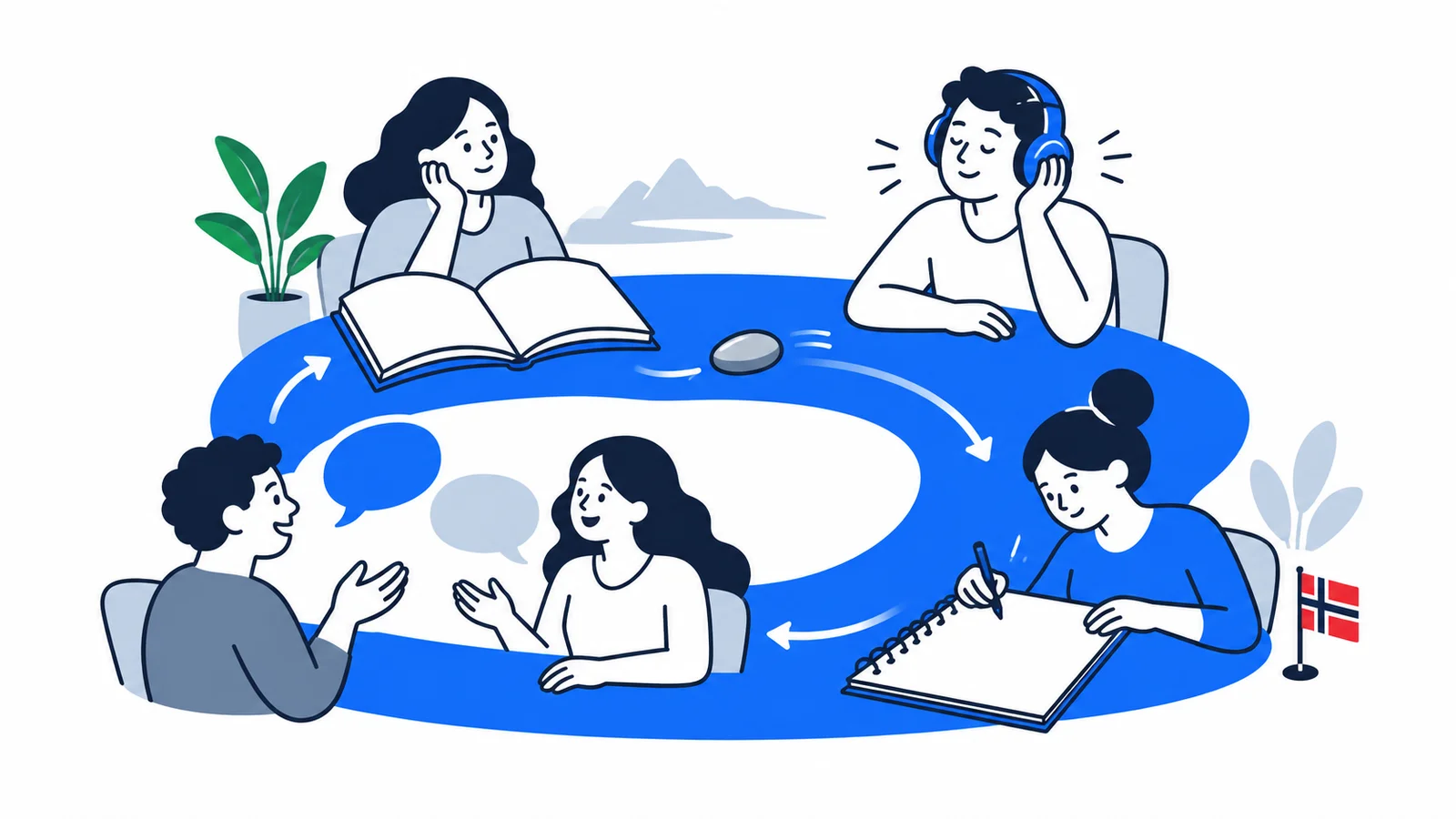

You prepare for Norskprøven (Norwegian language test) by practising in a focused way for the four parts – reading, listening, written work and spoken communication. Use free practice tasks from HK-dir, get to know the format, and practise a little every day at the right level.
Norskprøven is an important step on the way to a safe stay in Norway, and good preparation makes the test day much easier. This guide shows you how to practise for each of the four parts, which free resources you can use, and which mistakes to avoid. If you want to know how to sign up and what the test costs, you will find that in the guide on Norskprøven 2026: levels, sign-up and price.
How do you prepare for Norskprøven?
The best preparation is to practise exactly what the test checks. Norskprøven measures your Norwegian at level A1 to B2, and it has four parts that are graded one by one. So you can practise one part at a time. The most important advice is simple: start early, practise regularly, and use the official practice tasks from HK-dir so you know the format before the test day.
HK-dir (Directorate for Higher Education and Skills) makes and runs the test. On their website you will find example tasks that look exactly like the real test – that is the smartest place to start.
The four parts you practise for
Norskprøven has four parts:
- Reading – you read texts and answer questions. It lasts about 75 minutes.
- Listening – you hear Norwegian speech and answer questions. It lasts between 30 and 60 minutes.
- Written work – you write your own texts, for example a short message or a longer text. It lasts about 90 minutes.
- Spoken communication – you talk with an examiner in a conversation of 20–25 minutes.
The reading, listening and writing parts are taken on a computer, and the speaking part is often on a separate day. You do not need to take all four at the same time – many practise for and take only the parts they still need.
How to practise for reading and listening
The reading and listening parts are adaptive: the tasks get harder the more correct answers you give, and your level is worked out from how much you manage. Everyone starts on the same test, so here you do not choose a level yourself – just answer as well as you can.
How to practise well:
- Read and listen to Norwegian every day. News in clear language, podcasts and simple articles build your vocabulary fast.
- Practise finding the main point, not understanding every single word. The test checks if you get the content.
- Practise multiple-choice tasks with a clock, so you get used to the pace.
- Listen actively: write down keywords while you listen, and train your ears with Norwegian radio and TV.
How to practise for written work
For written work you sign up for a level range – A1–A2, A2–B1 or B1–B2. You cannot get a level higher than the top one in the range you choose, so aim for the one that fits your skills.
Good writing tips:
- Learn the task types: short messages (email, message) and longer texts where you tell, describe or give reasons.
- Write simply and correctly rather than advanced and wrong. Short, complete sentences count.
- Use linking words like "because", "but" and "therefore" to tie the text together.
- Plan your time: read the task carefully, make a quick plan, write, and save two minutes to check it.
How to practise for spoken communication
In the spoken part you talk with an examiner. You present something, answer questions and talk about familiar topics. Many feel nervous, but you practise best by speaking Norwegian out loud as often as you can.
- Practise with a partner or in front of the mirror, presenting yourself, your job and your everyday life.
- Go to a language café, where you practise speaking with others for free.
- Think flow, not perfection: it is better to say something simple than to stop completely.
- Ask people to correct you kindly, so you learn from your mistakes.
Free resources to practise with
You do not need to pay to prepare well:
- HK-dir has official example tasks that show exactly what the test looks like. Practise these first.
- LearnNoW from NTNU (a Norwegian university) is a free online course up to level A2, with support in several languages.
- NRK (Norwegian public broadcaster) has programmes in clear, simple Norwegian that are good for listening practice.
- Language cafés at the library or run by volunteers let you practise speaking for free.
You will find a full overview of useful websites in the guide on the best websites for preparation. If you get Norwegian lessons through the municipality, the teacher practises the format with you – see who has the right to free Norwegian courses in Norway.
Common mistakes – and which level to aim for
The most common mistakes are easy to avoid:
- Signing up for the wrong level on writing and speaking. Aim for the level you need, but be realistic.
- Practising too late. Language takes time – a little every day beats cramming right before the test.
- Forgetting what you will use the test for. If you need a certain level for residence or citizenship, you should know that before you sign up. Read which Norwegian level you need for residence and citizenship.
Remember that the result is not "pass" or "fail" in itself – you get a level (A1, A2, B1 or B2) on each part. Then you know exactly what you need to practise more for next time.
In short
- Norskprøven has four parts – reading, listening, writing and speaking – and you practise for each one separately.
- Use free practice tasks from HK-dir to get to know the format, and practise a little every day.
- For writing and speaking you choose the level range yourself – aim for the level you actually need.