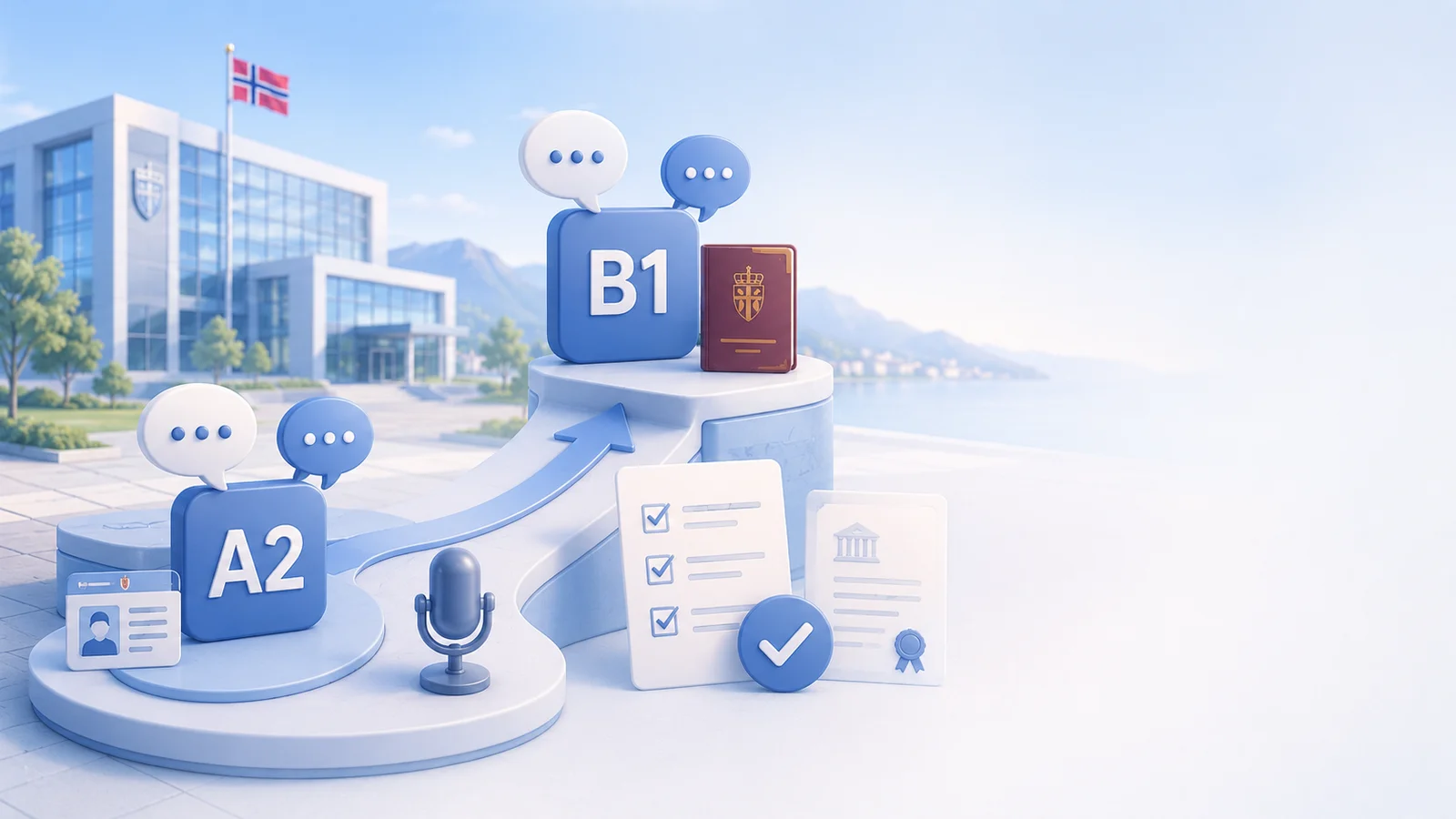



Norskprøven is the official test that measures how good your Norwegian is, at levels A1 to B2. It consists of four parts – reading comprehension, listening comprehension, written production and oral communication – and is run by HK-dir at approved test centres. Together with the samfunnskunnskapsprøven (the society-knowledge test), it is a requirement for permanent residence and citizenship.
Many people mix up Norskprøven and the samfunnskunnskapsprøven. They are two different tests, but they point to the same goal: a secure and lasting stay in Norway. This guide explains what Norskprøven is, how to register, what it costs, and when the result arrives. The site you are reading this on, SamfunnPrep, is built to practise for the samfunnskunnskapsprøven – but here you get a neutral, up-to-date overview of the language test.
What is Norskprøven, and what does it measure?
Norskprøven measures your language skills against the Common European Framework of Reference for Languages (CEFR) – the same scale used for languages across Europe. The levels run from A1 (lowest) to B2 (highest), with A2 and B1 in between. If you perform below the lowest level, your result is "Under A1".
The test has four parts, and each part is assessed separately:
- Reading comprehension – how well you understand written Norwegian.
- Listening comprehension – how well you understand spoken Norwegian.
- Written production – how well you write Norwegian.
- Oral communication – how well you speak Norwegian.
The written parts (reading, listening and writing) are taken on a computer, while the oral part is held as a conversation with an examiner present. The oral and the written parts are separate, and they are often on two different dates. The reading, listening and writing tests are usually on the same day.
In practice, reading comprehension and listening comprehension consist of tasks where you read or hear Norwegian and answer questions, for example multiple choice. In written production you write texts yourself, such as a short message or a longer text, suited to the level you are registered for. In oral communication you speak with an examiner – you present something, answer questions and converse about familiar topics. You do not have to take all four parts at once; many people take only the parts they are missing.
Norskprøven levels: how A1–B2 works
How you register depends on the part. For written production and oral communication you register for a specific level band: A1–A2, A2–B1 or B1–B2. So you choose which level you are aiming for, based on how good you are.
For reading comprehension and listening comprehension you do not register for a specific level. These parts are adaptive: the tasks adjust to your level as you go. The more correct answers you give, the more and harder tasks you get – and so you can reach a higher level. Everyone starts on the same test regardless of level.
The result is not "pass" or "fail" in itself. You get a level (A1, A2, B1 or B2) on each part, and which level you need depends on what you will use the test for. On the written and oral parts you cannot get a higher result than the top level you are registered for – if you choose A1–A2, you cannot reach B1 on that test. That is why it is wise to register for the level band that fits your skills.
Registering for Norskprøven via HK-dir
Everyone who takes Norskprøven as a private candidate (privatist) must register via HK-dir's website (prove.hkdir.no). You count as a private candidate if you pay yourself – for example because you do not have the right and obligation to free training, or because you are retaking the test.
Here is how to do it:
- Find a registration period. Registration is open in short windows before each test period. In 2026 the periods are in January, April, August and October.
- Choose a test centre. The test is taken at an approved test centre, often a municipal adult education centre. If you want to take the test in a municipality other than where you live, you must arrange it with the municipality before you register.
- Choose parts and level. Register for the parts you need, and choose the level band for the written and oral parts.
- Pay. You complete the registration by choosing payment and confirming.
Most test centres hold Norskprøven four times a year. That gives flexibility, but places can fill up – so register early in the registration window. You can retake the test in a later test period if you want to improve your level, but then you pay again as a private candidate.
What does Norskprøven cost for private candidates?
It is the municipality (the test centre) that sets the price, so it varies from place to place. According to HK-dir, the price can range from around 400 kroner for one part to up to about 2,500 kroner for the whole Norskprøven (as of 2026). You see the exact price in the registration portal, or you can contact the test centre directly.
Note: prices and dates change. Always check the current amount and registration period at prove.hkdir.no before you plan.
If you have the right and obligation to Norwegian training through the municipality, you often take the test for free the first time. To find out who has the right to free training, read about free Norwegian courses in Norway and the right and obligation rules.
When does the result come?
You get the result by email a few weeks after the test period – HK-dir states about three weeks in its FAQ, but the wait can vary between test periods. You get all the results at the same time. The test certificate itself is sent by post and may take a few extra days.
If you need to prepare well, there are official practice tasks and courses. You will find an overview of useful resources in the guide on the best websites for preparation.
Norskprøven and the samfunnskunnskapsprøven – two tests, one goal
It is easy to confuse the two tests, but they are not the same:
- Norskprøven measures your language at levels A1–B2 and has four parts.
- The samfunnskunnskapsprøven measures knowledge of Norwegian society and can be taken in a language you understand well. You will find the details in the guide on the format of the samfunnskunnskapsprøven.
Both are run by HK-dir, and IMDi is responsible for the integration policy behind them. For permanent residence, the general rule is a passed oral Norwegian test at level A2 or higher, while Norwegian citizenship requires oral at level B1 (with exceptions for weighty reasons). The rules have been tightened in recent years, so you should always check the exact requirements against the authoritative overview in the article on the requirements for Norwegian citizenship.
Some people may be entitled to exemption from Norskprøven, for example on health grounds. Such exemptions are assessed individually, and it is the municipality and the immigration authorities that decide. If you are unsure what applies to you, contact your municipality or see the information at UDI before you register.
In short
- Norskprøven has four parts (reading, listening, writing, oral) and measures Norwegian at levels A1–B2 under the CEFR.
- You register as a private candidate via HK-dir and take the test at an approved test centre, usually four times a year.
- The price is set by the municipality and ranges from around 400 kr per part to about 2,500 kr for the whole test (as of 2026) – check prove.hkdir.no for current figures.