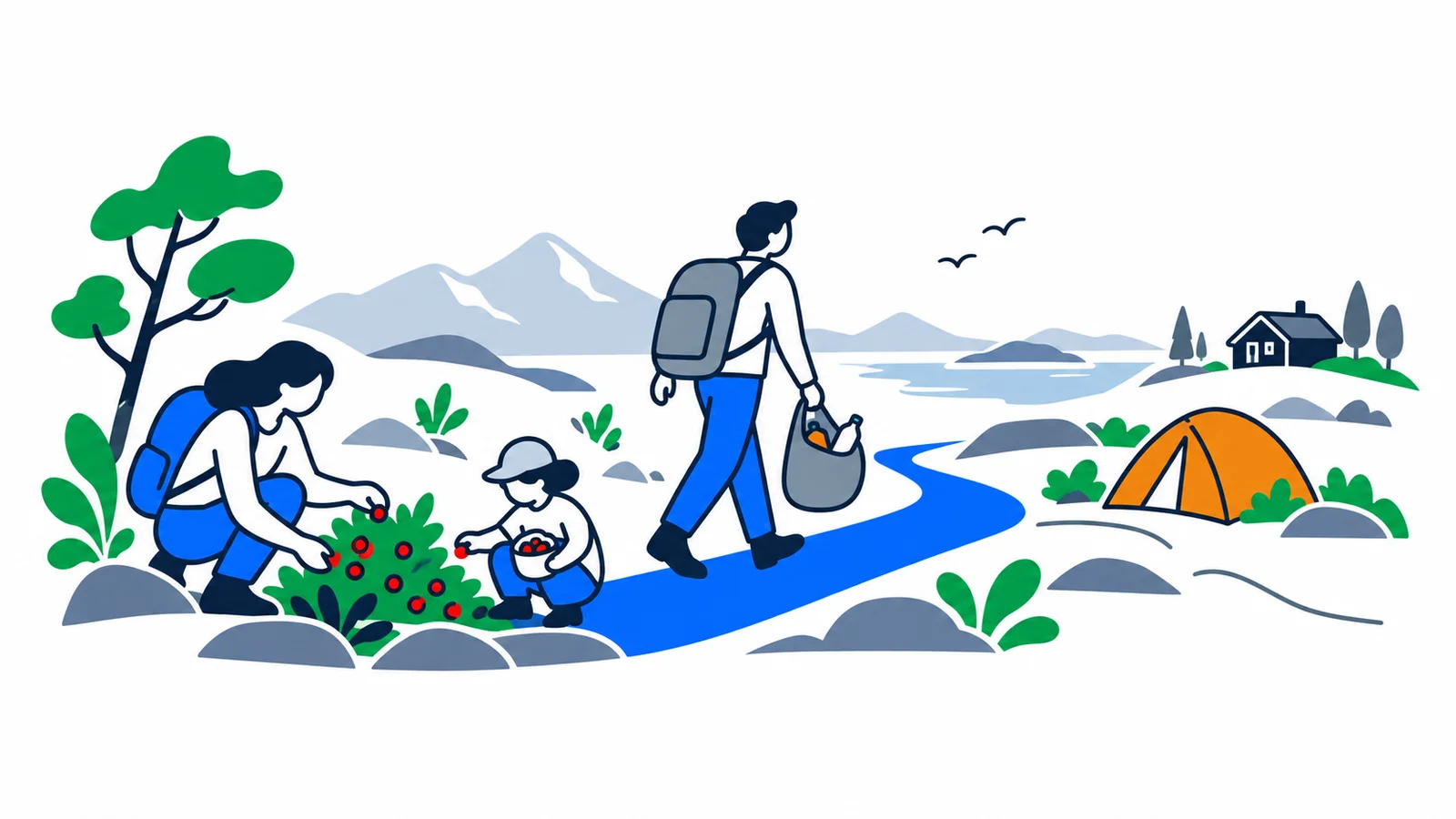
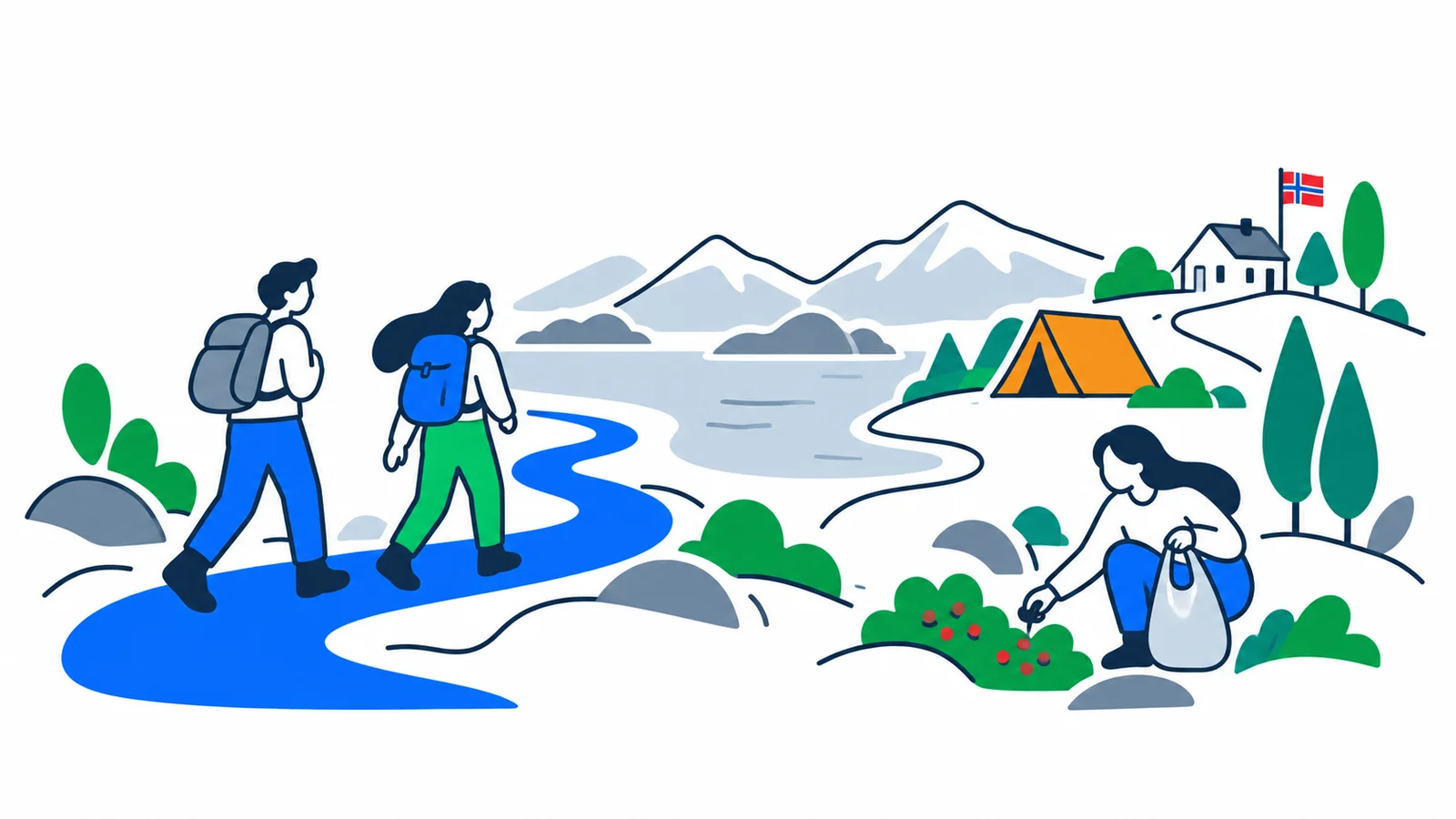

Friluftsliv in Norway means being outdoors in nature. You hike, swim, camp and pick berries. Thanks to allemannsretten (the right to roam), nature is free and open to everyone. With the right come duties: you must be considerate and clean up after yourself.
What is friluftsliv in Norway?
Friluftsliv in Norway is using nature in your free time. It can be a short walk in the forest, a day in the mountains or a weekend in a tent.
For many in Norway, friluftsliv is a big part of their identity. Nature is close, even in cities, and people use it all year round.
You do not need much equipment or money. Good clothes and shoes are enough to start. That is why friluftsliv is an easy way to get to know Norwegian culture.
Nature is used all year. In winter, many ski or toboggan, and in summer they swim and hike. A famous Norwegian saying says « out on a hike, never grumpy ».
Friluftsliv is closely connected to Norwegian values and unwritten rules: equality, respect for nature and the desire to be outdoors regardless of weather.
Allemannsretten: what are you allowed to do?
Allemannsretten gives everyone the right to move freely in nature. It is enshrined in the Right to Roam Act from 1957.
The right applies in utmark. Utmark is uncultivated nature such as forest, mountains, marshes and beaches. There you can walk, cycle, swim, rest and fish in the sea.
An important condition is that you move considerately and carefully. You must not damage nature or disturb others.
The right does not apply in innmark. Innmark is cultivated land, gardens and the area close to houses and cabins. There you must ask permission.
You can, however, walk over cultivated land from 15 October to 29 April, when the soil is frozen or covered with snow.
You can read more in our guide to the right to roam in detail. The rules are also explained by Miljødirektoratet (the Directorate for Environment), which is the state agency for the environment.
Can you camp in nature?
Yes, you can camp in nature almost anywhere in uncultivated land. This is part of allemannsretten.
Two rules are important to remember:
- The tent must be at least 150 meters from an inhabited house or cabin.
- You can stay a maximum of two nights in the same place without asking the landowner.
If you are far from houses or high in the mountains, you can stay longer without asking. Then there are few people nearby.
Always clean up the camping site when you leave. The place should look as nice as it did before you arrived.
Fire ban: when can you not light a fire?
There is a general fire ban in or near forest and open land from 15 April to 15 September every year. This date is the same throughout Norway.
During this period, it is forbidden to light open fires in nature. The ban applies to bonfires, disposable grills and portable grills. The rule comes from the Directorate for Civil Protection and Emergency Management (DSB).
You can still make a fire in places where it is safe, for example at fixed fireplace sites where fire cannot spread. If you are in doubt, do not light one. The person who lights the fire is responsible.
Outside this period you can light a fire, but always with caution.
Can you pick berries and mushrooms?
Yes, you have the right to pick berries and mushrooms in uncultivated land. You can also take wild flowers and herbs.
The rule is simple: you can harvest freely as long as you do it considerately. Some rare plants are protected and should be left in peace.
For cloudberries in Nordland, Troms and Finnmark, a special rule applies. There the landowner can prohibit picking. But cloudberries you eat on the spot, you can always pick.
Here is a brief overview of what is allowed and what is not:
| Allowed in uncultivated land | Not allowed |
|---|---|
| Walk, cycle and swim | Walk into gardens and cultivated land in summer |
| Camp over 150 m from houses | Light fires 15 April–15 September near forest |
| Pick berries, mushrooms and flowers | Pick protected plants |
| Stay two nights | Stay longer without asking the landowner |
Duties: nature is a shared responsibility
With allemannsretten come duties. You have both a right and a responsibility.
You must be considerate to other people, to animals and to the landowner. You must never litter. All rubbish you take home with you.
The goal is to leave nature without leaving a trace. The next person should find it as nice as you did.
This is also about sustainability and environment in Norway. Nature is a common good that everyone must take care of.
Friluftsliv as a way into community
Friluftsliv in Norway is a cheap and safe way to meet people. Many Norwegians are easier to get to know on a hike than indoors.
You can join a hiking group or go hiking with DNT – Den Norske Turistforening (The Norwegian Mountain hiking club), the largest outdoor organization in the country. DNT was founded in 1868 and has cabins and marked trails all over Norway. Many hikes are free and suitable for the whole family.
On a hike you also practice Norwegian in a relaxed setting. You hear the language and use it yourself, without stress.
Friluftsliv is also an easy start to volunteering and community work. Clearing a trail or participating in community work is a nice way to become part of the local community.
At SamfunnPrep we see that nature and values are connected. Knowing allemannsretten is both practical in everyday life and useful for the test.
Friluftsliv and allemannsretten are part of the curriculum for the citizenship test — practice for free on SamfunnPrep.