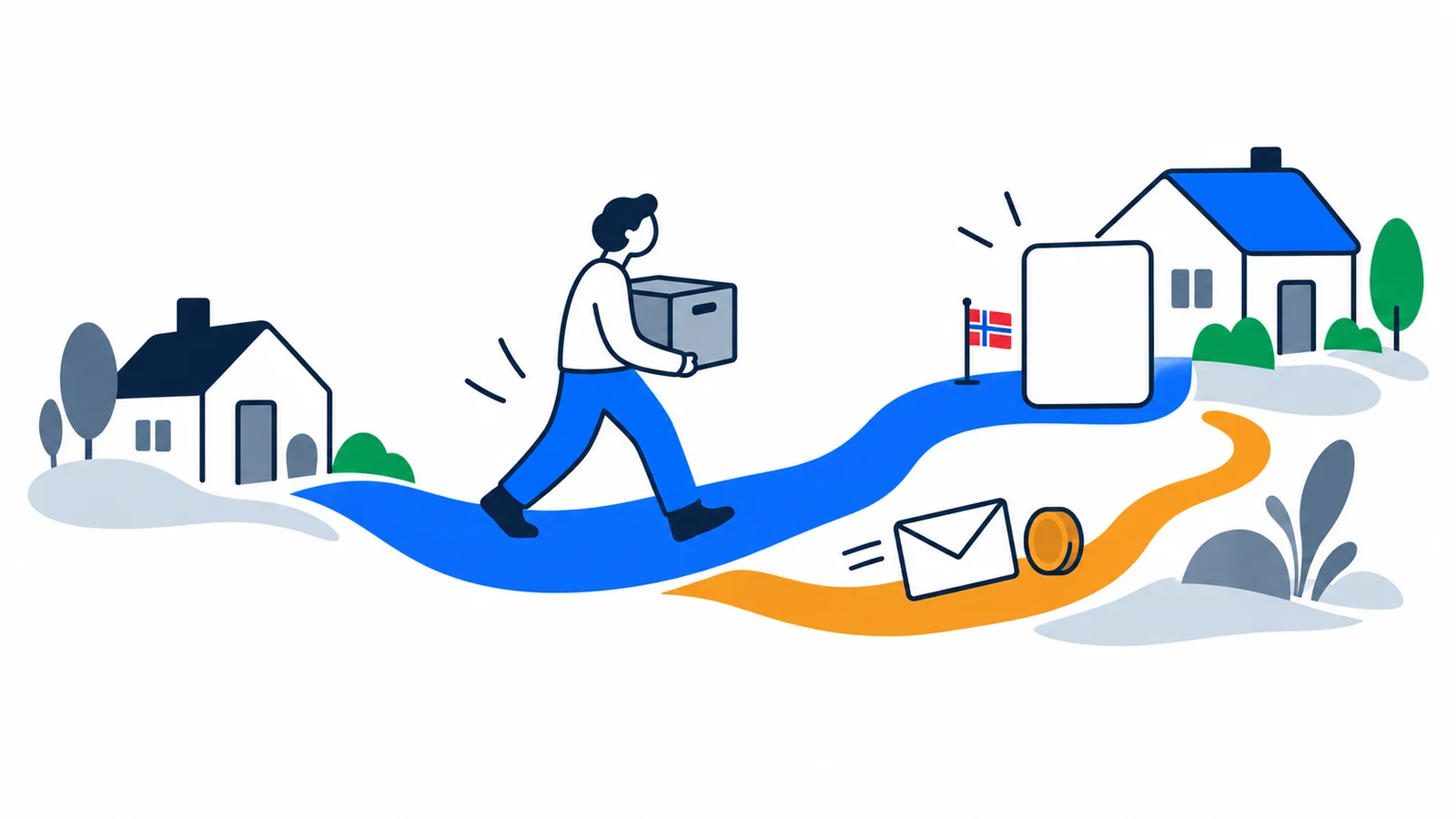


National registration means that you are listed in Folkeregisteret with the correct address and status. If you are going to live in Norway for at least six months in a row, you must be registered as a resident – a shorter stay usually only gives you a D-nummer.
What Is Folkeregisteret, and Why Do You Need to Register?
Folkeregisteret is Norway's official register of everyone who lives in or has a connection to the country. Skatteetaten runs the register, and the information is used by NAV, Lånekassen, the health service, the municipality and banks to know who you are and where you live. Without correct registration, you may have trouble receiving mail, applying for benefits, getting a student loan or getting a tax card. The register distinguishes between two statuses: resident (permanently registered with a fødselsnummer) and holder of a D-nummer (a temporary identity number without a permanent residence registration). Which status you get is, in practice, decided by how long you are going to stay in Norway.
This applies to you whether you are a labour migrant, a family immigrant, an EEA citizen, a refugee or a student. Note that registration in Folkeregisteret with Skatteetaten is something different from a residence permit from UDI: you can have legal residence without yet being registered as a resident, but most everyday rights follow the registration, not the residence permit alone.
Resident or D-nummer? The Six-Month Rule Explained
The main rule is simple: if you are going to live in Norway for at least six months in a row, you must submit an address change notification and be registered as a resident in Folkeregisteret, according to Skatteetaten. If you are planning a shorter stay – for example a seasonal job or a short study period – you instead get a D-nummer linked to your employer, bank, place of study or another requesting party. A D-nummer does not give you resident status, and it automatically becomes inactive five years after it is issued, even if you are still staying in Norway; the requesting party then has to ask for it to be reactivated. If you are unsure whether you have a fødselsnummer or a D-nummer, you can read more about the difference between fødselsnummer and D-nummer. If your plans change along the way so that your stay becomes longer than six months, you must report this and apply to be registered as a resident as soon as this becomes clear.
How to Register When You Move to Norway
To be registered as a resident, you must send an address change notification to Folkeregisteret and attend an ID check in person at a tax office that offers this service. The process is:
- Submit the address change notification digitally at skatteetaten.no, or on paper if you do not have an electronic ID yet.
- Book an appointment for an ID check at a tax office in advance – you cannot just show up unannounced.
- Bring valid identification (a passport is safest) and any documentation of your basis for residence.
- For EEA citizens, registration often comes together with an application for right of residence; read more about registration certificates for EEA citizens.
After a successful ID check, you are assigned a fødselsnummer, and you are registered as a resident at the address you provided. Processing time varies with demand at the tax office, so book an appointment as early as you can once you have a place to live. If the whole family needs to be registered, it can be a good idea to book appointments for everyone at the same time, since children under 18 usually have to attend the ID check together with a parent or guardian.
Address Change Notification Within Norway: The Eight-Day Rule
If you move within Norway – to a new municipality or a new address in the same municipality – you must notify Folkeregisteret. The deadline is clear: the address change notification must be sent at the earliest 31 days before and at the latest eight days after you have moved, according to Skatteetaten. Notifying an address change is free, and it is easiest done digitally with BankID or another electronic ID. If several people live in the same household, you can usually notify the move for your spouse, cohabiting partner with joint children, and your own children under 18 at the same time.
Note the distinction between place of residence and postal address: you must always be registered at the address where you actually live most of the time, not where you want to receive mail. If your mail should go somewhere else, you instead register a separate postal address in addition. A correct address in the register is essential for mail, voting cards, tax cards and decisions from NAV or the municipality to actually reach you. If you move to study, the same eight-day rule applies – students who live in a rented room or shared flat in a different municipality than their parents' home should, as a general rule, be registered at their place of study, not with their parents.
Moving Out of Norway: Emigration and Tax Liability
If you are moving abroad and planning to be away for more than six months, you must notify Folkeregisteret of your emigration. The notification should be sent at the earliest 31 days before you move, and you should send it before departure – not wait until you have arrived. Keep in mind that notifying emigration in Folkeregisteret does not automatically end your tax liability to Norway; there are separate rules for tax emigration at Skatteetaten, and the two processes must be assessed separately. If you still have income, assets or property in Norway after moving out, you should check which obligations apply – including those related to tax returns in Norway.
Why Correct Registration Matters
Your status in Folkeregisteret governs more than you might think. As a resident, you get, among other things:
- the right to choose a regular GP where you live;
- mail and decisions from NAV, Lånekassen and the municipality sent to the correct address;
- a tax card without unnecessary delay, and the correct municipality for tax and services;
- a basis for opening a bank account in Norway – most banks require resident status or a valid D-nummer.
At local elections, national registration also gives political rights: foreign citizens from outside the Nordic countries only get the right to vote in municipal and county council elections once they have been continuously registered as resident for three years before election day, according to regjeringen.no. In addition, the municipality uses data from Folkeregisteret for community planning – among other things to calculate the need for kindergarten places, school places and emergency preparedness in your local area. An incorrect address can therefore affect more than just your own mailbox.
Many of these rules are also part of the curriculum for Samfunnskunnskapsprøven – practice for free on SamfunnPrep and feel confident about the material before you take the exam.