
To apply for a local library card in Norway, visit your municipal library with valid ID. If you have a Norwegian national identity number or D-number and can sign in with ID-porten, you can also register for the national Bibliotekkortet online, then activate it at your chosen library. The first card and ordinary book loans are free; services and borrowing rules vary locally.
What does it cost to use a library in Norway?
Ordinary book borrowing and visiting a public library in Norway are free. The Public Libraries Act (folkebibliotekloven) § 1 states that libraries must provide books and other media "free to everyone living in the country." The law also requires that all municipalities have a public library (§ 4), and that the library be an independent meeting place for conversation and debate.
There is no membership fee, and you don't need to buy anything to sit there. Late returns, lost items, replacement cards or optional services can cost money. Rules vary from municipality to municipality, so check the deadlines on your loan receipt or on the library's website.
Local library card application: choose the right route
Your municipal library is the place to ask about borrowing and local services. There is no single application form that signs you up at every library automatically.
| Your situation | What to do | What to check |
|---|---|---|
| You can use ID-porten | Register at bibliotekkortet.no, then join your chosen library | Accept its lending rules and select a home library |
| You prefer help in person or cannot sign in online | Visit the staffed desk with valid photo ID | Ask which identity details the library needs and whether it issues a local or national card |
| You only have a DUF-number | Ask your local library about a local card | A DUF-number alone is not a national identity number for Bibliotekkortet |
| You need a card for a child | Ask about guardian consent or use the child registration option online | The guardian signs in through ID-porten; local age rules can differ |
The National Library's current guidance distinguishes national identity numbers and D-numbers from DUF-numbers. For an in-person visit, bring original identification and have your address and contact details ready. For example, Trondheim's ID rules accept identification with a photograph and date of birth, such as a passport or official ID card; copies and photographs of documents are not accepted there. Confirm your own library's requirements before travelling.
Apply online and activate the card locally
- Open the official Bibliotekkortet site and choose registration. Sign in using ID-porten.
- Complete your details and keep your digital card number or barcode.
- Join the library you want to use. Some libraries allow digital approval; others require a visit. Online national registration by itself does not make you a borrower at a specific library.
- Accept that library's lending rules and choose a home library. This controls where interlibrary orders arrive and can affect access to e-books and films.
- Check the due date when you borrow. Ask how to renew or return items, and whether after-hours access needs a separate agreement.
Bibliotekkortet can be used to join other Norwegian libraries, but you must activate it at each new library. Digital collections are generally licensed by the individual library. A national card therefore does not unlock every e-book service in the country. These distinctions are explained by the National Library's national-register guidance.
Practical example: you obtain a digital card before visiting Trondheim. The next step is to connect it to Trondheim folkebibliotek and accept its local rules. If you later move, join your new library and update the home-library setting. This is an illustrative workflow, not a reported user story.
Through Biblioteksøk you can request books from other libraries for collection at your home library. Check return instructions for each loan; do not assume every branch or library can accept an item borrowed elsewhere.
What can you do without a library card?
You don't need a library card to use the library — only to take items home. Anyone can enter, sit down and read newspapers, magazines and books for free. You can work on your own laptop or attend open events. Guest Wi-Fi, public computers and room booking may require local registration; ask the staff.
This makes the library one of the few places in Norway where you can spend time indoors without paying anything. If you're new to the country and want to save money, this is worth knowing. Feel free to bring the children — the children's section is open to everyone.
Can I borrow books in my own language?
Yes. The Multilingual Library (Det flerspråklige bibliotek), a service from the National Library (Nasjonalbiblioteket), has books, films and language courses in over 50 languages — including Ukrainian, Arabic, Polish, Somali, Tigrinya, Russian and Persian. Your local library can order book packages from it, completely free.
Ask the staff at the counter. Many libraries also have their own shelves with books in the most common languages in the municipality, as well as easy books in Norwegian for those learning the language.
Free Norwegian training and language cafes
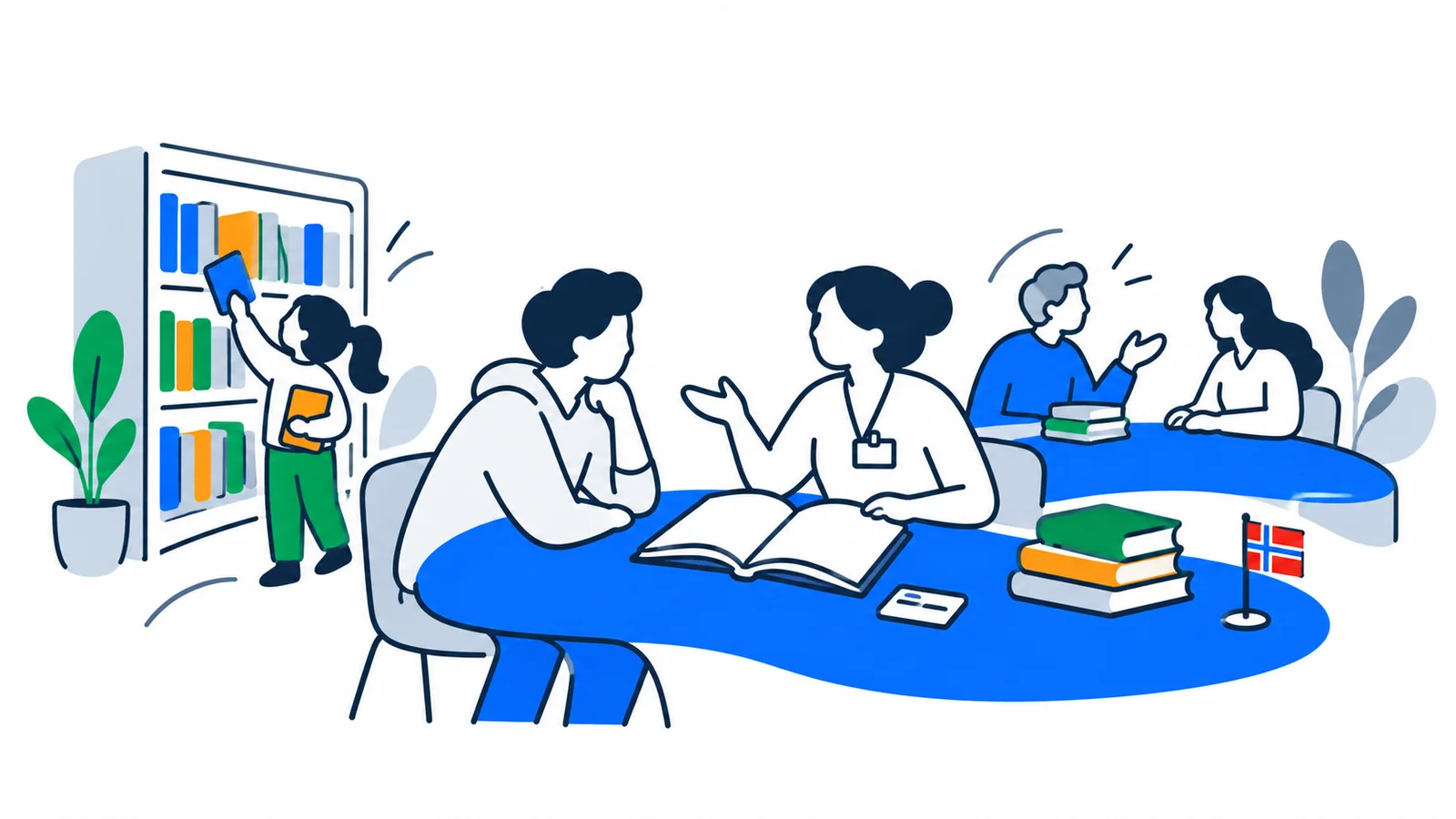
Many libraries organize language cafes: a free, informal gathering where you practice speaking Norwegian with volunteers and other participants. You usually don't need to sign up — just show up. It's one of the easiest ways to get conversation practice, and you can combine it with other offers to learn Norwegian for free in Norway.
The language cafe is also a meeting place. Many newcomers to Norway say it's difficult to get to know people. The library is a natural place to start — feel free to read our advice on building a network when you're new to Norway.
Offers for children and families
Libraries are great for families. The children's section has books, comics and often free events such as story time and homework help. In the summer, children in grades 1–7 can participate in Sommerles, a free reading campaign. The 2026 round ran from 1 June to 31 August and is now over; check your library for the next round. Children register on sommerles.no with an adult and collect points and prizes by reading — e-books and audiobooks count too.
A tip from libraries: read to your children in their mother language. A strong mother language makes it easier for children to learn Norwegian, and the library can provide children's books in many languages.
If your family wants to borrow more than books, there are also equipment centers where you can borrow sports equipment for free through BUA.
More than books: e-books, newspapers and after-hours access
Your library card gives you more than physical books. Most libraries offer free e-books and audiobooks through their own apps, and many provide digital access to Norwegian and foreign newspapers. In the National Library's online library at nb.no, you can also read many older Norwegian books and newspapers for free online. In the library building you'll find free wireless internet, computers, and often meeting rooms you can use for reading or meetings.
Many municipalities also offer after-hours access: with your library card and PIN code, you can unlock access to the library outside staffed opening hours, for example early in the morning or late in the evening. Then you can borrow, return materials and work by yourself when staff are not present.
Struggling with digital services? The library can often help. Many libraries offer free guidance on using public websites, apps and email — just ask at the counter about when they have digital help available.
The library as a free study space
If you're taking the Norwegian language test or the social studies test, the library is a quiet and free study space — and you can borrow textbooks there. SamfunnPrep offers independent free practice for the social studies test. For the Norwegian language test, use HK-dir's language-test resources.
If you're new to Norway, getting a library card should be on your list of first priorities. Feel free to check out the checklist for your first week in Norway on SamfunnPrep — the library is one of the items that costs you nothing and gives back a lot.