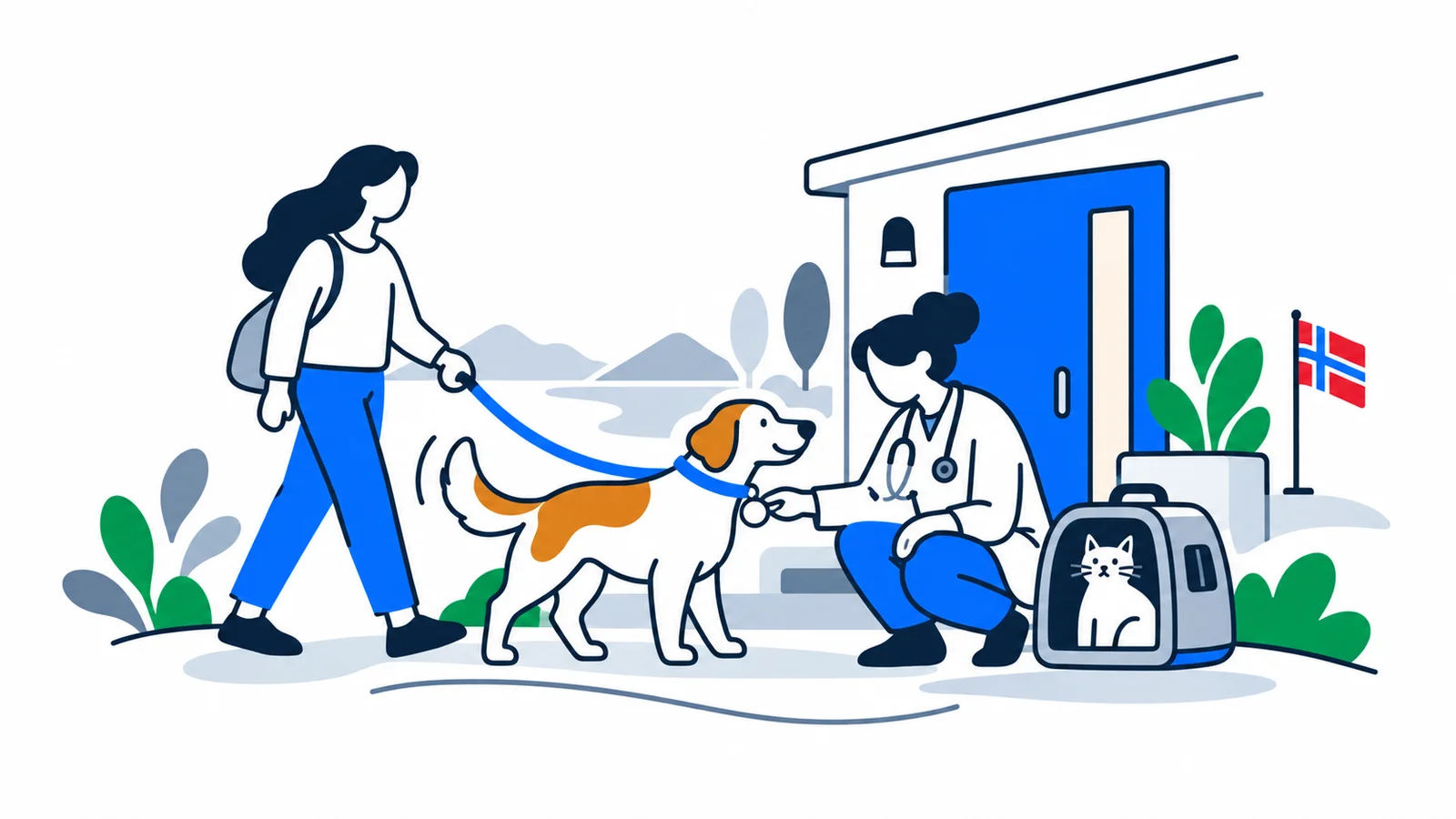

You can bring a dog or cat to Norway when the animal is ID-tagged, rabies vaccinated, and has an EU pet passport. In Norway, six dog breeds are prohibited, leash requirements last from April 1 to August 20, and as a renter you often have the right to keep animals. Here are the rules for pets in Norway you should know.
Bringing pets to Norway: these are the requirements
Dogs, cats, and ferrets can be brought from an EU/EEA country when four requirements are met: microchip, valid rabies vaccine, EU pet passport – and for dogs also deworming treatment. The requirements come from the Norwegian Food Safety Authority, which is the state's authority for animals and food. If you're moving to Norway with animals, you should plan this together with the rest of your move – feel free to use the first-week tool on SamfunnPrep.
Order matters:
- Microchip first. The animal must be ID-tagged with a chip to ISO standard 11784 before it is vaccinated. Vaccine given before the chip does not count.
- Rabies vaccine. The animal must be at least 12 weeks old. After the first vaccine, you must wait 21 days before it is valid for travel.
- EU pet passport. Issued by a veterinarian in an EU/EEA country and must be signed by the owner.
- Deworming for dogs. Dogs must be treated for fox tapeworm 24–120 hours before arrival in Norway, documented in the passport. If you travel frequently, the dog can instead receive regular treatment at maximum 28-day intervals (the 28-day rule). Cats do not need deworming.
You can bring up to five animals, and only your own. At the border, you go through the red zone and show the animal and documents to Norwegian Customs. If the animal comes from a country outside the EU/EEA, requirements are stricter – many countries also require a blood test showing that the rabies vaccine is effective. Always check the rules for your country at mattilsynet.no before your trip. If the animal doesn't meet the requirements, it can be sent back or placed in an animal boarding facility – at your expense.
Which dog breeds are prohibited in Norway?
Six dog breeds are illegal to own, breed, and import in Norway: pitbull terrier, American Staffordshire terrier, fila brasileiro, tosa inu, dogo argentino, and Czechoslovakian wolfdog. The ban also applies to mixed breeds containing one of these breeds – regardless of how small the proportion is – and hybrids of dog and wolf. The rules are set out in the Dog Act and its regulations.
If you buy a dog abroad, you must therefore be able to document what breed it is. If the breed is unclear, it is the owner who must prove that the dog is legal.
Leash requirement: when must your dog be on a leash?
From April 1 to August 20 there is a leash requirement throughout Norway. Then all dogs must be kept on a leash or be properly fenced. The period protects wild animals and birds when they have young, and livestock such as sheep.
Many municipalities have additional, longer leash requirement rules – for example near schools, on illuminated cross-country skiing trails in winter, or in areas with livestock throughout the season. Check your municipality's website. Outside the leash requirement period, the dog can be off-leash, but you should always have control over it. Breaches of the leash requirement can be punished with a fine. The right to move freely in nature with a dog is closely related to the right of public access.
Do you have the right to keep pets in a rental apartment?
Yes, often – even if the landlord has set a ban. The Rental Housing Act § 5-2 says that the tenant can keep animals when two conditions are met: there are good reasons for it, and the keeping of animals is not a nuisance to the landlord or others in the property.
Good reasons can be that the animal is important to you or the children, or that you need a guide dog or therapy dog. A quiet indoor cat in an apartment is rarely a nuisance. If you disagree, the matter can be resolved by the Tenancy Dispute Board. Also read the guide on rental contract and your rights as a tenant. The same principle applies in housing cooperatives and condominiums.
What does it cost to have animals in Norway?
Animals have no public health coverage in Norway. Exemption cards and co-payments apply only to people – at the veterinarian you pay the full price yourself, and surgery can quickly cost several thousand krone. Many therefore get pet insurance, which covers part of veterinary costs for a fixed annual price. Compare terms before you choose – see the guide on insurance for newcomers to Norway.
Other fixed costs are food, ID-tagging, vaccines, and possible dog care. Set up a simple annual budget before you get animals.
If you are to get animals in Norway, buy from a reputable breeder with a written contract, or adopt through a rehoming organization. Be skeptical of cheap puppies without papers offered online – they are often smuggled in, can be sick, and you risk the animal being taken from you.
ID-tagging and registration: what is required?
As of July 2026, ID-tagging is voluntary but strongly recommended – a chip registered in the DyreID registry means you get your animal back if it gets lost. The rules are changing:
- The Storting voted in April 2025 that ID-tagging of dogs should become mandatory in Norway. As of July 2026, the regulation had not yet come into force.
- The proposal for mandatory ID-tagging of cats was voted down in April 2025.
- The EU agreed in November 2025 on new rules on welfare and traceability for dogs and cats. Through the EEA agreement, they will in due course require ID-tagging of cats in Norway as well, but with long transition periods for private owners – around ten years for dogs and fifteen years for cats after the rules come into force.
In other words: Chip your animal now, and you'll be ready whenever the requirements come.
Want to understand more of the everyday rules in Norway? SamfunnPrep has guides in 11 languages about life in Norway – and free practice for the society knowledge test. Try SamfunnPrep free.