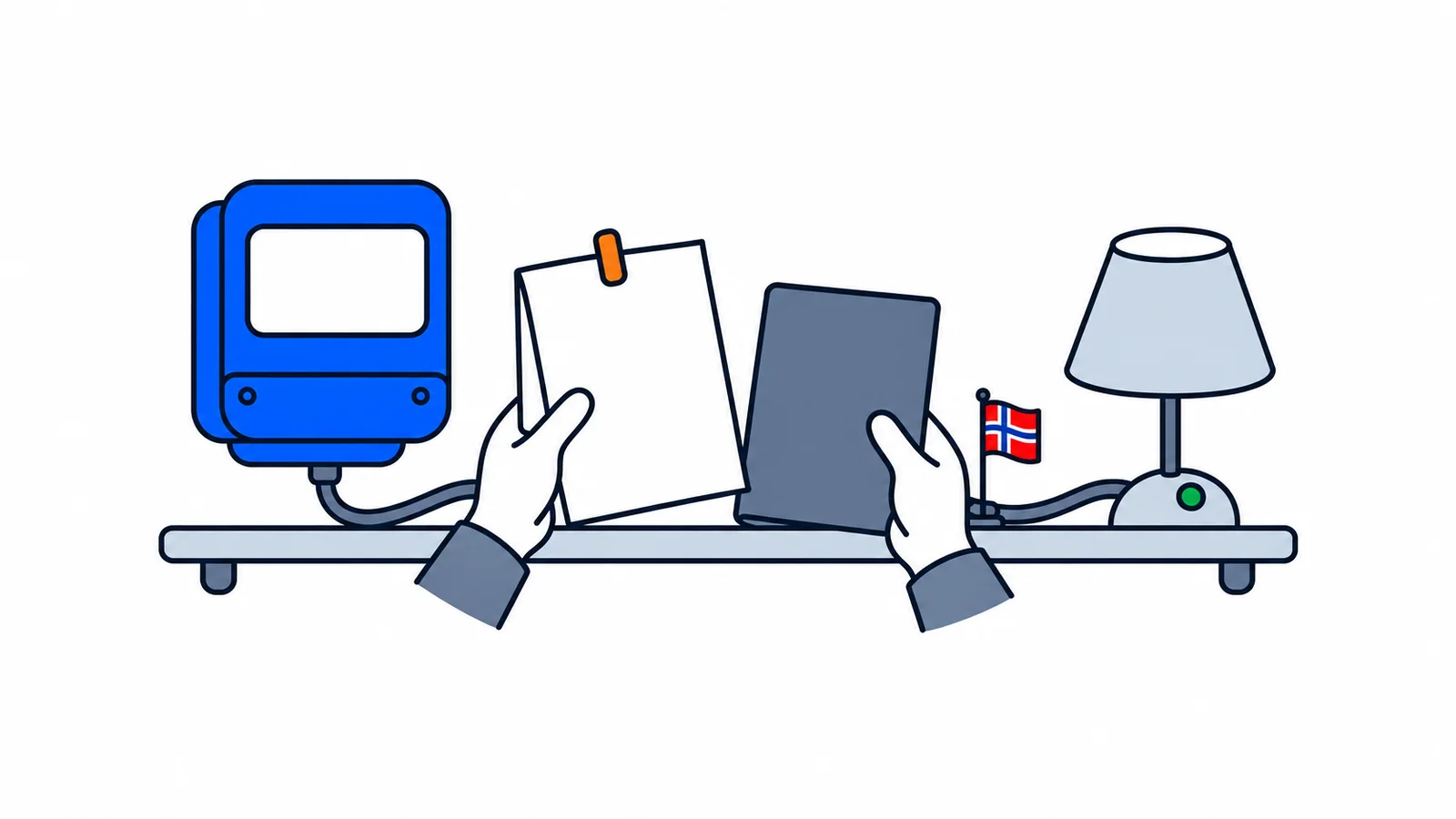
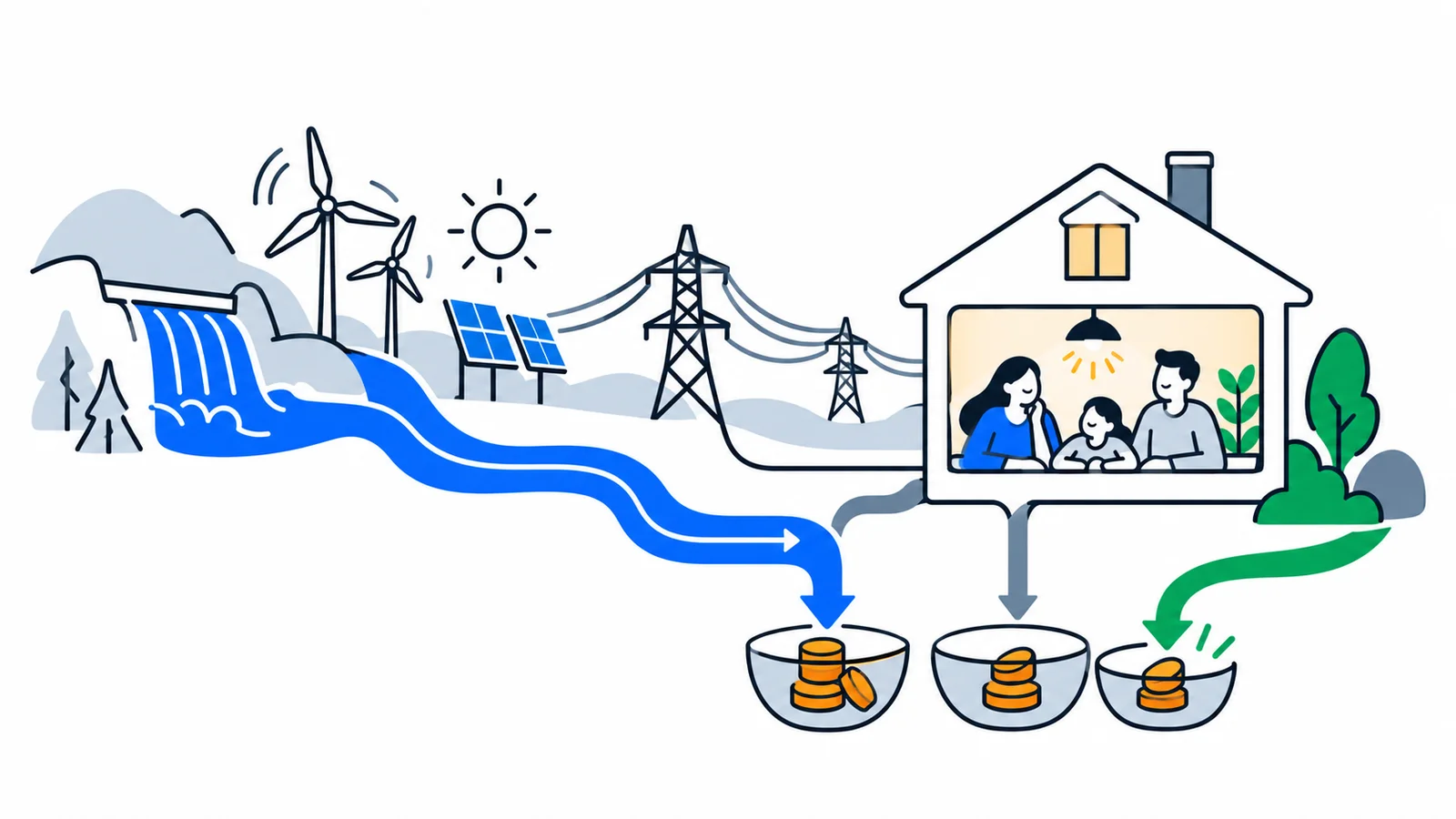

Your power bill in Norway has two parts: electricity (the power you use, from a supplier you choose yourself) and grid rent (the fee for using the power grid, one fixed company per area). In 2026 the state covers part of the bill through electricity support and the optional Norgespris scheme.
Electricity and grid rent – two bills, one purpose
Your power bill consists of two completely separate costs: electricity and grid rent. Electricity is the actual power you use, and you can freely choose which electricity supplier you buy it from, just like you choose a mobile phone plan.
Grid rent is something different. It is the fee you pay to use the power grid – the lines, transformer stations and cables that carry the electricity to your home. Here you have no choice: there is only one grid company in each area, and it is a regulated monopoly controlled by the Norwegian Energy Regulatory Authority (RME), part of NVE (the Norwegian Water Resources and Energy Directorate). Grid rent goes toward operating and maintaining the power grid, not toward profit for a company you chose yourself. The reason the market is split this way is that Norway opened up free competition on the actual sale of electricity in the 1990s, while the power grid remained a natural monopoly – it does not make sense for several companies to dig their own cables in the same street.
On your bill you will therefore see two main items: electricity price (kroner per kWh you have used, plus a fixed monthly amount to your supplier) and grid rent (an energy component based on your consumption and a capacity component based on the hours you use the most electricity). Both items also include value added tax (VAT) of 25 percent and an electricity tax to the state.
Electricity support and Norgespris in 2026
The state automatically covers part of your power bill through electricity support, and you can also choose a fixed price called Norgespris.
As of 2026, electricity support covers 90 percent of the spot price in hours where the price exceeds 77 øre per kWh excluding VAT, up to 5,000 kWh of consumption per month per metering point. The support is automatically deducted from your grid rent invoice – you do not need to apply for it.
In addition, there is Norgespris: a voluntary scheme where you pay a fixed price of 40 øre per kWh excluding VAT (50 øre including VAT) for your electricity, no matter how high the spot price gets in the market. The scheme runs from October 1, 2025 to December 31, 2026, with the same consumption cap of 5,000 kWh per month. You can sign up at any time via My Page at Elhub or your grid company, and you have a 14-day right of withdrawal after signing up.
Spot price, fixed price or Norgespris – what should you choose?
Most Norwegian households choose spot price, because it has historically been the cheapest option over time, according to Forbrukerrådet.
Spot price follows the power price hour by hour, plus a small markup for the supplier. Forbrukerrådet recommends agreements with at least a twelve-month price guarantee on the markup. Fixed price gives you a predictable amount each month, but is often more expensive over time and can tie you into a longer period – check the termination fee before you sign. Norgespris resembles a fixed price, but is state-regulated and can pay off during periods of high spot prices in winter.
Switching electricity supplier is free and usually takes only a few minutes. The switch takes effect within 14 days, and you do not need to cancel the old agreement yourself – the new supplier takes care of that. Compare deals at strømpris.no, Forbrukerrådet's service that shows all electricity agreements in the Norwegian market. According to Forbrukerrådet, many households can save money by switching from an expensive or variable agreement to an ordinary spot price agreement, so it pays to check your price regularly instead of staying on the same agreement year after year.
Price areas: why electricity costs differ across Norway
Norway is divided into five price areas, NO1 to NO5, and the spot price can vary a lot between them within the same hour.
NO1 covers Eastern Norway (Østlandet), NO2 covers Southern Norway (Sørlandet) and parts of southwestern Norway, NO3 covers Central Norway (Midt-Norge), NO4 covers Northern Norway (Nord-Norge) and NO5 covers Western Norway (Vestlandet). The differences arise because the power grid between the regions has limited capacity: when there is a lot of power in one place and little in another, not everything can be transmitted freely, and the price ends up different between the areas. The price can also be affected by the foreign cables to the United Kingdom and the continent, which are located in the south and west. Which price area you live in is determined by your address, not by which supplier you choose. This ties in with personal finance in Norway, where electricity is often one of the largest and most fluctuating items in the household budget.
How to read your power bill
A power bill usually shows consumption in kWh, spot price, markup, grid rent, taxes and electricity support deducted.
Check these items: consumption (kWh) tells you how much electricity you have actually used; spot price is the market price for that period; markup is the supplier's profit per kWh; grid rent is split into an energy component and a capacity component; electricity support is shown as a separate deduction. Elhub, the national database for metering data, collects your consumption figures from the power meter and makes them available to you and your electricity supplier at minside.elhub.no. If you pay your bill via avtalegiro (direct debit), it can be useful to have read about opening a bank account in Norway so that the payment is deducted automatically every month.
How to cut your electricity costs in winter
The biggest savings usually come from heating, since it often makes up more than half of the electricity consumption in a Norwegian home during winter.
A heat pump uses significantly less electricity than panel heaters to produce the same amount of warmth, and can pay off over time even though the investment is high. Move energy-intensive tasks like laundry, dishwashing and charging your electric car to the night or early morning, when the spot price and the capacity component are usually lower. Lower the temperature by a couple of degrees at night and in rooms you rarely use, and seal windows and doors to stop heat from escaping. Because the capacity component is calculated from your highest consumption hours, it can also pay off to avoid using the oven, electric car charging and the washing machine at the same time – instead, spread your heaviest consumption across the day. If you have a low income and high housing costs, it can also be worth checking the rules for housing allowance in 2026, which is a separate state support scheme for housing costs.
Many of these rules about electricity, grid rent and the Norwegian economy are also part of the curriculum for the Samfunnskunnskapsprøven. Practice for free with SamfunnPrep and test what you know.