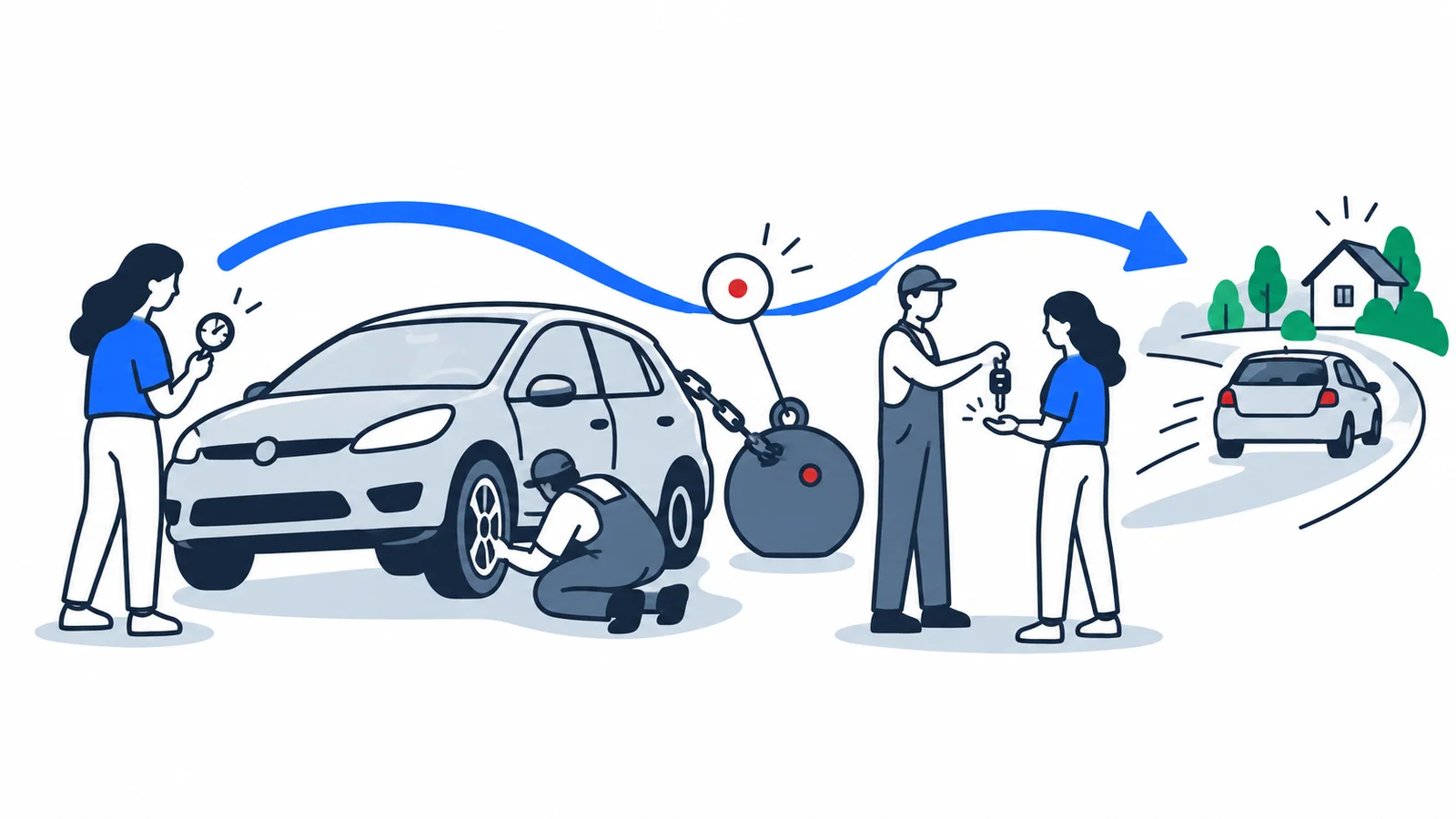

When you buy a used car in Norway, you should check the EU-kontroll (roadworthiness test), mileage, and any debt registered against the car before you sign a contract, and complete the ownership transfer with Statens vegvesen using BankID right after the purchase.
Where can you find a used car?
Most used cars in Norway are sold on the website Finn.no, which has listings from both private sellers and dealers. If you buy from a dealer, you have a five-year right to complain (reklamasjonsrett) if the car is not as agreed. If you buy from a private individual, this right is two years, and the car is normally sold «as is». Dealers are often more expensive, but they offer more security and sometimes their own warranty. Buying privately can be cheaper, but then you need to do more thorough checks yourself.
If you live outside a city, the local selection may be smaller. It can be worth widening your search to neighboring counties on Finn.no, and it is a good idea to bring a Norwegian-speaking friend along when you go to view and test-drive the car. In many places there are also local car dealers who take in used cars as trade-ins — these can be a good alternative if you want to avoid long trips to see cars from private sellers. Always compare several listings before you decide, and use the price of similar cars as a starting point when you negotiate.
If you do not have a driving licence yet, you should check how much a driving licence costs in Norway before you plan your budget for the car purchase. If you have a driving licence from another EU/EEA country, the United Kingdom, or Switzerland, you need to know how to convert your driving licence to a Norwegian one, so that you can legally drive the car you buy.
Check the car thoroughly before you buy
Always ask for the service booklet and the full service history. If service is missing, or the mileage seems unreasonably low for the car's age, you should be cautious. Also check when the car last had an EU-kontroll (periodic vehicle inspection). Passenger cars must first be inspected when they are four years old, and then every second year. Cars over ten years old must be inspected every year. You can check the deadline for a specific car using its registration number at Statens vegvesen.
Look for rust underneath the car and in the wheel arches, unevenness in the paintwork, and moisture in the interior and the boot. Check the tread depth of the tires and that the air conditioning, lights, and electronics work. Test-drive the car at both low and high speed, and listen for unusual sounds from the engine and chassis. Test the brakes properly, ideally with a hard stop, to see whether the car stays straight. If the car is out of warranty, Forbrukerrådet (the Consumer Council) recommends ordering an independent condition report from NAF, Viking, or an approved inspection body before you decide.
Check whether there is debt registered against the car
A car can have heftelser (liens), meaning debt that stays attached to the vehicle even when it changes owner. If the previous owner has a loan with the car as security, the creditor can, in the worst case, reclaim the car if the loan has not been paid off. Statens vegvesen therefore recommends that buyers check Brønnøysundregistrene for any liens before the money is paid. It only takes a few minutes, and it is one of the most important checks you make as a buyer.
Write a purchase contract
Always write a written purchase contract, even when buying from a private individual. Forbrukerrådet has a free contract template you can use. The contract should include the price, mileage, any known faults and defects, and how the payment is made. Pay by bank transfer, not cash, so that you have documentation of the payment. If you do not have a Norwegian bank account yet, you can read about how to open a bank account in Norway.
Complete the ownership transfer with Statens vegvesen
Eierskifte, meaning the transfer of ownership, is done digitally through Statens vegvesen. The seller sends a sales notification (salgsmelding) to the buyer via «Din side» (the personal «My page» login area), and the buyer confirms it with BankID. If the car has a co-owner, that person must also confirm. Both parties need a Norwegian national identity number (fødselsnummer) or a d-number to log in. The seller remains responsible for the car until the buyer has confirmed the sales notification, so do not wait too long to confirm it.
After the ownership transfer is confirmed, the buyer pays the re-registration fee (omregistreringsavgift) to Statens vegvesen. The amount depends on the car's weight and age — newer and heavier cars cost more to re-register than older and lighter ones. Cars over 30 years old are exempt from the fee, as are certain transfers within the family, such as between spouses.
If you are completely new to Norway, the ownership transfer itself can be the most difficult step. Without a Norwegian national identity number or d-number and BankID, you cannot confirm the sales notification digitally yourself. If you need to buy a car before you have this in place, you should check the solution with Statens vegvesen in advance, since a car registered under the wrong name can cause problems with both insurance and fines later on.
Have insurance ready before you drive
You cannot legally drive an uninsured car, not even for the short trip home from the seller. Arrange at least third-party liability insurance (ansvarsforsikring, the legally required minimum coverage) before you pick up the car, and set the start time to exactly when you take it over. If you want better coverage, for example against theft or damage to your own car, you can also choose partial casco (delkasko) or full casco (kasko) coverage in addition. If you drive without valid insurance, you risk both a fine and having to cover any damage you cause yourself.
Ongoing costs of owning a car
Owning a car costs more than the purchase price itself. The traffic insurance tax (trafikkforsikringsavgift) is a state tax calculated per day and paid together with your insurance premium — it replaced the old annual vehicle tax (årsavgift). In addition, there are toll charges in many places in Norway, especially in and around the larger cities; these are paid automatically via an AutoPASS tag or your registration number. You should also budget for fuel or electricity.
If you drive in winter, you will likely need studded tires or good winter tires. As a general rule, studded tires are allowed from 1 November until the Sunday after Easter in most of the country, and somewhat longer in Nordland, Troms, and Finnmark. If you use studded tires outside the season without the road conditions requiring it, you risk a fine. Set up a realistic budget for all these expenses — our guide to personal finances in Norway can help you get started.
Understanding Norwegian systems for buying, transferring ownership, and consumer rights is useful in everyday life, and connects to much of what you need to know as a newcomer in Norway. Do you want to practice practical civics knowledge on your own? Try SamfunnPrep for free.