
Do you want to get married in Norway? First, you must obtain a certificate of eligibility from Skatteetaten, choose your wedding form, and be present with two witnesses. Here are the steps, documents, and extra requirements when one or both of you are foreign nationals.
Getting Married in Norway: Step-by-Step Guide
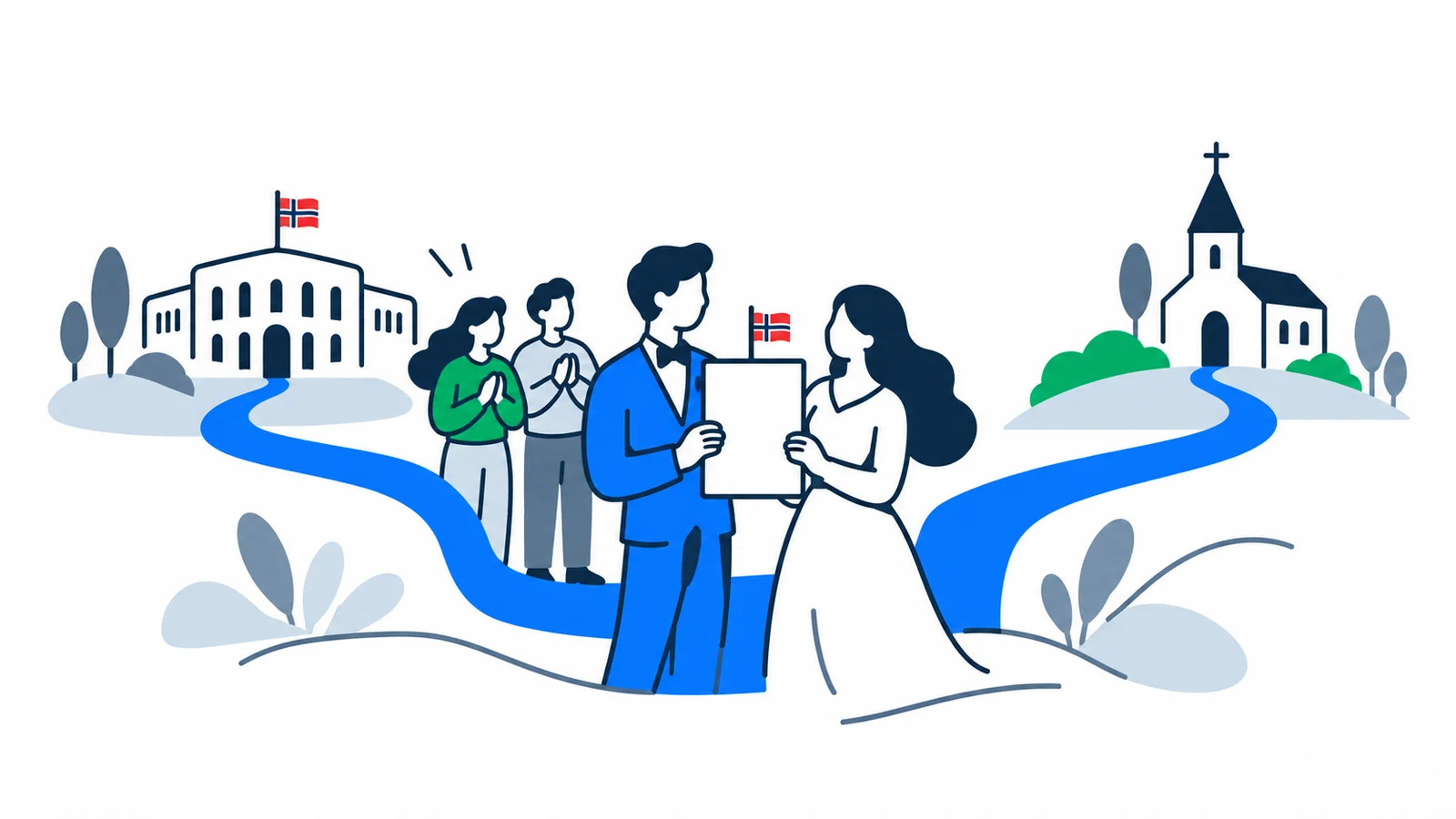
To get married in Norway, you must follow four main steps. First, the authorities check that you are eligible to marry, then you choose your wedding form.
Being married gives you different rights and obligations than living together as partners. If you want to know the difference, you can read more about marriage and cohabitation in Norway.
Here is the path to marriage, step by step:
- Apply for a certificate of eligibility from Skatteetaten (the tax authority that also maintains the National Registry). This is a check that you meet the conditions to marry.
- Choose your wedding form. You can choose a civil wedding at your municipality, or a religious or value-based ceremony.
- Hold the wedding. Two witnesses must be present when you marry.
- Registration. The marriage is then registered in the National Registry.
What is a Certificate of Eligibility?
A certificate of eligibility is proof that you are allowed to marry. Skatteetaten checks, among other things, that you are over 18 years old, not already married, and not closely related.
The certificate is also called "certificate that there is no impediment to the marriage." As of 2026-07-10, it is valid for four months, and you must marry within this deadline. Skatteetaten sends the certificate digitally via Altinn.
You apply online. Each of you fills out your own statement, and the two sponsors complete their part. When Skatteetaten approves the application, you receive the certificate.
Processing takes time. You should expect several weeks, and in some cases up to five to six weeks if the documents must be reviewed manually. Apply therefore well in advance of the wedding, especially if you need documents from abroad.
When Should You Start Planning?
Begin well in advance. Skatteetaten recommends starting the paperwork several weeks before the wedding. If you need documents from abroad, with translation and apostille, you should aim to start two to three months in advance.
Remember also that the certificate of eligibility is valid for four months. Therefore, do not apply too early either, so that the certificate still applies on the actual wedding day.
What Documents Do You Need?
For the application for a certificate of eligibility, you typically need:
- Statement of eligibility — one form from each of you.
- Sponsor statement from two sponsors. A sponsor is a person who confirms that there is no impediment to the marriage. You need two sponsors, and they must be at least 18 years old.
- Certificate of discharge or confirmation that a previous marriage has ended, if one of you has been married before.
- Valid identification, for example a passport.
Be careful that the documents are not too old. Many documents must be no more than four months old.
Civil or Religious Wedding?
You choose how you want to marry. A civil wedding is a non-religious ceremony. In Norway, it is the municipality that conducts civil weddings, and for residents of the municipality, such a wedding is usually free during regular working hours and in the municipality's own premises.
If you want a religious ceremony, you can marry in, for example, The Church of Norway or another faith community. A value-based wedding, for example with Human-Etisk Forbund, is a humanistic alternative.
If you want to marry in a different municipality from where you live, it is often possible, but some municipalities may charge a fee. Check with the municipality in advance.
Regardless of form, two witnesses must be present during the actual wedding ceremony. The witnesses can be the sponsors, or two other adults over 18 years old. Bring valid identification to the wedding day. Send the certificate of eligibility to the person who will conduct your wedding well in advance, so that it arrives before the ceremony.
Unsure about the rules that apply to families in Norway? On SamfunnPrep's tools you will find simple overviews.
Extra Steps for Foreign Nationals
If one or both of you are foreign nationals, you must submit additional documents. You must document marital status — that is, that you are unmarried and free to marry.
You will often need this:
- A certificate of marital status from your home country, showing that there is no impediment to marriage.
- Translation of documents that are not in English or a Nordic language. The translation must be done by an authorized translator.
- Apostille or legalization if the document or translation was made abroad. This confirms that the document is authentic.
- Valid passport, and for people outside the Nordic region also documentation of legal residence in Norway.
If you will live together in Norway after the wedding, family immigration rules may become relevant. Read more about family immigration and the maintenance requirement.
What Happens After the Wedding?
After the wedding, the person who conducted your ceremony sends a notification to Skatteetaten. The marriage is then registered, and your marital status changes in the National Registry (the public register of who lives in Norway). You do not need to do this yourself.
You receive a marriage certificate confirming that you are married. Keep it safe. You may need it later, for example when changing your name or applying for residence.
If you change your surname or move in together, remember to notify the authorities. Read more about national registry registration and change of address.
Summary
Getting married in Norway involves four steps: a certificate of eligibility from Skatteetaten, choice of wedding form, the wedding ceremony with two witnesses, and registration in the National Registry. The certificate is valid for four months, and a civil wedding at the municipality is generally free. Foreign nationals need additional documentation of marital status.
Family and civil law are part of the knowledge that many learn for the National Test in Social Studies — practice for free on SamfunnPrep.