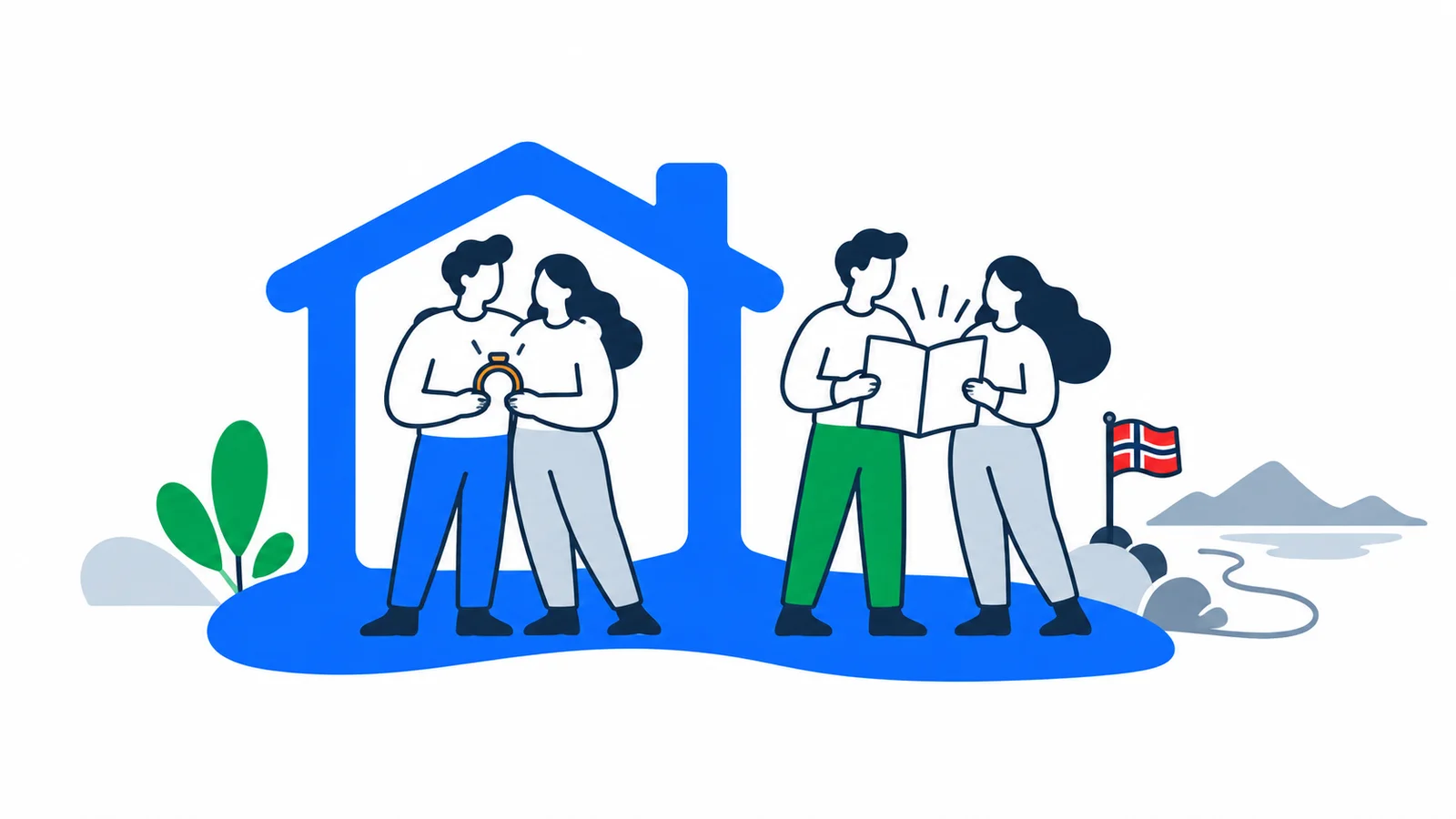

In Norway, adults can choose to marry or live as cohabitants. The biggest difference is legal: spouses get more automatic rights, while cohabitants often need agreements and a will.
Marriage and cohabitation in Norwegian figures
SSB shows that cohabitation is common in Norway. About 30% of people living in a couple relationship are cohabitants, while the rest are married. Marriage is still most common, but cohabitation is a normal and accepted family form. Many couples live together as cohabitants before they possibly marry.
In 2025, 21,574 marriages were entered into in Norway, according to SSB. That was more than the year before and the highest level since 2017. People also marry later than before. In the latest SSB article with exact age figures, for 2024, the average age for first-time marriage was 35.2 years for women and 37.2 years for men. A simple rule is therefore that many marry for the first time in their 30s.
A household means people who live in the same dwelling. In everyday speech it often means people who live together and share expenses. SSB has stated that the average household size in Norway is around 2.1 people. This is linked to many people living alone and many families being small.
To understand family policy and rights, it helps to know about equality and family in Norway. Norwegian law is based on adults being able to choose their form of relationship, and women and men having the same right to own property, work, marry and divorce.
The most important legal difference: married vs. cohabitant
Spouses have a clear legal framework. The Marriage Act and the Inheritance Act give spouses rights and duties toward each other, including financial support during marriage, division of values after a break-up, rights in many estate situations and automatic inheritance if one spouse dies.
Cohabitants do not have the same automatic package of rights. It is not true that everything you own is automatically divided equally if the relationship ends. The main rule is that each cohabitant owns what he or she bought or is registered as owning. If you bought a home together, your ownership shares and payments should be clear.
Inheritance is often the key difference. A spouse inherits under the law. A cohabitant does not automatically inherit just because you live together. The Inheritance Act gives limited inheritance rights to cohabitants who have, have had or are expecting a child together: up to 4 times the National Insurance basic amount (4G). Cohabitants without joint children generally have no statutory inheritance right.
This also matters for families considering family immigration and income requirements. Authorities may ask about marital status, cohabitation, shared address and finances, but that does not mean cohabitants get the same private-law protection as spouses.
Cohabitation agreement: how to protect your rights
A cohabitation agreement is a written agreement between cohabitants. It can say who owns what, how you divide debt, what happens to the home after a break-up, and how to settle matters if one person has paid more than the other.
A good agreement can cover:
- who owns the home, car, furniture and savings
- who pays loans, rent, electricity and fixed expenses
- how you divide gains or losses on a home
- what happens if one person moves out
- how you document large gifts or private loans
A cohabitation agreement is not the same as a will. The agreement usually regulates finances while you are alive and at break-up. A will regulates what happens when one of you dies. If you want your cohabitant to inherit more than the law gives, you normally need a will. Many people use a lawyer, especially if they own a home together, have children from earlier relationships, unequal equity or family in several countries.
If the issue is communication, conflict or separation rather than paperwork, the family counselling office is a free public service.
Same-sex marriage in Norway
Norway has a gender-neutral Marriage Act. From 1 January 2009, two people of the same sex can marry in the same way as two people of different sexes. The Marriage Act says that two people of opposite or same sex may enter into marriage.
The requirements apply to everyone: both must be 18 or older, neither can already be married, and the marriage must be voluntary. Forced marriage is prohibited and can be punishable. Someone who is pressured, threatened or controlled into marriage should contact the police, a crisis centre, child welfare services if under 18, or other support services.
Same-sex marriage is part of a wider rights picture. Read more about queer rights in Norway. For the social studies test, the key point is simple: since 2009, same-sex couples have had the right to marry in Norway.
Joint parental responsibility, also for unmarried parents
Parental responsibility means the right and duty to make important decisions for the child, such as name, passport, health care, school choice and moving abroad. Daily choices are often made by the parent the child is with, but major questions normally require consent from both parents when responsibility is joint.
For children born in Norway from and including 1 January 2020, the starting point is automatic joint parental responsibility. This applies when parents are married, cohabitants or not living together. Skatteetaten registers this in the National Population Register when parenthood is registered.
This is a common test trap: if a child was born in 2021, both parents normally get joint parental responsibility even if they are not married. If the parents later move apart, joint parental responsibility continues until they agree otherwise or a court decides otherwise. Read more in divorce and separation in Norway.
Birth and the National Population Register
When a child is born in Norway with a midwife or doctor present, the midwife or doctor sends a birth notification to Skatteetaten. Parents usually do not send it themselves. If the birth happens without a midwife or doctor, the mother must report the birth within one month.
Skatteetaten registers the child in the National Population Register and gives the child a national identity number. If the mother and father are married, the husband is usually registered automatically as father. If the parents are not married, the father must declare paternity. Co-motherhood has separate rules, especially after assisted reproduction.
The practical advice is simple: check Skatteetaten information after the birth, declare paternity or apply for co-motherhood if needed, and choose the child’s name by the deadline.