
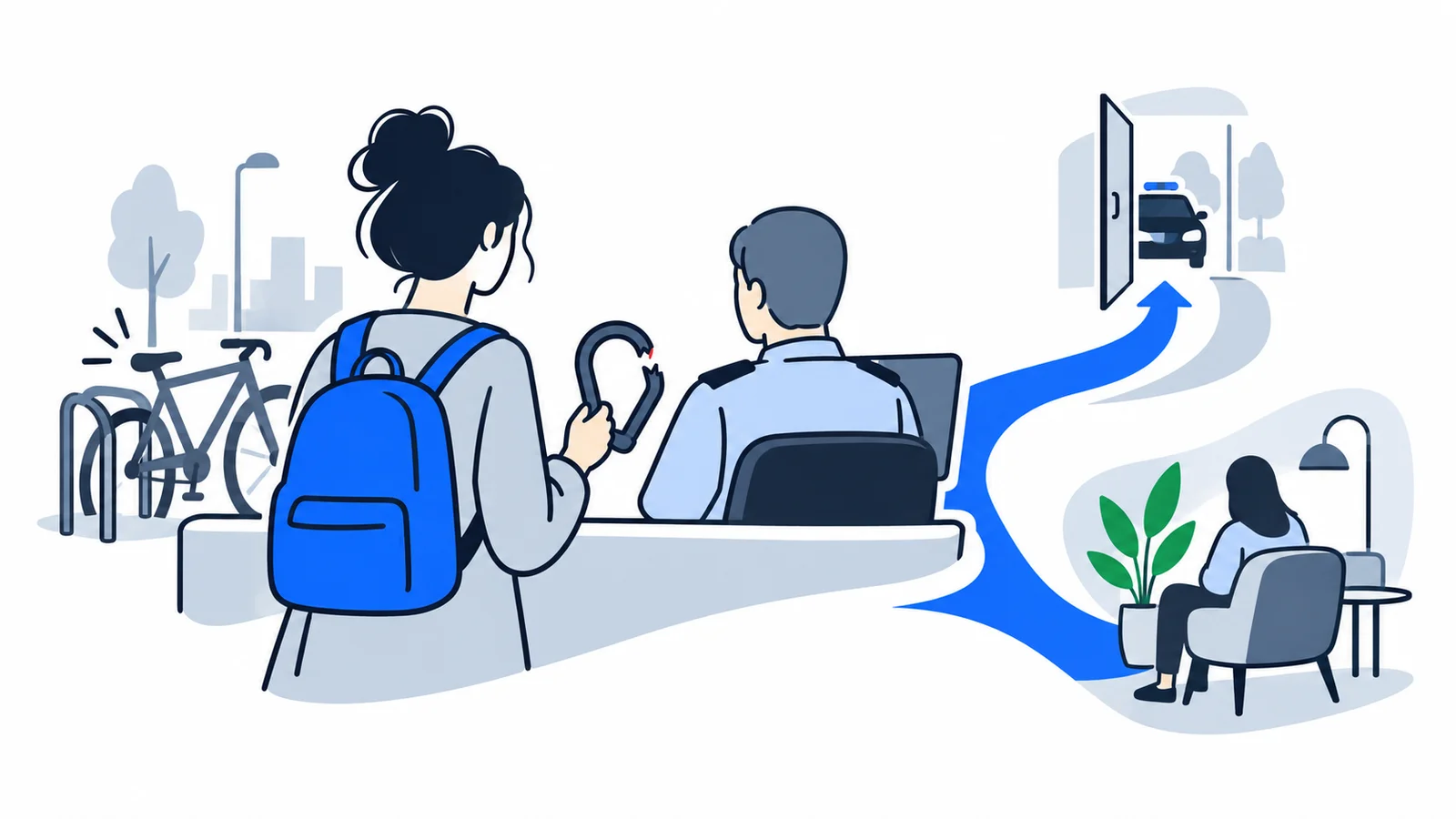

Have you been a victim of a crime in Norway? Reporting to the police is a free, legally protected right — and it does NOT lead to deportation. This guide shows you when to call 112 versus 02800, how to report online, what victim services offer, and why immigrants can safely use the Norwegian police.
112 vs. 02800: Emergency or not?
112 — the police emergency number:
Call 112 only in acute situations:
- Life-threatening danger (weapons, serious assault, fire)
- Ongoing crime (robbery, burglary, assault)
- Immediate danger to others
- Traffic accident with personal injury
- Child abduction in progress
112 is free from all phones, even without a SIM card, and is answered 24 hours a day. If you call with speech difficulties or anonymously, you just need to wait for an answer.
02800 — the police service number:
Call 02800 when it is not urgent:
- Report theft you discover later
- Report a non-urgent incident
- Give tips or witness information
- Questions about follow-up in a case
- Schedule an appointment in person
Kripos tip line: For serious crimes you do not wish to report with your name, see tips.kripos.no (anonymous).
Online reporting versus visiting a police station
Online report via politiet.no
Go to politiet.no/tjenester/anmeldelse and select your case. Online reporting is available for many types of offences:
- Theft (mobile phone, bicycle, bag)
- Burglary of home, car or cabin
- Property damage (graffiti, vandalism)
- Online fraud and identity theft
- Online threats
- Lost items (ID, cards)
Requirement: BankID or MinID for identification. See BankID and MinID if you do not have this set up.
Advantages: Available 24/7, you get a case ID immediately, can follow your case online.
Visiting a police station in person
Certain cases require a physical visit:
- Serious assault and sexual abuse
- Cases where you need to show injuries (requiring medical photography)
- Child abuse and domestic violence cases
- Cases where you need to bring evidence (physical objects)
- Cases where a legal aid lawyer should be present
Call 02800 and book an appointment. Bring a passport or national ID card.
What do you need to report a crime?
Have ready:
- Identification. Passport, ID card, driver's licence or other approved ID.
- Description of the incident. Who, what, when, where. Time, location, person description if you saw the perpetrator.
- Evidence. Pictures, video, screenshots, receipts, contracts, messages, emails.
- Witnesses. Names and contact information if someone saw or heard the incident.
- Your contact information. So the police can follow up with you.
You do NOT need to have all the evidence ready — the police will investigate the case. Making a report is not the same as proving someone's guilt.
Victim services: free support and information
Support Center for Crime Victims (telephone 800 40 008)
A free, confidential telephone service for everyone who has been a victim of crime in Norway — regardless of citizenship and residence status. They help with:
- Emotional support and crisis management
- Information about your rights and the legal process
- Practical guidance through the reporting process
- Contact with legal aid lawyer, psychologist and crisis centre
- Interpreter free if needed
Open weekdays 09–15 (conversations on weekends via SMS).
Legal aid lawyer
If you are a victim of serious crime (assault, sexual offences, death threats), you have the right to a free legal aid lawyer who represents your interests throughout the case. The court appoints the lawyer at state expense.
Crisis centre
For abused women, men and children, all Norwegian municipalities have a crisis centre with protection accommodation, counselling and help to build a new life. Call 116 006 for the national crisis centre line.
Crime victim compensation
If you have been a victim of assault or threats, you can apply for crime victim compensation from the state via the Crime Victim Compensation Board. Application is sent via nav.no/voldsoffererstatning. Deadline is normally 3 years after the incident.
It is free and your right — no one is deported for reporting
This is perhaps the most important thing to know: reporting a crime does not lead to deportation.
- Police and UDI are separate systems. The police have no obligation to inform UDI about reports from victims.
- Your testimony protects you and others. Without a report, the offender can continue to harm others.
- Undocumented people also have the right to report. The police must accept reports regardless of residence status.
- Child abuse and domestic violence: Reporting triggers support measures, not punishment against the victim.
- Human trafficking victims: Have the right to a reflection period and residence regardless of previous status.
Special considerations for vulnerable groups
- Women subject to negative social control: Have the right to a crisis centre and residence protection.
- LGBTQ+ people: LGBTQ+ rights are protected in Norway. Discrimination is prohibited.
- Children: Have their own right to report, should have an adult with them.
Statute of limitations: deadline for reporting
There are different statutes of limitations depending on the offence:
| Offence | Statute of limitations |
|---|---|
| Simple theft, property damage | 2 years |
| Aggravated theft, robbery | 10 years |
| Rape | 25 years (adult), from age 18 for children |
| Murder | No statute of limitations |
| Online fraud over 100,000 kr | 10 years |
Report as soon as possible — the older the case, the more difficult it is to investigate.
What happens after you report?
- Case handling. The police investigate and collect evidence, witness interviews, technical evidence.
- Decision. Either closed (insufficient evidence), penalty notice (fines), prosecution decision or decision not to prosecute.
- Court proceedings. If prosecuted, the case goes to the district court. You may be called as a witness.
- Judgment. Written decision with reasoning.
- Compensation. If convicted, you can receive compensation directly from the perpetrator.
Right of appeal applies to both the accused and the victim. See our guide on the rule of law and courts.
Specific types of cases
- Debt collection and debt problems — not a police matter, but the Consumer Authority
- Workplace crime (wage theft, undeclared work) — contact A-krim or the Working Environment Authority in addition to the police
- Credit default notice — civil matter
- Discrimination — The Equality and Anti-Discrimination Ombud
Summary
Reporting to the police in Norway is a free, legally protected right. Call 112 in immediate danger, 02800 for non-urgent matters. Use politiet.no/tjenester/anmeldelse for online reporting with BankID. Contact the Support Center for Crime Victims (800 40 008) for free confidential help, and request a legal aid lawyer for serious crimes. Reporting does not lead to deportation — the police and UDI are separate systems, and your report helps both you and potential future victims.