How Norway is governed and how people can influence society.
Reading time
≈ 7 min
At a glance
Who decides what happens to a school, a law or public money in Norway? Follow decisions from voters to municipal councils, the Storting and the government. Learn why independent courts and the freedom to disagree matter, and how you can influence issues that affect everyday life.
The essentials to remember
01
Parliament
The Storting passes laws and the national budget and scrutinises the government.
02
The government
The government implements policy and is accountable to the Storting.
03
Three levels
Municipal, county and national authorities have different responsibilities.
04
You can take part
Voting has eligibility rules; participation is possible without a vote.
05
Freedom to disagree
Freedom of expression and association protect lawful disagreement.
Understand the topic
01
From proposal to law: who does what?
Norway distributes state power between the Storting, the government and the courts. The Storting passes laws, allocates money through the national budget and scrutinises the government.
The government proposes policy and implements decisions. Independent courts resolve legal disputes and decide criminal cases.
Imagine a new law: the government may propose it, the Storting passes it, and a court may later apply it to a particular case. These connected institutions have different responsibilities.
02
Why is the government accountable to parliament?
Under parliamentarism, the government answers to the Storting. If the Storting passes a motion of no confidence in the government, it must seek resignation.
Norway uses negative parliamentarism: a new government does not first need to win a separate vote of confidence to take office. A minority government can therefore govern, while seeking support for decisions and budgets.
Losing an ordinary parliamentary vote does not automatically mean losing a vote of no confidence.
03
Find the authority responsible for your issue
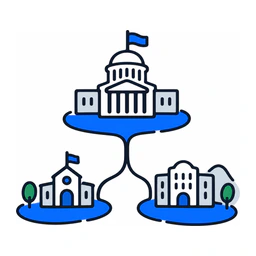
Public responsibilities are divided between national, county and municipal authorities. National authorities are responsible for matters including laws and hospitals.
Counties handle upper secondary education and county roads. Municipalities handle primary and lower secondary schools, kindergartens, elderly care and household waste services.
National rules set many boundaries within which local politicians make choices. If a primary school faces closure, the municipality is therefore a sensible starting point.
Identify who owns the decision before choosing how to influence it.
04
Elections combine representation and personal choice
Elections select representatives to make political decisions on people's behalf. Parliamentary and local elections concern different institutions and each take place every four years, at different points in the cycle.
Voting is secret: you should be able to choose without showing others your vote. Voters must turn 18 by the end of the election year.
Norwegian citizenship is required for parliamentary elections; other residents may qualify for local elections. Always check which election and registration conditions the information concerns.
In a parliamentary election, you elect representatives through parties’ electoral lists; you do not vote directly for a prime minister. The distribution of seats affects which parties can form a government and secure support for policies. A local election elects the municipal council, which in turn elects the mayor. Elections therefore give influence through representative institutions.
05
Majority decisions have limits set by rights
Democracy means more than the largest number of votes winning. Human rights protect individuals and minorities, including when a majority disagrees with them. Under the rule of law, power must be exercised according to law, and independent courts help protect against arbitrary decisions.
Equal human worth means that people have the same value. Equality also concerns real opportunities in education, work and participation. Protection against discrimination covers grounds including gender, ethnicity, religion and disability. A service described as “open to everyone” can still be difficult to use if its entrance has only stairs. We must therefore examine practical barriers too.
Freedom of religion and belief includes the right to believe, change belief or have no religion. Christianity has shaped Norwegian history and traditions; society today includes several religions and worldviews. You can criticise a belief while respecting the person. Freedom of expression does not make threats lawful.
06
You can participate between elections
You can approach elected representatives, join an organisation, write an opinion piece or contribute when a proposal is opened for consultation. Freedom of expression protects criticism and disagreement within legal limits.
Freedom of association allows people to work together. Democracy also involves responsibility: following laws, providing accurate information to public bodies and checking sources before sharing a claim.
A useful contribution explains both your concern and your reasons. You do not need to wait for the next election to speak.
Useful distinctions
Separation of powers and parliamentarism
Separation of powers distinguishes state institutions' functions. Parliamentarism concerns the government's accountability to the Storting.
Voting rights and participation
Voting eligibility has specific conditions. Opportunities to participate in society extend beyond the right to vote.
From learning to everyday life
Think through an example
Your neighbourhood school may close
The municipality is considering merging two primary schools. Your child attends one of them, but you are not yet eligible to vote in Norway.
Can you influence the decision, and where should you start?
Explanation
Yes. Read the municipal proposal, contact local elected representatives and check whether consultation is open. You can also work with parents or a local organisation. Municipalities are responsible for these schools, and contributing your views does not depend on eligibility to vote in parliamentary elections.
Norway's elected national parliament, which passes laws and the national budget.
Regjeringen
The prime minister and ministers responsible for carrying out national policy.
Maktfordeling
The division of state functions between legislative, executive and judicial institutions.
Mistillit
A no-confidence decision that can require the government or a minister to resign.
Høring
A consultation inviting views before a proposal is decided.
Stemmerett
The right to vote when you meet the conditions. Eligibility rules differ between parliamentary and local elections.
Ytringsfrihet
The right to express opinions and receive information, subject to legal limits, including those on threats and hate speech.
Domstol
An independent institution that decides legal disputes and criminal cases under the law. Courts must not be controlled by political parties.
Politisk parti
An organisation bringing people together around political goals and standing candidates in elections to influence how society is governed.
Kommunestyre
The municipality’s highest elected body. It approves the municipal budget and makes important decisions about local services.
Rettssikkerhet
Protection against arbitrary treatment by the authorities. It includes independent courts and the right to defend yourself in a criminal case.
Likestilling
Equal rights and opportunities for everyone, regardless of factors such as gender, ethnicity, disability, religion and sexual orientation.
Sample questions, explained
Explore two questions about this topic, with correct answers and explanations.
Example 01Who elects the mayor in a Norwegian municipality?
Correct answer
The municipal council elects the mayor from among its own members after the election
Explanation
The municipal council elects the mayor for the election period. In municipalities with an executive committee, the mayor is elected from its members, who are also council members. In municipalities with a parliamentary model, the mayor is elected from the municipal council’s members. The mayor chairs council meetings and is the municipality’s legal representative.
Example 02You have strong views on an issue the government is working on. How can you, as an ordinary resident, formally give your opinion during the process?
Correct answer
Send a written response when the matter is on public consultation (høring)
Explanation
Many proposals are sent out for public consultation in Norway. Both professional organisations and individual residents can submit written comments. This is one way people can take part in an open democracy between elections.
How to prepare
Follow a proposed law: who can propose it, who adopts it and who implements it? Then identify the right level for an issue about a local primary school. Why cannot a majority freely remove a minority’s rights? Name one way to influence an issue even without voting rights.
Edited examples from SamfunnPrep’s question bank, not official HK-dir test questions.
Questions and answers
Must I be a Norwegian citizen to participate in democracy?
Norwegian citizenship is required to vote in parliamentary elections, while other residents may qualify for local elections. Participation is broader than voting. You can contact representatives, join organisations and contribute to public consultations. Check the election type and registration requirements when finding out whether you personally can vote.
Must the government resign whenever it loses a parliamentary vote?
No. Losing an ordinary vote is not automatically a no-confidence decision. The government is accountable to the Storting and must seek resignation if it passes no confidence. A minority government can therefore govern while seeking support for policy and budgets. Norway does not require a separate positive confidence vote before taking office.
Your next step
3 days free
Turn what you know into confident answers.
Put this topic into practice, learn from mistakes and see what you have mastered. One question at a time.
Practise this topic: Democracy and civic participation
20 practice questions in your trial. The full practice bank is available in Norwegian and English.
Focused practice
Questions that help you use what you have learned.
Clear explanations
Understand why an answer is right.
Your progress
See your results and what to revisit.
Where would you like to go next?
Explore a connected topic
History explains how rights developed. Source criticism supports informed participation, while geography helps identify the level of government responsible for an issue.





 Think through an example