Norwegian history helps explain the constitution, elected institutions and public welfare arrangements. Explore six connected stages: early societies and unions, 1814, expanding democracy, industrialisation, war and welfare. Focus on what changed for people and who gained power or rights, rather than memorising dates without their meaning.
The essentials to remember
01
1814 and 1905
17 May marks the 1814 Constitution; the union with Sweden ended in 1905.
02
1884
1884 is regarded as parliamentarism's breakthrough, followed by further development.
03
1913
Women gained universal voting rights on the same terms as men in 1913.
04
1940–1945
Nazi Germany occupied Norway from 1940 to 1945.
05
Welfare before oil
Welfare arrangements developed before substantial petroleum revenues.
Understand the topic
01
From early societies to political unions
After the Ice Age, people in the area lived through activities including hunting and fishing. Farming, trade and new tools later changed society.
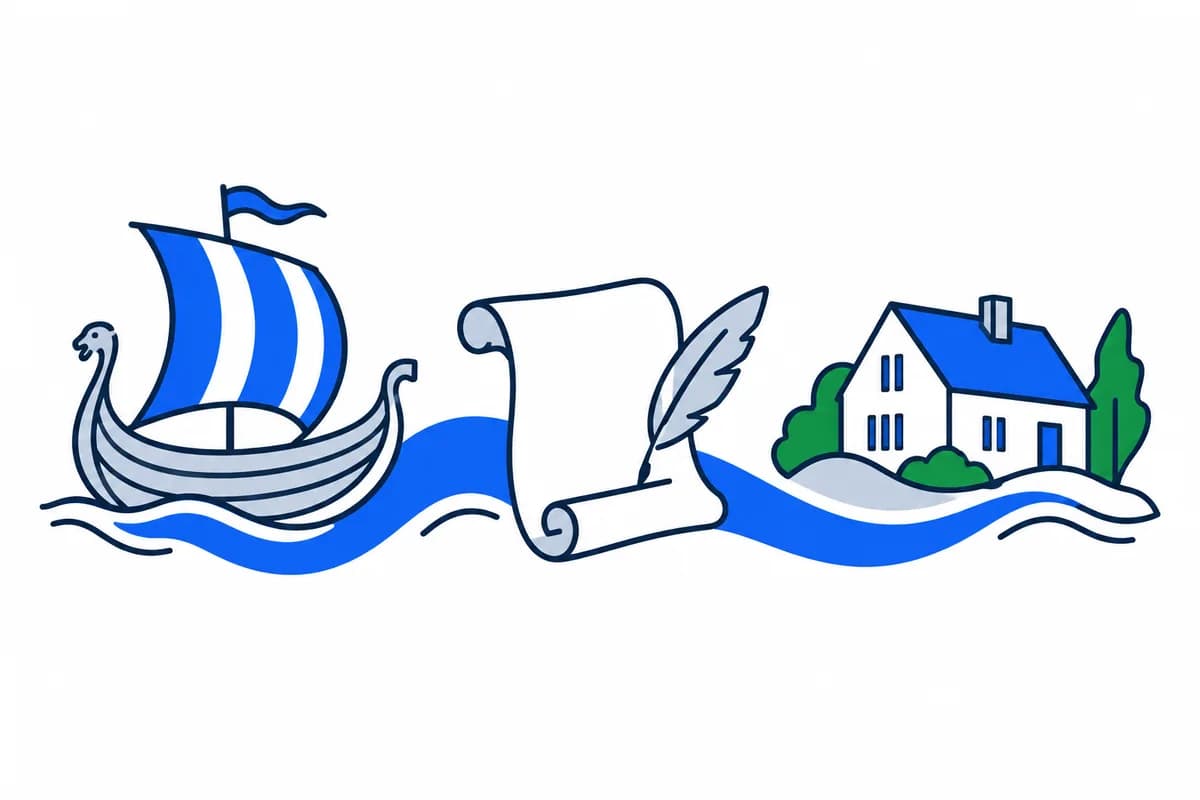
The Viking Age involved trade and travel as well as violent raids. Christianity and the church gained influence in the Middle Ages, and the Black Death devastated the population.
Norway subsequently entered unions with neighbouring countries. Its long connection with Denmark shaped government and written language.
Modern Norway therefore emerged through many changes, rather than a single founding event.
02
1814 and 1905 mean different things
The union with Denmark ended in 1814. The background was international: Denmark–Norway was on the losing side in the Napoleonic Wars. The Treaty of Kiel in January 1814 was to transfer Norway to the Swedish king.
Norwegian leaders responded with a constitutional process. The Constitution was adopted at Eidsvoll on 17 May, establishing a new political framework that included the Storting.
War and negotiations later in 1814 led to union with Sweden. Norway retained an amended Constitution and internal self-government, but shared a monarch with Sweden.
The Swedish union ended in 1905. A constitution, internal self-government and full independence were therefore different steps. This is why 17 May commemorates the Constitution, while 1905 marks the end of the union.
03
Political influence expanded over time
The 1814 Constitution did not give every resident the vote. During the nineteenth century, struggles over political power continued.
The year 1884 is regarded as the breakthrough of parliamentarism: the government's relationship with the Storting became decisive, although the practice continued to develop. Women organised for political rights and gained universal voting rights on the same terms as men in 1913.
Independence and democratisation are therefore different processes. A country can achieve greater self-government before all adults gain equal political opportunities.
A wider democracy did not mean equal treatment for every group. Norwegianisation pressured Sámi, Kvens/Norwegian Finns and Forest Finns to give up languages and culture, including through schooling. Parliament apologised in 2024 and acknowledged lasting consequences. This helps explain why language rights and minority protection matter today.
04
Industrialisation changed work and collective action
During the nineteenth century, factory employment grew and many people moved from rural areas to towns. Long working days, insecure earnings and cramped housing affected many working families.
Others emigrated, including to America, seeking new opportunities. The labour movement and trade unions organised demands for better conditions and security.
The women's movement challenged restrictions on women's participation. This history shows how collective action and political decisions could gradually change both working life and people's ability to make decisions about their own lives.
05
1940–1945: occupation and liberation
Germany attacked Norway on 9 April 1940, and the country remained occupied until 1945. The king and government continued their work from exile while people in Norway faced control, shortages and repression.
Many joined the resistance; others collaborated with the occupying authorities. Jewish people were persecuted and deported, and the war caused severe losses.
Liberation in May 1945 ended the occupation. Connect this period with the importance of democracy, protection of minorities and independent institutions when you study its events.
06
Welfare, petroleum and a changing society
After the war, Norway rebuilt and continued developing welfare arrangements. The National Insurance Scheme took effect in 1967, bringing together important forms of financial security.
The major Ekofisk discovery followed in 1969, with production beginning in 1971. Petroleum revenues later became highly significant, but the welfare state already had a history.
Work, taxation, political choices and collective organisation also mattered. The sequence helps distinguish a resource that strengthened the economy from institutions whose development had begun before it.
History is also visible in the calendar: 17 May marks the Constitution, 8 May liberation in 1945, and 1 May is International Workers’ Day. Sámi National Day on 6 February recalls the first Sámi congress in 1917. Christmas and Easter have Christian roots, but people may observe them religiously, culturally or not at all. A shared day off therefore does not mean everyone shares a belief or tradition.
Useful distinctions
1814 and 1905
1814 is associated with the Constitution and a new union; 1905 with the end of the Swedish union.
Independence and democratisation
An independent country does not necessarily give everyone equal political rights. Widening participation is a separate development.
From learning to everyday life
Think through an example
A conversation before the children's parade
A neighbour says 17 May celebrates Norway leaving the union with Sweden, and that everyone gained the vote that day.
How can three dates help you explain the difference?
Explanation
17 May refers to the Constitution in 1814. The union with Sweden ended in 1905. Women gained universal voting rights on the same terms as men in 1913. The dates concern a constitutional framework, national independence and expanded political rights respectively.
The Constitution: the highest law establishing government and fundamental rights.
Union
A political connection between countries, such as sharing one monarch.
Parlamentarisme
A system in which the government is accountable to parliament.
Okkupasjon
Military control of a territory by a foreign power.
Folketrygden
Norway's National Insurance Scheme, introduced in 1967.
Vikingtid
The period around 800–1050, when seafaring, trade, settlement and Viking raids connected Nordic people with other parts of the world.
Svartedauden
The plague epidemic that reached Norway in 1349. Many people died, and the population decline had major consequences for society.
Unionsoppløsning
The ending of a union between countries. In Norwegian history, it especially refers to the union with Sweden ending in 1905.
Industrialisering
The shift towards production using machinery and factories. It created new jobs and led more people to move to towns and cities.
Velferdsstat
A society where public authorities have substantial responsibility for education, healthcare and financial security, funded through shared contributions.
Riksforsamlingen
The assembly of representatives that met at Eidsvoll in 1814 and drafted and adopted Norway’s Constitution.
Gjenreisning
Rebuilding what has been destroyed. In Norwegian history, the term is especially used for reconstruction after the Second World War.
Sample questions, explained
Explore two questions about this topic, with correct answers and explanations.
Example 01What was the Treaty of Kiel in 1814?
Correct answer
A peace treaty in which Denmark ceded Norway to Sweden during the Napoleonic Wars
Explanation
The Treaty of Kiel was signed on 14 January 1814 between Denmark-Norway and Sweden. Denmark ceded Norway to the Swedish king. Norwegians refused to accept this and instead gathered at Eidsvoll to write the Constitution and declare independence.
Example 02What was the Norwegianization policy toward the Sami?
Correct answer
An assimilation policy that suppressed Sami language and culture in favour of Norwegian
Explanation
The Norwegianisation policy sought to make groups including the Sami, Kvens/Norwegian Finns and Forest Finns Norwegian in language and culture. It harmed language, identity and rights, including through schools. The policy was dismantled over time, but its effects continue. The Storting apologised in 2024.
How to prepare
Place 1814, 1884, 1905, 1913, 1940–1945 and 1967 on a timeline. Explain the change at each point, not only the date. Why is “Norway gained a constitution” different from “everyone gained equal rights”? Use Norwegianisation to challenge the idea that change always benefited every group.
Edited examples from SamfunnPrep’s question bank, not official HK-dir test questions.
Questions and answers
Does 17 May celebrate the end of the union with Sweden?
No. It marks the Constitution adopted at Eidsvoll in 1814. Norway entered a union with Sweden later that year, and the union ended in 1905. Women gained universal voting rights on the same terms as men in 1913. A constitution, independence and broader democratic participation are different historical developments.
Did Norway’s welfare state begin with the oil discovery?
No. Welfare arrangements developed before petroleum revenues became highly significant. The National Insurance Scheme began in 1967; Ekofisk was discovered in 1969 and production started in 1971. Oil later strengthened the economy, but work, taxation, political choices and collective organisation also shaped the development of financial security.
Your next step
3 days free
Turn what you know into confident answers.
Put this topic into practice, learn from mistakes and see what you have mastered. One question at a time.




 Think through an example