
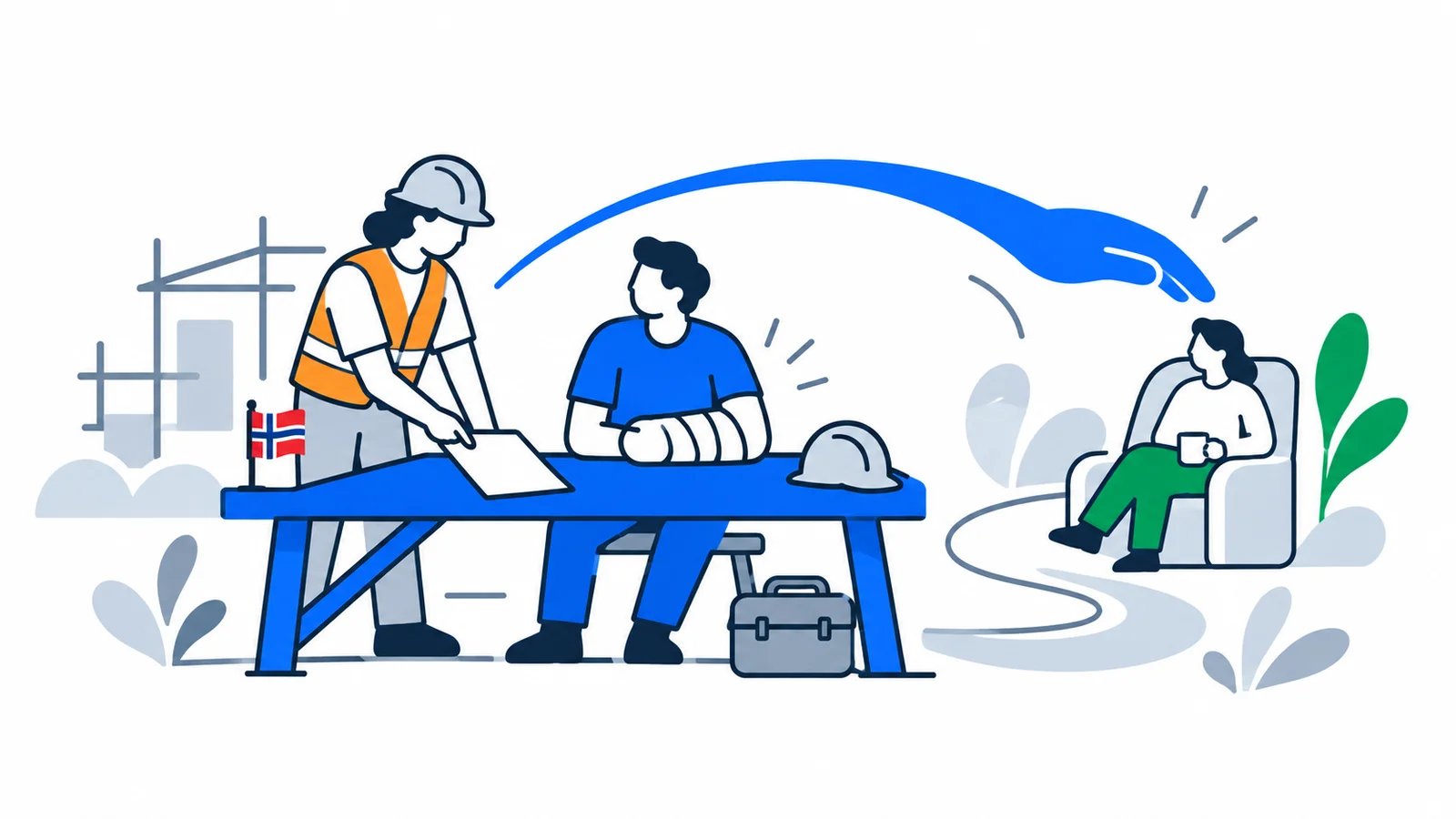

A work injury is damage you suffer in an accident at work. All employers in Norway must have occupational injury insurance for their employees. If your injury is approved by NAV, you get extra rights – such as free treatment and compensation for permanent injury.
Many newcomers work in high-risk occupations, such as construction, cleaning, transport and warehousing. It is important to know your rights. This guide explains what counts as a work injury, what rights you get, and how to report the injury on time. A work injury gives you more than the usual rights you have as an employee, and the topic is also part of the themes for newcomers.
What is a work injury?
A work injury is a personal injury that happens in an accident while you are at work. For NAV to approve the injury as a work injury, three conditions must be met at the same time. The injury must have occurred:
- at work – while you were doing your job
- at the workplace – where you normally work
- during working hours – in the time you were at work
An occupational disease is something different: an illness you develop over time from harmful exposure at work, for example dangerous substances or noise. The disease must be on a special list in the regulations on occupational diseases to be approved.
An example: If you fall from scaffolding during working hours, it is a work injury. If you develop permanent hearing loss from loud noise at work over several years, it can be an occupational disease.
Two schemes that provide compensation
It is easy to mix up two different schemes. In a work injury, you can get money from both:
- NAV (the National Insurance Scheme) – gives you extra rights in the public welfare system when the injury is approved.
- The occupational injury insurance – a private insurance that the employer pays for, and which covers economic loss that the insurance has not already covered.
You must deal with both to get everything you are entitled to. They handle the case separately.
Must the employer have occupational injury insurance?
Yes. All employers in Norway are legally required to have occupational injury insurance for all employees, regardless of how small the business is. This is stated in the law on occupational injury insurance.
The insurance applies even if no one is at fault for the accident. You do not need to prove that the employer did anything wrong. If the employer has forgotten to take out insurance, the Occupational Injury Insurance Association (YFF) pays your compensation anyway. YFF then demands the money back from the employer. An employer without mandatory insurance risks a fine or imprisonment. You do not lose your right even if the employer has made a mistake.
What rights does an approved work injury give you?
An approved work injury gives you several benefits you do not have with ordinary illness:
- Free treatment. You do not have to pay a deductible for treatment caused by the injury, and HELFO covers certain costs for doctor and dentist visits.
- Compensation for permanent injury. If you have suffered a permanent injury with at least 15 percent permanent medical disability, you can get compensation for permanent injury. It is a one-time payment for the injury itself, regardless of whether you lose income.
- Better calculation. Sickness benefits, work assessment allowance and disability benefit are often calculated more favorably when the cause is an approved work injury.
What can you get compensation for?
The occupational injury insurance should cover your economic loss after the injury, in addition to what you get from NAV. This can include:
- lost income – salary you miss while you are ill
- loss of future income if you cannot work as before
- extra expenses for treatment, medicine and aids
- compensation for permanent injury for permanent injury
How much you get depends on how serious the injury is and how much it affects your work capacity. Keep all receipts and medical documents – they are your evidence when the compensation is calculated.
How to report a work injury – step by step
- Tell your employer immediately when the injury has occurred.
- The employer has a duty to report the injury to NAV. From 1 January 2026, this must be done digitally.
- Report yourself if the employer does not do it. You can send an injury report to NAV on your own.
- Also report to the insurance company that the employer uses.
- Go to the doctor and get the injury documented. Good documentation is crucial for the compensation later.
Reporting an injury to NAV costs nothing. If the injury occurs in a dangerous place or is serious, the employer must also notify the Labour Inspection Authority immediately.
Deadlines you must remember
Deadlines are the most common reason people lose money they were entitled to. Remember these two:
- NAV: Report the injury as soon as possible, and no later than one year after the accident. For occupational disease, the deadline runs from when you understood that the disease came from work.
- The insurance: The claim against the insurance company expires after three years, counted from when you knew or should have known about the injury and who is responsible.
If the case is difficult or you get a rejection, you may be entitled to free legal aid. Many insurance cases also cover costs for a lawyer.
What is not covered?
Not everything that happens during a working day is a work injury. Ordinary travel between home and work is normally not considered a work injury. The same applies to injuries that occur during private errands during working hours. If you work from home, coverage only applies when you are actually doing your work – not when you are cooking or taking a break. Good insurance for your free time is therefore a useful supplement, because it covers where occupational injury insurance stops – read more in our guide on insurance for newcomers.
On SamfunnPrep, we explain workplace rights in a language you understand. Rules about work and welfare are also curriculum for the citizenship test – practice for free on SamfunnPrep.