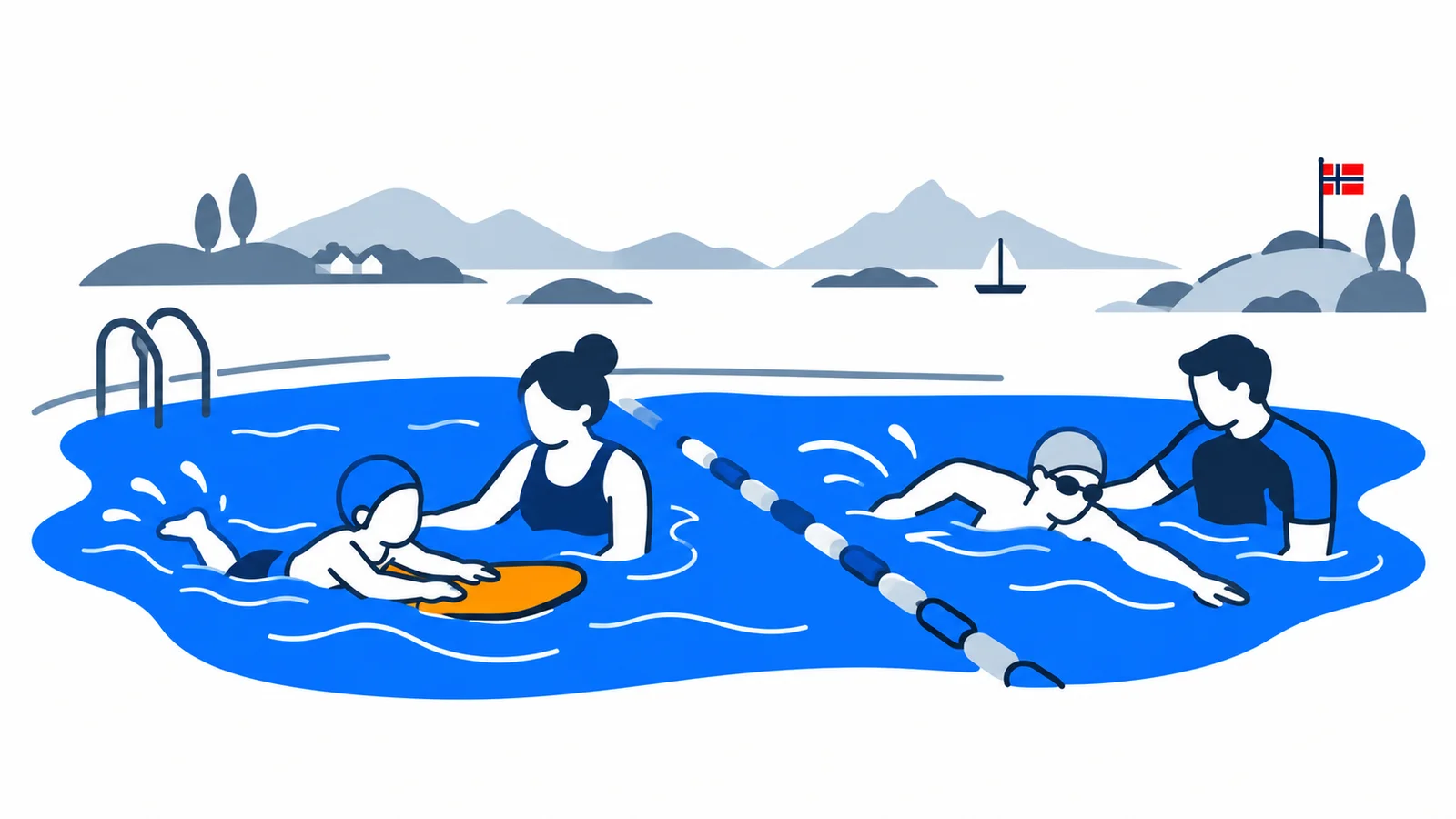

Swimming in Norway is an important skill. The country has a long coast, many lakes and swimming throughout the summer. Children learn to swim for free at school, and adults can take swimming courses – some courses are for women only. Being able to swim saves lives.
Swimming is part of school
In Norway, children learn to swim at school. It is stated in the curriculum, and the instruction is free. Swimming is part of the school system in Norway, and the school has a specific goal: a swimming proficiency test that students must pass by the end of 4th grade, around nine years of age.
To pass the test, the student must:
- fall into deep water,
- swim 100 meters on their stomach, and dive down to retrieve an object,
- stop and rest for 3 minutes while floating,
- and then swim 100 meters on their back and get out on land.
The goal is for the child to become proficient in swimming and safe in the water. Later, after 10th grade, students learn more swimming techniques and water rescue – how to save themselves and others in, on and by water.
For swimming lessons, the child needs swimwear and a towel. Some schools can lend out swimwear if the family doesn't have it. Swimming is mandatory, just like other subjects. If the child is uncomfortable in water or has never swum, you should inform the school early so they can make arrangements.
Why swimming saves lives
Being able to swim can mean the difference between life and death. Every year people drown in Norway. In 2025, 49 people drowned, a sharp decline from 95 the year before, according to Redningsselskapet. Most were men, and many were elderly.
Many who come to Norway have never learned to swim. Newly arrived children with another mother tongue are overrepresented among those who are not proficient swimmers, and that is precisely why the state provides extra help. If parents cannot swim, it also becomes more difficult to teach children. Therefore, swimming instruction is important for the whole family. Read more about public health and common causes of death in Norway.
Free swimming instruction for newly arrived children
Municipalities can receive government support for extra swimming instruction for newly arrived children who have just arrived in Norway. The program has existed since 2015. It provides children who have not learned to swim with an additional offer beyond regular school swimming. The goal is to reduce the risk of accidents while bathing and help students reach the goals in the curriculum.
If your child has just started Norwegian school and cannot swim, ask the school or municipality if there is a separate swimming course. Newly arrived children also have the right to school and specialized language instruction.
Swimming courses for adults – also women-only
It is never too late to learn to swim. Swimming clubs, municipalities and volunteers offer swimming courses for adults throughout the country, including for beginners who are afraid of water. You can find courses on tryggivann.no, a service from Norges Svømmeforbund.
In many places there are separate women-only swimming courses – for women only, with female instructors and in closed pools. This makes it safer and easier for women who don't want to swim with men. Such courses are often arranged by the municipality, swimming clubs, the Red Cross (Røde Kors) or local organizations. Ask at the local pool, in the municipality or at a voluntary organization. A swimming course not only provides safety in water – it's also a nice way to meet people.
Safe swimming in summer
In summer, many swim in the sea, in rivers and in lakes. Then it is important to know the swimming safety rules from Redningsselskapet:
- Swim preferably where there are other people, and never completely alone.
- Keep an eye on children at all times – a small child can drown silently in just a few seconds.
- Use life jackets on children who cannot swim, both in a boat and by the water.
- Don't dive in unfamiliar places; the water may be shallower than you think.
- Don't swim when you have been drinking alcohol.
- Remember that water in Norway is often cold, even when the sun is shining. Cold water can make you tire quickly.
Teaching children these rules is just as important as the swimming itself.
How to get started
Do you want to learn to swim, or do you want your child to become more confident in the water? Here's how you proceed:
- Ask the school about your child's swimming instruction, and whether there is an extra course.
- Search for 'swimming courses' together with the name of your municipality, or visit tryggivann.no.
- Ask about women-only swimming if that suits you better.
- Always be careful when swimming in nature, and teach children the rules about water.
Health, school and safety in everyday life are part of Norwegian society, and topics on the civics exam (samfunnskunnskapsprøven). On SamfunnPrep you practice for free on how Norway works. Ready to practice? Try SamfunnPrep for free.