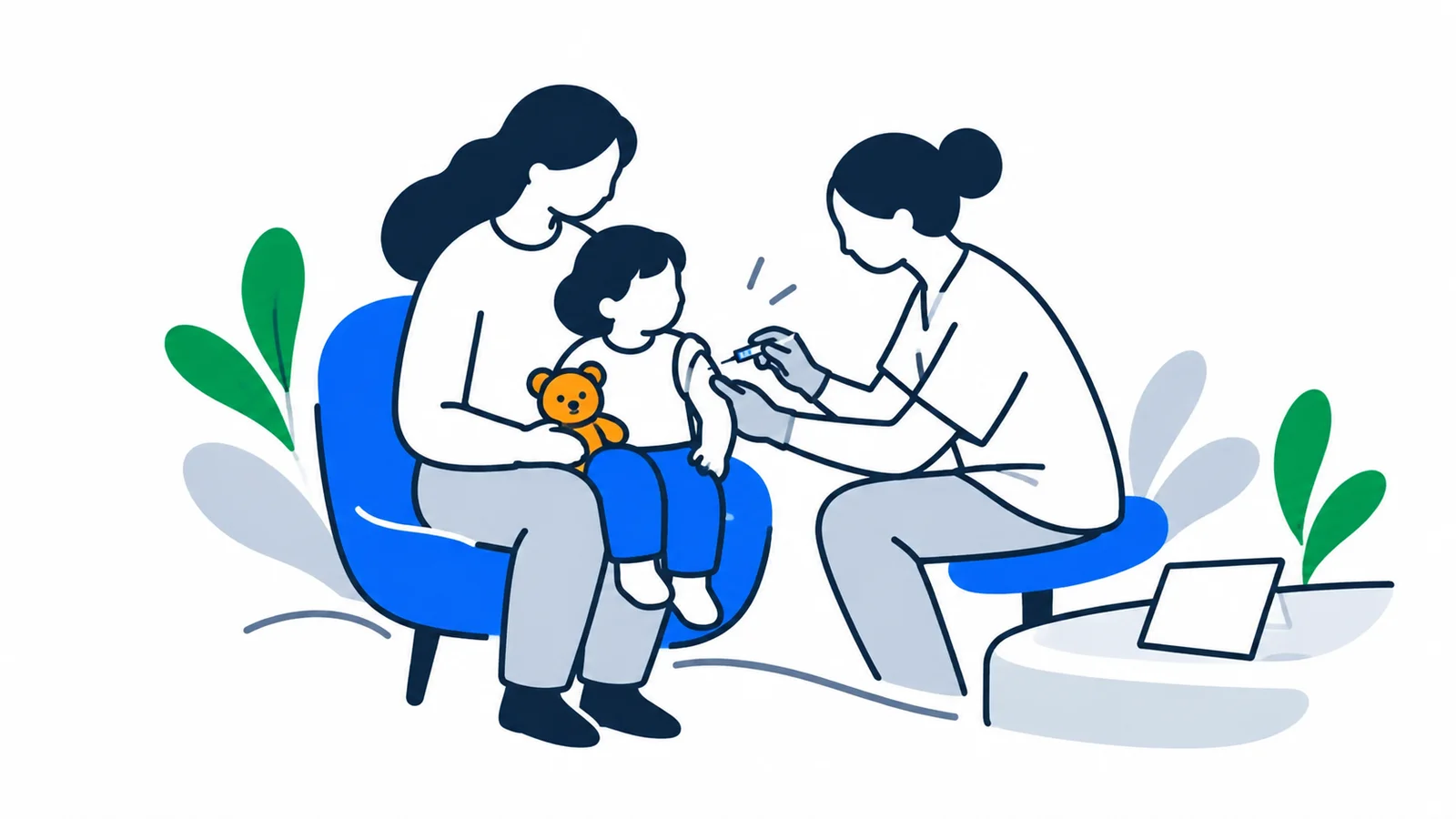

The childhood vaccination programme (barnevaksinasjonsprogrammet) offers free vaccines against 12 diseases to every child in Norway, from the age of 6 weeks to 10th grade at school. The vaccines are given at the public health clinic (helsestasjon) and by the school nurse (helsesykepleier). The programme is voluntary but strongly recommended – and more than 9 in 10 children take part.
What is the childhood vaccination programme?
The childhood vaccination programme is a free service for all children and young people up to the age of 20 who live in Norway. It protects against 12 serious diseases: rotavirus, diphtheria, tetanus, whooping cough (pertussis), poliomyelitis (polio), Hib infection, hepatitis B, pneumococcal disease, measles, mumps, rubella and HPV (human papillomavirus).
The programme is decided by the Ministry of Health and Care Services on the advice of the Norwegian Institute of Public Health (FHI). The vaccines are given in two places:
- At the helsestasjon (public health clinic) while the child is young (from 6 weeks to school age).
- By the school nurse (skolehelsetjenesten, the school health service) from primary through lower secondary school.
You do not have to book an appointment yourself the way you do with your GP – the helsestasjon and the school call the child in according to the schedule. Read more about how the health services fit together in the guide to the Norwegian health system.
The vaccination calendar: which vaccines and when
The vaccines follow a fixed plan. The first vaccine is given at 6 weeks of age, and the last in 10th grade. This is the calendar as of 2026:
| Age / grade | Vaccine |
|---|---|
| 6 weeks | Rotavirus (against stomach flu) |
| 3 months | Rotavirus (dose 2) + diphtheria, tetanus, whooping cough, polio, Hib, hepatitis B + pneumococcal |
| 5 months | Diphtheria, tetanus, whooping cough, polio, Hib, hepatitis B (dose 2) + pneumococcal |
| 12 months | Diphtheria, tetanus, whooping cough, polio, Hib, hepatitis B (dose 3) + pneumococcal |
| 15 months | MMR – measles, mumps, rubella |
| 2nd grade (approx. 7 yrs) | Diphtheria, tetanus, whooping cough, polio (booster) |
| 6th grade (approx. 11 yrs) | MMR (dose 2) |
| 7th grade (approx. 12 yrs) | HPV – against HPV, given to all genders |
| 10th grade (approx. 15 yrs) | Diphtheria, tetanus, whooping cough, polio (booster) |
Most of the shots against diphtheria, tetanus, whooping cough, polio, Hib and hepatitis B are given as one combination vaccine – that is, one jab, not six. Since 2018/2019 the HPV vaccine in 7th grade has been offered to both girls and boys, because the virus can cause several types of cancer in both sexes.
Free and voluntary – but strongly recommended
All vaccination in Norway is voluntary. For children under 16, a parent or guardian must consent before a vaccine is given. You are never forced, and there is no fine or penalty for saying no.
At the same time the programme is free, and the health authorities strongly recommend it. Uptake is very high: in 2025 the overall vaccination coverage among 2-year-olds was 92% nationally, and more than 95% of children have had the MMR vaccine (per FHI's 2025 report). This high coverage is why Norway has managed to eliminate measles, rubella and polio as established diseases in the country.
When many people are vaccinated, the few who cannot be vaccinated are also protected – for example newborns or children with serious illness. This is called herd immunity.
Children arriving in Norway: catch-up vaccination
Is your child arriving from another country unvaccinated or partly vaccinated? Then the child has the right to catch up on the missing vaccines free of charge – whatever the reason the vaccines are missing. This is called catch-up vaccination (innhentingsvaksinasjon).
Here is how it works:
- Bring all the documentation you have on earlier vaccines (a vaccination card or papers from your home country).
- The helsestasjon or the school health service draws up an individual plan based on what the child has already had, adapted to the Norwegian programme.
- If you are missing papers, that is fine – health staff lean towards giving one dose too many rather than one too few, because extra doses are rarely harmful.
You will find the helsestasjon in your municipality, and school-age children can get help through the school health service. If the family also needs a GP, see the difference between the GP, the emergency room and the hospital.
Where do you find your child's vaccination record?
Every vaccine given in Norway is registered in the national vaccination registry SYSVAK. You can see your child's vaccines like this:
- Log in to helsenorge.no with BankID – your child's vaccination card is there.
- The vaccines also appear in kjernejournal (the core medical record), which health staff use.
Parents have access to the vaccination record for children under 16. The record is useful if you move, change helsestasjon or are going to travel. If your child is about to start school or kindergarten, it is good to have the overview ready – read more about the Norwegian school system.
Common worries – briefly about vaccines
It is completely normal to wonder whether vaccines are safe. A few facts that may help:
- Side effects are usually mild and pass: a little soreness where the shot was given, a slight fever, or the child being a bit tired for a day.
- The vaccines in the programme are thoroughly tested and closely monitored by FHI year after year.
- The claim that the MMR vaccine causes autism has been thoroughly disproved in many large studies.
If you are unsure, you can talk to the nurse at the helsestasjon or your GP. They are happy to answer questions before you decide – the aim is for you to feel confident in your choice.
FHI is also considering expanding the programme: in January 2026 the institute sent a recommendation to the Ministry of Health and Care Services to introduce a chickenpox (varicella) vaccine into the childhood vaccination programme. It has not yet been introduced, but may come.