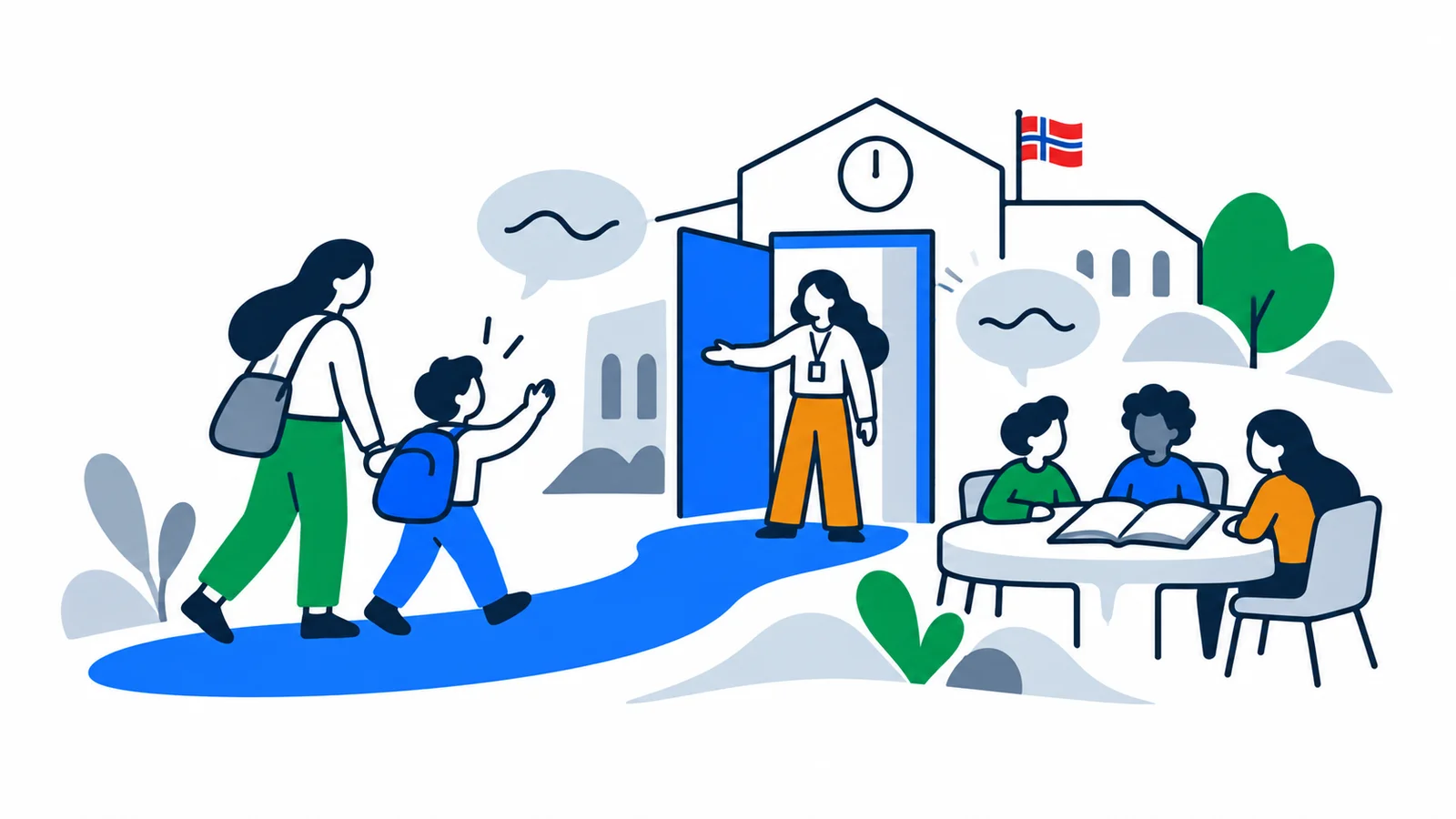

All children living in Norway have the right—and obligation—to free primary school, regardless of their parents' residence status. Children of asylum seekers also have the right to a school place as soon as possible. Newly arrived students also have the right to special language training (extra Norwegian) and can receive an introduction programme for up to two years. The rules are set out in the new Education Act (opplæringslova) from 2024.
All children have the right and obligation to primary school
The right to primary education applies to all children in Norway and is set out in the Education Act section 2-1. The law is new: the Storting passed it in 2023, and it came into force on 1 August 2024. It replaced the old Education Act from 1998, but the main rules on the right to school have been carried forward.
The key points to know:
- The right applies from when the child is of school age (usually from the year the child turns 6 years old) through 10th grade.
- Education is free. The municipality cannot charge for instruction, textbooks, or other materials.
- The right applies regardless of residence status. Even children with unresolved or unlawful residence status have the right to primary school as long as it is likely they will be in Norway for more than three months. This follows from the UN Convention on the Rights of the Child, which Norway is bound by.
Along with the right comes an obligation: the child must actually attend school. This obligation begins when the child has been in Norway for three months. To understand how grades, subjects, and marks fit together, you can read more about the Norwegian school system.
Asylum-seeking children: school place as soon as possible
Children of asylum seekers have the right to primary school while the family awaits a decision, if it is likely they will receive residence status or the case will take more than three months to process.
The municipality must fulfill the right as soon as possible. The main rule is that a full educational offering must be in place no later than three months after the child arrives in the country (section 2-1). This deadline was temporarily extended from one to three months following the high numbers of arrivals from Ukraine, and the extension still applies in 2026.
Even if the municipality cannot provide a complete offering right away, education must start as soon as possible—with the parts the municipality has capacity for. The deadline does not restart if the family moves to another municipality. If you are living in an asylum reception centre, the centre has a duty to help you make contact with the school.
In practice, this means that as a parent you can contact the municipality as soon as you arrive—you do not need to wait for your case to be processed at UDI (the Immigration and Integration Service). Children below school age may also have the right to childcare (barnehage), but there are separate rules for that.
Special language training: extra Norwegian (section 3-6)
Students with a native language other than Norwegian and Sámi have the right to special language training under Education Act section 3-6. The right lasts until the student can understand enough Norwegian to follow regular instruction.
Special language training can consist of:
- Intensive Norwegian language instruction—extra Norwegian lessons tailored to the student's level. This is the core of the programme.
- Instruction in the student's native language—teaching in the child's own language, if necessary.
- Bilingual subject instruction—a teacher explains subjects (such as mathematics or science) in the student's native language, if necessary.
The municipality must assess what the student can do, and make a formal decision about what help the child will receive. A formal decision is an official, written determination that you have the right to see. If you disagree with the decision, you can lodge a complaint—the school must explain how to do so. The assessment is carried out regularly, and special language training is meant to be temporary: it is gradually reduced as the student masters Norwegian. The goal is not to isolate the child, but to provide enough support so the student can quickly participate fully in a regular class. Adult family members may also need Norwegian—see the guide to free Norwegian courses in Norway.
Introduction programmes and introduction classes (section 3-7)
For students who have just arrived in Norway, the municipality can provide an introduction programme under Education Act section 3-7. This means the student receives all or part of their education in a separate group, class, or school—often called an introduction class or welcome class.
| Question | Answer |
|---|---|
| Who? | Students who have lived a short time in Norway and have a decision for special language training |
| How long? | A maximum of two years, up to one year at a time |
| Voluntary? | Yes—parents must consent |
The introduction programme should not last longer than necessary. In an introduction class, the school can make exceptions to the curriculum and timetable, so that instruction is tailored to the student's level. The offer is voluntary—the child cannot be placed there against the family's wishes. Many students move to a regular class before two years have passed, as their Norwegian improves. The student still has the right to special language training after the introduction programme ends, if their Norwegian is still not good enough.
Also the right to upper secondary education
Young people who have completed primary school or equivalent have the right to upper secondary education. Newly arrived young people may have the right to upper secondary education even if they are somewhat older than usual, and special language training and introduction programmes are available here too—under Education Act sections 6-5 and 6-6. The county municipality (fylkeskommune) is responsible for upper secondary school, so contact them. Many counties offer their own combination classes, where newly arrived students receive both primary school subjects and preparation for upper secondary education at the same time as they learn Norwegian.
How to enrol your child
The municipality is responsible for providing a school place. Here's how to proceed:
- Contact the municipality where you live—often the education office or school office, or the local school directly.
- Are you living in a reception centre? The centre will help you contact the municipality.
- Ask for an assessment of your child's Norwegian and academic level.
- Request a formal decision about special language training, and ask whether the municipality offers an introduction programme if your child has just arrived.
You have the right to an interpreter in important meetings with the school if you need one. If your child needs before- or after-school care, you can read about after-school care and holiday care in a separate guide.
A key resource is NAFO—the National Centre for Multilingual Learning. NAFO has websites with information about rights, assessment, and introduction programmes, and produces materials that schools use when teaching newly arrived students.
The official regulations can be found at Udir (the Directorate for Education and Training) at udir.no, and the law text is available at Lovdata. If you are unsure about your child's rights, you can contact the municipality or the county governor (statsforvalteren) in your county, who supervises that schools follow the law. Remember: school is not just a right, but an important pathway into Norwegian society for the whole family.