
If your child isn't getting enough out of regular teaching, they have the right to extra help at school – completely free. This right is now called individually adapted education (formerly called special education). PPT assesses the need, the school makes a decision, and you can appeal if you disagree.
What is special education in Norway?
Special education in Norway is extra help for students who aren't getting enough out of regular teaching. From 1 August 2024, a new Education Act applies. In it, the term has been changed to individually adapted education. Many parents, teachers and websites still use the word special education, so you'll encounter both names for the same thing.
This is different from adapted education. Adapted education is something all students get within regular classes – for example, easier or harder tasks. Individually adapted education is a separate, legally established right you get when regular adaptation isn't enough. If you want to understand the full context, you can read about the Norwegian school system.
Who has the right – and what does the Education Act say?
Under the Education Act § 11-6, a student has the right to individually adapted education if they need it to get satisfactory educational benefit. The right applies throughout primary school and upper secondary school.
It's not about having a specific diagnosis. It's about the benefit: is your child learning enough, compared with what's realistic for this particular child? The right applies to all students – including children with a short time in Norway. For newly arrived children, there are also special rules; see newly arrived children's right to school. Asking for help is a right, not something to be ashamed of. It's part of children's rights in Norway.
The help can take many forms. It might be fewer students in a group, an extra teacher or assistant, dedicated teaching materials, more time, or separate goals in some subjects. What your child receives should be clearly stated in the decision.
How your child gets help: the path from concern to decision
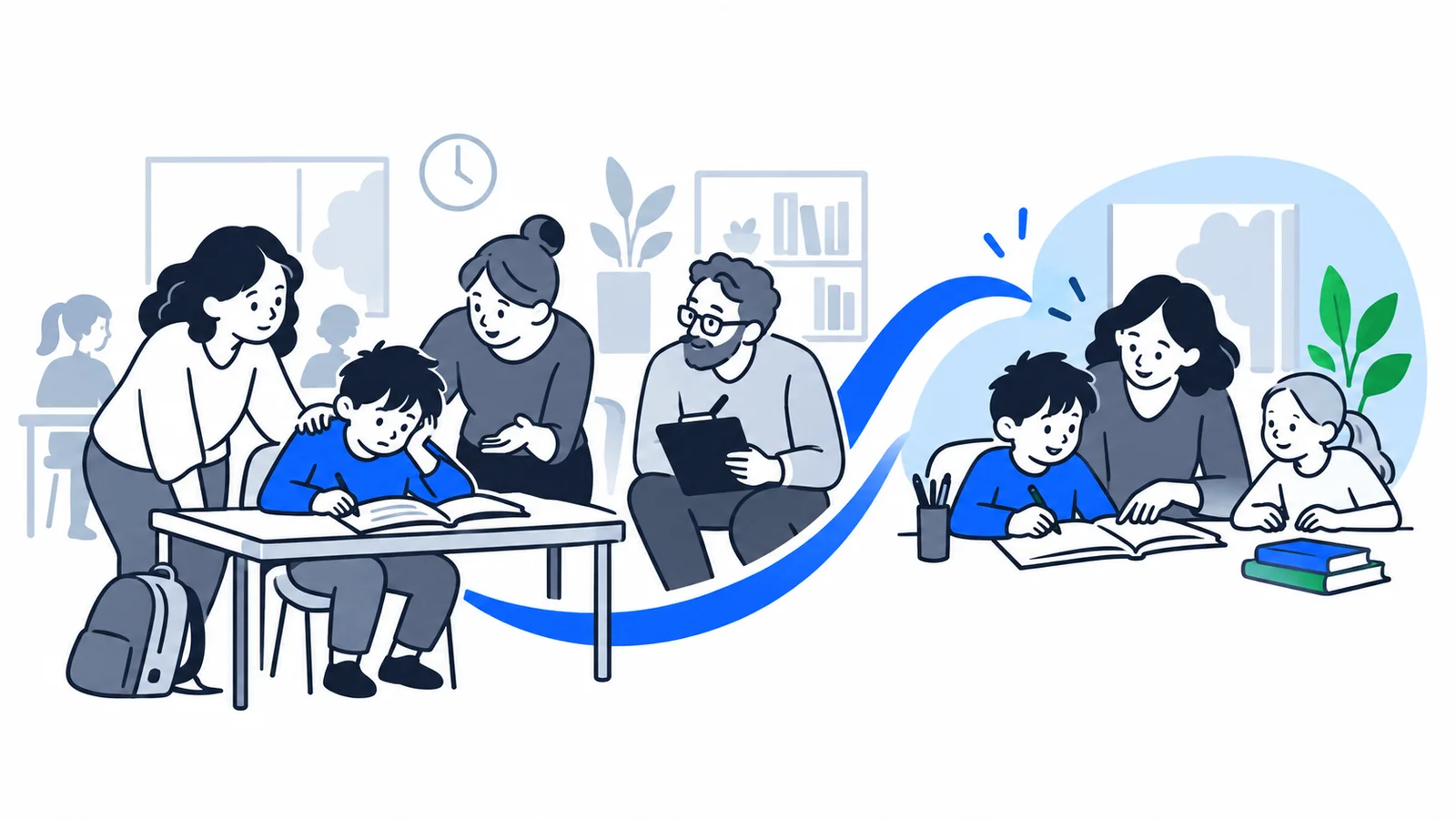
The process has fixed steps. As a parent, you can ask the school for an assessment yourself – you don't need to wait for the teacher to bring it up first.
- Report the concern. Talk to the class teacher or principal about what you're worried about. A parent meeting or meeting with the school is a good place to start.
- The school refers to PPT. PPT (Educational and Psychological Service) is a free municipal service that helps the school assess students' needs.
- PPT creates an expert assessment. An expert assessment is a professional evaluation in which PPT looks at what your child is getting out of the education, why it isn't enough, what goals are realistic, and what kind of help is needed. You must give consent before PPT starts.
- The school makes an individual decision. An individual decision is a formal, written determination about your specific child. The principal decides on behalf of the municipality, based on the assessment from PPT.
- The school creates an IOP. An IOP (Individual Education Plan) is a plan that describes goals, content and how the education will be delivered.
- The school writes a report. At the end of the school year, the school creates an annual report on how things have gone. Many schools also provide a mid-year report.
If you're short on time, you can ask the school to write down the date when you reported the concern. That makes it easier to keep track of whether the matter is progressing.
What is an expert assessment from PPT?
The expert assessment is the core of the case. The school cannot provide individually adapted education without PPT first assessing the need (Education Act § 11-7). The assessment should, among other things, say something about what benefit your child is currently getting, why it isn't enough, what goals are realistic, and what measures will help.
The school's decision should be based on this assessment. If the school disagrees with PPT, it must explain why in the decision. That's why it's a good idea to ask to read both the expert assessment and the individual decision itself. That way, you can see that the help your child receives is connected to the need PPT has identified.
Can you appeal if you disagree?
Yes. You always have the right to appeal an individual decision – both if you're denied and if you think the decision's content is inadequate.
- Send the appeal to the school or municipality that made the decision. The deadline is three weeks from when you received the decision.
- If the municipality doesn't change its mind, it forwards the appeal to the County Governor. The County Governor is the state's representative in the county and decides the appeal.
- You can ask for access to documents and help along the way. Appealing is free.
If the case is taking a long time, you can follow up in writing. The school has a duty to process the case within a reasonable time, and an appeal should not affect the help your child is already receiving.
What does special education cost in Norway?
Nothing. Both public primary school, help from PPT and individually adapted education are free. This follows from the Education Act. You should not pay for assessment, decisions, extra hours or teaching materials your child needs. The same applies in upper secondary school.
| Term | What it means |
|---|---|
| PPT | Municipal service that assesses the student's needs |
| Expert assessment | PPT's professional evaluation of the child |
| Individual decision | The school's written determination |
| IOP | Individual Education Plan for the child |
| County Governor | Decides appeals in the county |
Learn your rights – practice with SamfunnPrep
Rights for children, school and family are a regular topic in the Citizenship Test. On SamfunnPrep you practice exactly these kinds of questions, with short explanations in a language you understand. The better you know the terms like PPT, expert assessment and individual decision, the more confident you'll be the next time you talk to the school about your child. If you want to know your rights – both for the test and in everyday life – you can start free on SamfunnPrep.
Sources: Directorate for Education and Training (Udir), the Education Act on Lovdata and the County Governor, checked 8 July 2026.