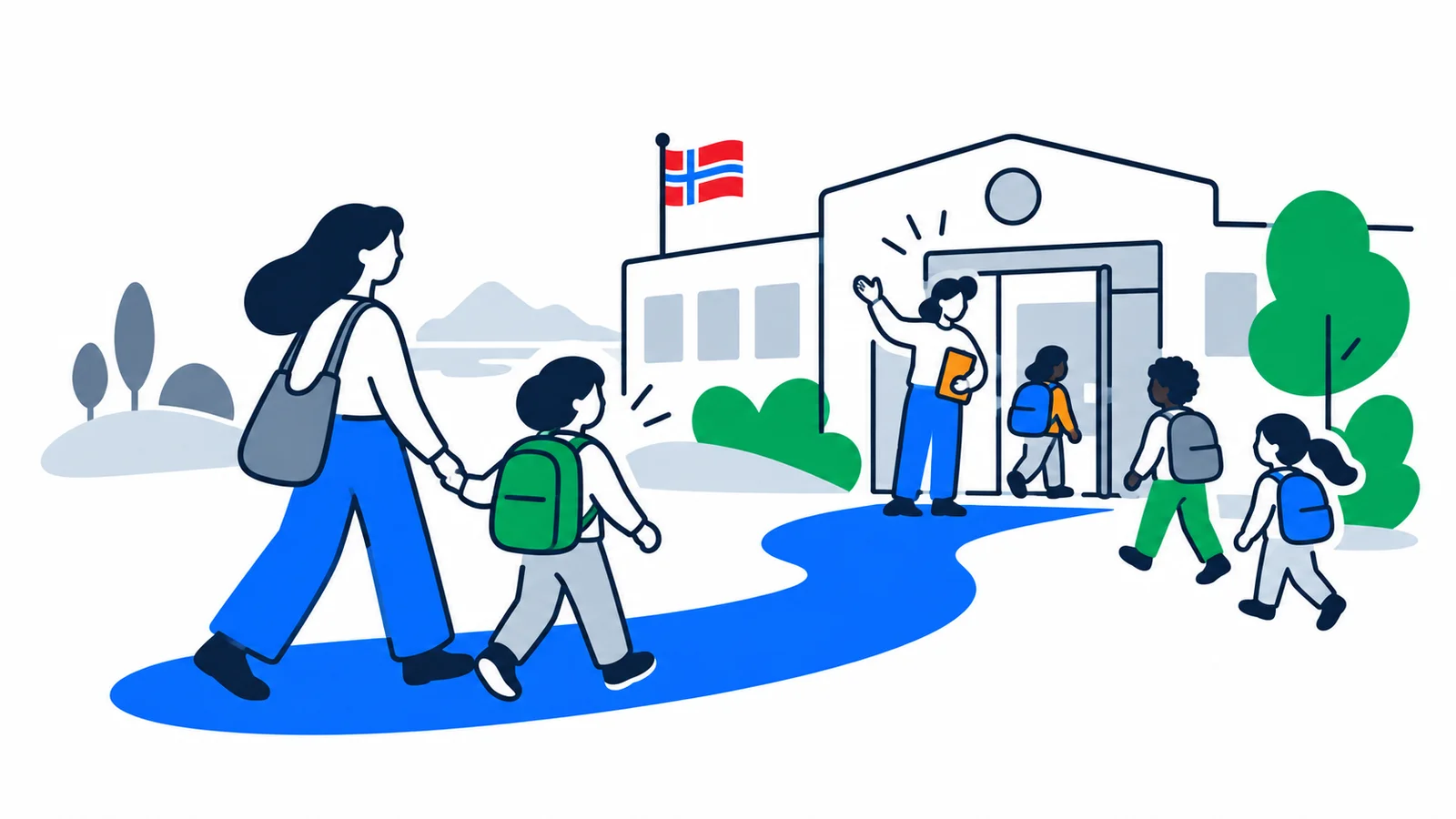

The school year in Norway normally starts in August, but the exact first day is set locally. Starting grade 1 is a separate question: children normally begin in the calendar year they turn 6, even if their birthday is later in the year. Check your municipality’s school calendar (skolerute) and the school’s letter for the date and meeting time.
School start in Norway: brief explanation
The usual age for starting grade 1 is national; annual dates and enrollment arrangements are local. Compulsory education (grunnskole) covers grades 1–10. The right to education and the duty to receive it have different conditions. Under Education Act § 2-2, the duty applies when a child has been in Norway for three months. It can be fulfilled at a public school, an approved private school or through private home education under the statutory rules. Udir is the Norwegian Directorate for Education and Training. Opplæringslova § 2-2
Compulsory education (grunnskole) has two stages: primary school (grades 1–7) and lower secondary school (grades 8–10). This is how it looks:
| Age (years) | Grade | School |
|---|---|---|
| 6–12 | 1st–7th grade | Primary school |
| 13–15 | 8th–10th grade | Lower secondary school |
After grade 10, compulsory education is finished. Then young people can apply to upper secondary school. If you want to understand the entire path from kindergarten to upper secondary school, you can read our guide to the Norwegian school system.
When does the school year start in Norway?
There is no single first school day for all of Norway. Schools usually return in August after the summer holiday; municipality and school calendars give the actual date. A date from Oslo does not necessarily apply in Bergen or another municipality.
| Municipality and school year | First school day | Status on 26 September 2026 | Official source |
|---|---|---|---|
| Oslo, 2026/2027 | Monday 17 August 2026 | Already passed | Oslo school calendar |
| Bergen, 2026/2027 | Friday 14 August 2026 | Already passed | Bergen school-start information |
| Oslo, 2027/2028 | Monday 16 August 2027 | Published future date | Oslo school calendar |
These are local examples, not national dates. Confirm the school's meeting time: first-graders can start at a different time from older pupils. SFO/AKS opening dates and hours can also differ from the teaching calendar.
To find your own date, open your municipality's official site and search for skolerute plus the school year, such as 2027–2028. Then check your school's page or welcome letter. Make sure you are reading the final calendar for pupils, rather than a consultation draft or staff planning day. If a future calendar is not published, contact the school instead of carrying last year's date forward.
At what age does a child start grade 1?
Children normally start grade 1 in the calendar year they turn 6. For example, a child born in December 2020 normally started in August 2026 while still aged 5; a child born in January 2021 normally starts in August 2027. These are illustrative age calculations, not individual enrollment decisions.
The school year usually runs from August to June. Earlier or deferred entry is possible under Education Act § 2-4, with parental application or consent and an expert assessment. Parents cannot simply choose a different starting year without the municipality's decision.
Local school and enrollment: how your child gets a place
The municipality is responsible for providing a school place. School catchment areas and local decisions determine placement; the assigned school is not always the physically closest building. Udir explains the local-school principle.
Enrollment dates and forms vary. Oslo's information for children starting in autumn 2026 described letters in November 2025, while Bergen states that allocation letters are sent in February. Use your municipality's current instructions rather than treating one city's timetable as a national rule.
- Check that the municipality has your current address and contact details.
- Read the allocation letter and complete any registration or information form the school requests.
- Contact the municipality or school if you have moved recently or did not receive a letter.
- If you cannot use a digital form, ask for another way to register. Bergen specifically tells families without a Norwegian identity number to contact the school by phone or in person.
- Apply separately if you want a different school or an earlier/deferred start; check the local deadline and appeal instructions.
Moving during the school year does not mean waiting until next August. Contact the new municipality about placement and transfer of necessary school information.
Is school free?
Yes. Public compulsory schooling is free for all children. It does not matter how much the parents earn. The school should cover what the child needs for teaching, such as textbooks, stationery and other materials. This right is set out in the Education Act. You should also not pay for regular outings and activities during school time.
Many children also have the right to free school transport. The right applies if the distance to school is more than 2 kilometers for children in 1st grade, and more than 4 kilometers for children in 2nd–10th grade. Children with a particularly dangerous or difficult route to school can get transport regardless of distance. Transport to and from out-of-school care is usually not free.
But one offer often costs money: out-of-school care. In Oslo it is called AKS (Activity School). Out-of-school care is an offer before and after school hours for children in 1st–4th grade. Out-of-school care is voluntary, and most parents pay for the place. From autumn 2024, some hours are free for the youngest children, but the rest you pay for yourself. Read more about out-of-school care and AKS if you are considering this.
Newly arrived children: contact the municipality now
Children have a right to public compulsory education from the year they turn 6 until they complete grade 10, if they are likely to stay in Norway for more than three consecutive months. The right does not depend on the child or parents having lawful residence. Do not wait for the next annual school start before contacting the municipality.
The current statutory text of Education Act § 2-1 published by Udir requires provision as quickly as possible and, as checked on 26 September 2026, no later than three months after arrival in Norway. This is an outer limit, not a reason to delay a place that can be provided sooner. The page also contains older explanatory passages referring to one month; use the current statutory text and ask the municipality to explain the arrangement for your child.
Tell the municipality the child's age, arrival date, address and previous schooling. Explain any missing paperwork or difficulty using an online form; ask what is needed and how the child can begin. For further context, see newly arrived children's right to school.
First day of school: what should you prepare?
Preparing for school start in Norway is not difficult. Here is a simple checklist for you who are sending a child to their first school day:
- Reply to the letter from the municipality, or contact them if you have not received it.
- Attend registration if the school invites you.
- Label clothes and equipment with the child's name and preferably a telephone number.
- Make a simple packed lunch and include a water bottle. The packed lunch should be easy for the child to open.
- Practice at home putting on and taking off clothes, hanging up clothes and tidying up after yourself.
- Pack the school bag together with the child, so the child knows what they have with them.
On the first day of school, many first-graders arrive in somewhat nice clothes. The teacher greets the children, and the first day is often short and pleasant. The first few weeks the child gets to know the teacher, the class and the school. The school also has a free school health service with a school nurse who follows the child's health and well-being. If you want to work well with the school in the future, you can read about parent meetings and school collaboration.
Practice Norwegian society with SamfunnPrep
School is an important part of Norwegian society. Knowing how school, family and rights work helps you in everyday life. Many of these rules are also part of the curriculum for the Norwegian Citizenship Test. On SamfunnPrep you can practice topics about children, school and family in a simple way.
Ready to practice? Try SamfunnPrep free and become more confident about the rules in Norwegian society.