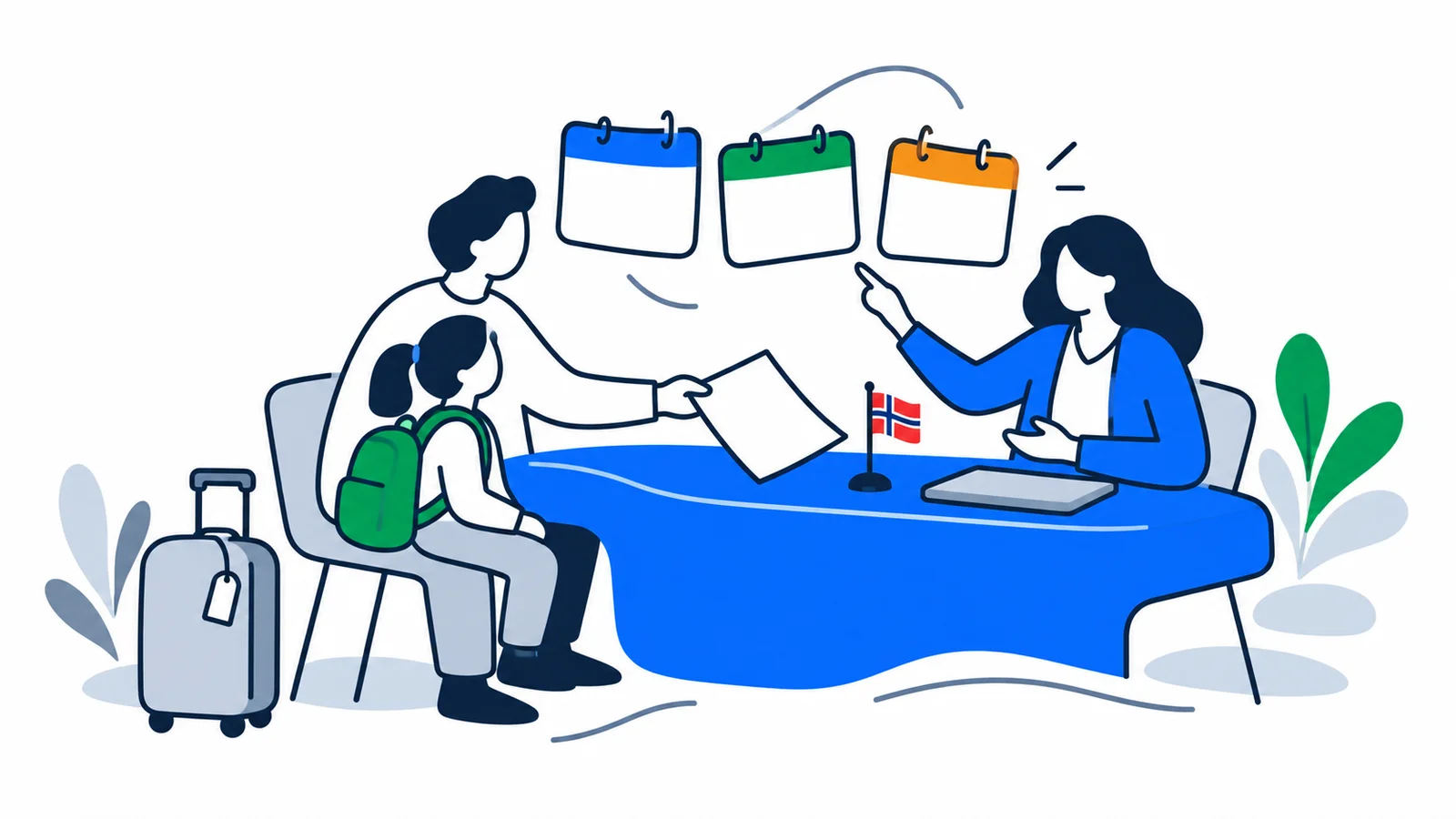

The school schedule in Norway determines when children have holidays and time off from school. The municipality sets it, so holidays vary slightly from place to place. If you want to take your child out of school outside these holidays, you must apply for leave beforehand. Primary school is mandatory from 1st to 10th grade.
What is the school schedule, and when are school holidays?
The school schedule is the school's calendar for the entire year. It shows when there is instruction, holidays, and days off. The school year in Norway has at least 190 school days, distributed across at least 38 school weeks. The municipality sets the school schedule, so holidays can fall in slightly different weeks from municipality to municipality. If you want to understand the entire school system, you can read about the school system in Norway.
However, holidays follow a fixed pattern in most places:
| Holiday | When (typically) |
|---|---|
| Autumn holidays | Week 40 (early October) |
| Christmas holidays | Approx. 20 December – 1 January |
| Winter holidays | Week 8 or 9 (late February) |
| Easter holidays | Days around Easter |
| Summer holidays | Late June – mid-August |
In Oslo, for example, the autumn holidays are 28 September–2 October 2026, and winter holidays in week 8. You will find your child's school schedule on the municipality or school website. For secondary school, the county municipality sets the schedule. The school leisure-time scheme (SFO/AKS) is often open during holidays, but you must register and pay—see the guide on SFO and AKS in Norway.
Holiday or leave—what's the difference?
Holiday is time off that is already in the school schedule. In that case, you don't need to apply for anything. Leave is something different: it is time off from regular school days, for example when you want to travel while school is in session. A good tip is to plan longer trips during school holidays. That way, your child doesn't miss instruction, and you don't need to apply.
Can you take your child out of school to travel?
Yes, but only if you apply for leave beforehand and the school agrees. Primary school is mandatory. Children have both the right and the obligation to primary education from the year they turn six until they have completed 10th grade. This is stated in the Education Act (opplæringslova) § 2-1 and § 2-2. The obligation also applies to children who have just arrived in the country—read about newly arrived children's right to school.
Because education is an obligation, you cannot simply keep your child at home. Traveling to your home country during school time without applying is unauthorized absence.
How many days off can your child get?
The school can grant leave for up to 10 school days (two school weeks) per school year if education as a whole remains adequate. But there is a pitfall many don't know about. The new Education Act (opplæringslova), which takes effect from 1 August 2024, has removed the fixed two-week limit from the law itself. Now the rule is in the Education Act § 2-2, and each municipality determines the limit in its own regulation.
This means the rules vary from municipality to municipality:
- Most municipalities maintain the limit of 10 school days per school year.
- Some municipalities, such as Oslo, generally do not grant leave for holidays at all.
- If your child gets leave for more than 10 days, days over 10 must be recorded as absences on the school report.
What is considered adequate is assessed individually by the principal for each child. The principal considers, among other things, how old the child is, how the child is doing at school, and how much instruction the child will miss. A child struggling with Norwegian is therefore more likely to have a request denied than a child who is keeping up well.
How to request leave from school
You apply in writing to the principal of the school, well in advance of the trip. Many schools require the application at least 14 days in advance. The principal assesses whether education will still be adequate for your specific child.
Here's how to proceed:
- Apply early and in writing. Use the school's form or send a brief message to the principal.
- State when and how long your child will be away and why.
- Wait for a response before booking your trip. A yes is not guaranteed.
- Appeal if your request is denied. You typically have a three-week appeal period.
It's also good to talk to the teacher. Good cooperation between school and home makes it easier to plan. On SamfunnPrep you will find more guides about school, children, and daily life in Norway.
What happens if you travel without applying?
Then the absence is considered unauthorized, and it can have consequences. Parents can be fined if they intentionally or negligently keep their child away from compulsory education. This is stated in the Education Act (opplæringslova) § 2-7.
Two things are especially important to know:
- The school can report it. In cases of serious or prolonged absence, the school can notify child protective services or the police.
- Extended foreign trips can result in losing your school place. If your child is abroad for more than three months, the compulsory education obligation ceases. Your child can then be withdrawn from school, and you must reapply for a school place when you return.
Also remember that your child can easily fall behind after a long absence. The school has no obligation to provide additional instruction to make up for lost time. As a parent, it is your responsibility to help your child catch up on what was missed.
Does your child have the right to time off for religious holidays?
Yes. Students who belong to a religious community other than the Church of Norway have the right to time off on that community's religious holidays. This is a separate right under the Education Act (opplæringslova) § 2-2 and is in addition to regular leave days. Parents must ensure that the child makes up what is missed. Read more about time off for religious holidays.
The rules about school, holidays, and leave are part of society you should understand as a parent. On SamfunnPrep you will find simple tools for newcomers to Norway that explain everyday life step by step. Many of these rules are also part of the curriculum for the Citizenship Test (samfunnskunnskapsprøven)—practice for free on SamfunnPrep.