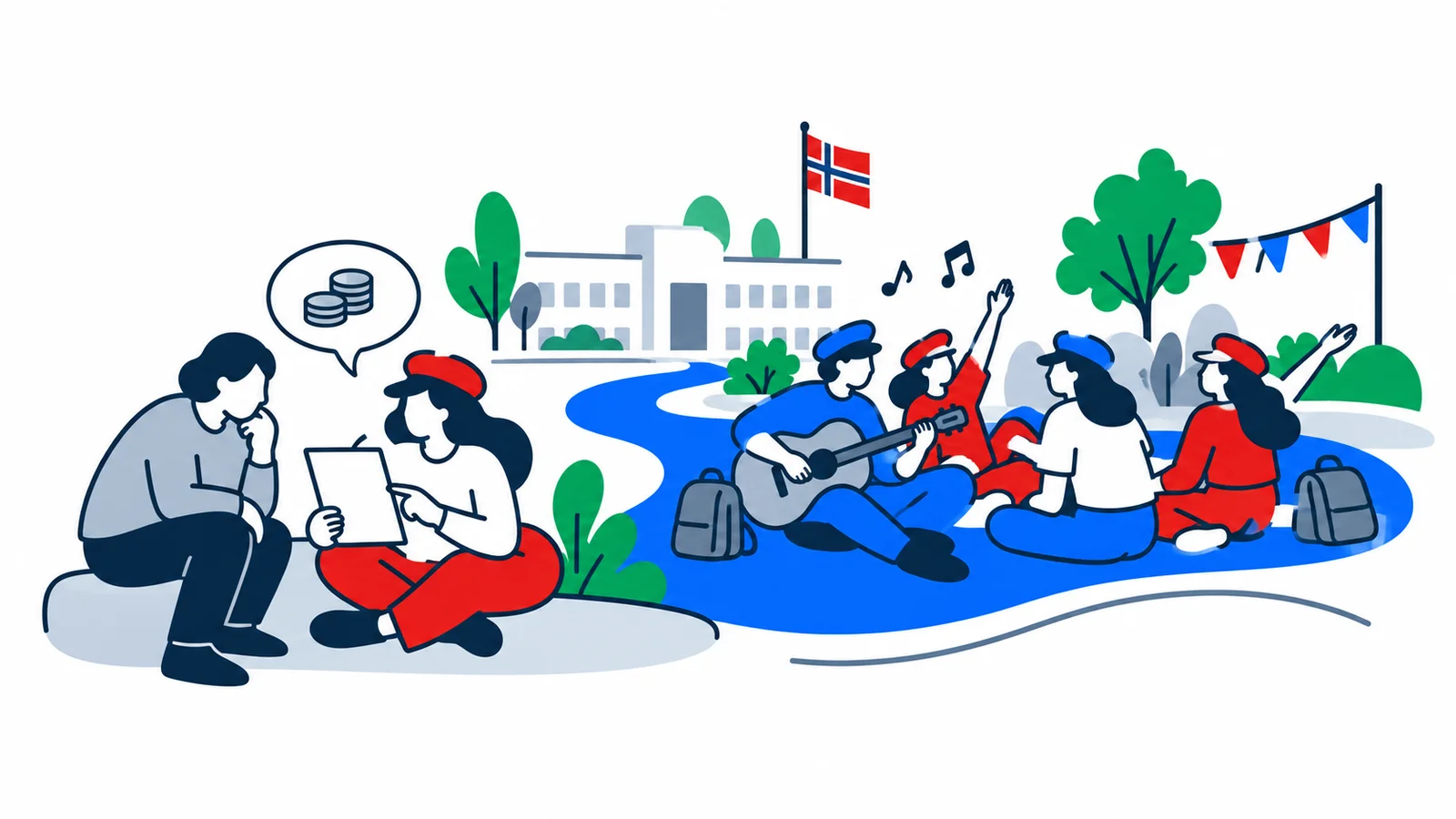


SFO – in Oslo called AKS – is the school leisure scheme for the youngest schoolchildren. Students in grades 1–3 have the right to 12 free hours of SFO per week, and no family pays more than 6 percent of household income for a place. You apply through your municipality, and income is usually retrieved automatically.
For many newcomers to Norway, SFO is an unfamiliar word. But the scheme is a major help in everyday life when both parents work, take courses or learn Norwegian. This guide explains what SFO and AKS are, how many hours are free in 2026, the rule for reduced fees, and how to apply. The figures apply as of 8 July 2026.
What is SFO and AKS?
SFO stands for skolefritidsordning (school leisure scheme). It is an offer of safe play and activities before and after school time, and during school holidays. The scheme is for the youngest pupils, from grade 1 to 4. Children with special needs have the right to a place until grade 7.
The school organizes the scheme, and children are there while parents are at work. SFO is not teaching. Children play, eat, are outdoors and do activities with adults.
In Oslo, the same scheme is called AKS – Aktivitetsskolen (Activity School). AKS is essentially Oslo's name for SFO, but with some different rules that we will return to.
How many free SFO hours in 2026?
Students in grades 1, 2 and 3 have the right to 12 free SFO hours each week. This is the most important rule for families with children.
Free core hours were introduced step by step: grade 1 from autumn 2022, grade 2 from autumn 2023 and grade 3 from autumn 2024. From 1 August 2026, the 12 free hours become a statutory right under the Education Act. The Storting (parliament) approved this in January 2026. This means the municipality must offer the place to everyone who wants it.
If your child uses only these 12 hours per week, SFO is completely free in grades 1–3. If you need more hours, you pay for the extra – but never more than the ceiling in the next section.
Reduced parental payment: maximum 6 percent of income
Even if you need a full place, there is a price ceiling. In grades 1–4, no family shall pay more than 6 percent of total household income for an SFO place. If the household earns little, the price is low. If you earn more, you pay up to the ceiling.
Here are the main rules:
| Grade | Free part | Payment for full place |
|---|---|---|
| Grades 1–3 | 12 hours per week (statutory from 1.8.2026) | Max 6% of income for extra hours |
| Grade 4 | No national free core hours | Max 6% of income |
| Grades 5–7 | Free for children with special needs | – |
The fee reduction schemes are national. But it is the municipality that processes the application and sets the practical details. Keeping track of such fixed expenses is an important part of personal finance in Norway.
Free SFO for children with special needs
Children with special needs have the right to free SFO in grades 5, 6 and 7. At these grades, the scheme is otherwise not free for other pupils.
This right ensures that older children who need support get a safe after-school offer without extra cost. The municipality assesses the need and makes a decision.
Opening hours and holidays
SFO is open before and after school time, usually from around 07:00 in the morning to 16:30–17:00 in the afternoon. The exact times are set by the municipality.
The obligation to have SFO applies during the school year. Most municipalities have SFO open during school holidays as well, but some weeks in summer may be closed. In some places you must register for holiday SFO or pay extra for holiday days. Check what applies at your child's school.
How do you apply for SFO and reduced fees?
You apply for an SFO place and reduced fees through your municipality. Many municipalities use a dedicated parent portal, for example Vigilo or Visma Flyt Skole. You log in with an electronic ID via ID-porten.
This is how the income calculation works:
- Income is usually automatically retrieved from Skatteteaten (the latest tax assessment).
- If the municipality cannot get hold of the figures, you must yourself submit your tax return and document other taxable income.
- You must usually apply again each year, because income may change. Check the deadlines with your municipality.
If you have a younger child at home, you may be entitled to other family benefits while you wait for school to start. Read about the rules for cash benefits in 2026.
SFO in Oslo: Activity School (AKS)
In Oslo, the rules are somewhat more generous than the national minimum. Activity School (AKS) offers a free part-time place to all students in grades 1–3, regardless of income. Here too, the ceiling of 6 percent of income applies to those who need a full place.
Oslo has also had a free part-time place in grade 4. From the school year 2026/2027, this becomes means-tested. The free place in grade 4 then only applies to households with total income up to 1 500 000 kroner. If you earn more, a full place in grade 4 costs 2 589 kroner per month, as of 8 July 2026. If you live in Oslo, check the updated rules with Oslo municipality.
Why does SFO matter for work and integration?
SFO makes it possible for both parents to work or pursue education. Without safe childcare after school, often one parent must stay home. Free core hours lower the threshold, especially for low-income families.
For children, SFO is also a place to practice Norwegian and make friends outside the classroom. Good contact with school helps both. Feel free to attend parent meetings and cooperation with Norwegian school to get to know the teachers.
Managing school, work and Norwegian courses is a lot to keep track of. The checklist Your first week in Norway from SamfunnPrep helps you take the most important steps in the right order. The rules about SFO and school are also part of the curriculum for the civics test – you can practice for free at SamfunnPrep.
In brief
- SFO (in Oslo: AKS) is the leisure scheme before and after school for students in grades 1–4.
- Students in grades 1–3 get 12 free hours per week – a statutory right from 1 August 2026 – and no one pays more than 6 percent of income for a place.
- You apply through your municipality, income is usually retrieved automatically, and you must usually apply again each year.