
Short answer: You have the right to an interpreter in Norway when language is a barrier in meetings with the public sector. The interpreter is free for you, impartial, and bound by confidentiality. You should never use your children as interpreters.
Many newcomers think they must manage on their own, or bring a friend to translate. This is not true. The public sector has a responsibility to ensure you understand and are understood. This is part of your rights in Norway, just like other human rights in Norway.
What does the right to an interpreter in Norway mean?
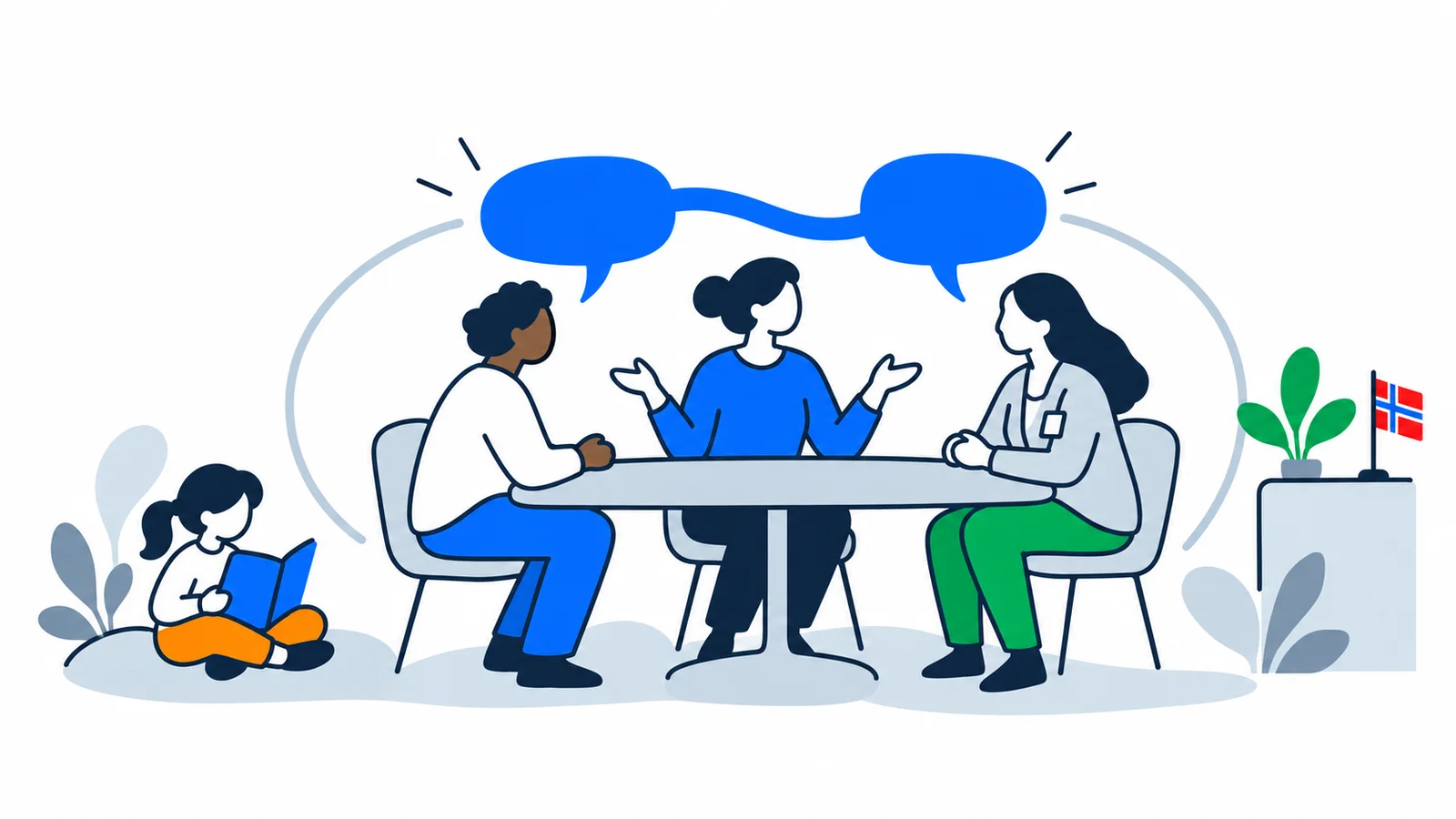
Right to an interpreter in Norway means that a public authority must use an interpreter when language stands in the way of good and proper help. An interpreter is a person who translates orally between you and an official, for example a doctor or a caseworker.
It is the service itself that decides when an interpreter is needed. Staff must order an interpreter if they are in doubt about whether you understand. You can also ask for it yourself. The point is simple: important messages about your health, money, or children should not be lost in translation.
The Interpreter Act: what does the law say?
The Interpreter Act (2022) requires public authorities to use an interpreter when it is necessary for legal protection or proper assistance. The full title is "Act on public authorities' responsibility for the use of interpreters," and it came into force on January 1, 2022.
The law places responsibility where it belongs: with the public sector, not with you. Some important rules are:
- Public authorities must use an interpreter when language is a barrier (§ 6).
- The interpreter must be qualified and obtained from the National Interpreter Register (§ 7).
- It is forbidden to use children as interpreters (§ 4).
- The interpreter has confidentiality obligations and must be impartial (unbiased).
The register of qualified interpreters is run by IMDi (the Directorate of Integration and Diversity). A qualified interpreter has passed an approved test or training. Until December 31, 2026, there is a transition arrangement, so the public sector can in some cases use other interpreters – but they should always choose a qualified interpreter when possible.
Where does the right to an interpreter apply?
The right to an interpreter applies in large parts of the public sector – everywhere you need to understand important information. This includes, among other things:
- Healthcare: general practitioner, emergency medical services, and hospitals
- NAV and other welfare services
- School and kindergarten
- Police
- Courts and legal proceedings
- Child protective services
If you are going to see a general practitioner, emergency services, or hospital, you have the right to an interpreter if you do not understand each other well enough. The same applies when meeting with NAV as an immigrant, where messages about money and deadlines must be completely clear.
With the police and in court, interpreters are about legal protection: you must understand what you are being asked and what is being decided. In child protective services, interpreters are important so that both parents and children are heard correctly. If you do not get an interpreter when you need it, you can ask the service to postpone the meeting until an interpreter is available.
Is the interpreter free, and what is confidentiality?
Yes, the interpreter is free for you – the public sector orders and pays. You should never receive a bill for an interpreter from a doctor, NAV, or other public services.
Confidentiality means that the interpreter is not allowed to tell others what is said in the meeting. Everything you tell your doctor through the interpreter is protected in the same way as if you spoke directly to the doctor. The interpreter must also be impartial: the interpreter does not take sides, gives no personal advice, and translates everything that is said – accurately and completely.
Therefore, a professional interpreter is safer than a friend or family member. A friend might leave out something embarrassing, or add their own opinions. A qualified interpreter does not do that.
Why should you not use children as interpreters?
You should not use your children, friends, or family as interpreters, because the law forbids it and because it is not safe. The Interpreter Act § 4 clearly states that public authorities must not use children as interpreters. The exception is emergency situations where you cannot wait.
The reason is consideration for the child. A child might misunderstand difficult words, hold back information, or learn things about their parents that are heavy to carry. Children should be children – they should not have responsibility for adults' problems, illness, or finances. Ordering an adult, qualified interpreter protects both you and your child.
How do you request an interpreter?
You request an interpreter by clearly stating in advance what language you need. The earlier you say it, the easier it is for the service to find a good interpreter at the right time.
Here is how you do it in practice:
- Say so when you book an appointment: "I need an interpreter in [your language]."
- Give notice in good time, not the same day.
- Show up – remember that the interpreter can also come via screen or phone.
Many services now use screen interpreting or remote interpreting. Then the interpreter sits somewhere else and participates via video or phone (Interpreter Act § 8). This is completely legal and works well, especially for languages with few interpreters nearby. If you want to know more about a specific area, we have a separate guide about interpreters in kindergarten and school.
Knowing your rights is an important part of becoming a confident participant in Norwegian society – and this topic is part of the curriculum for the Norwegian Citizenship Test. You can read more about the Interpreter Act on IMDi's website (imdi.no) and in the Norwegian Encyclopedia (snl.no).
Ready to practice? Try SamfunnPrep for free. At SamfunnPrep you practice on real questions about rights and Norwegian society, at your own pace. SamfunnPrep helps you understand both the test and everyday life in Norway.