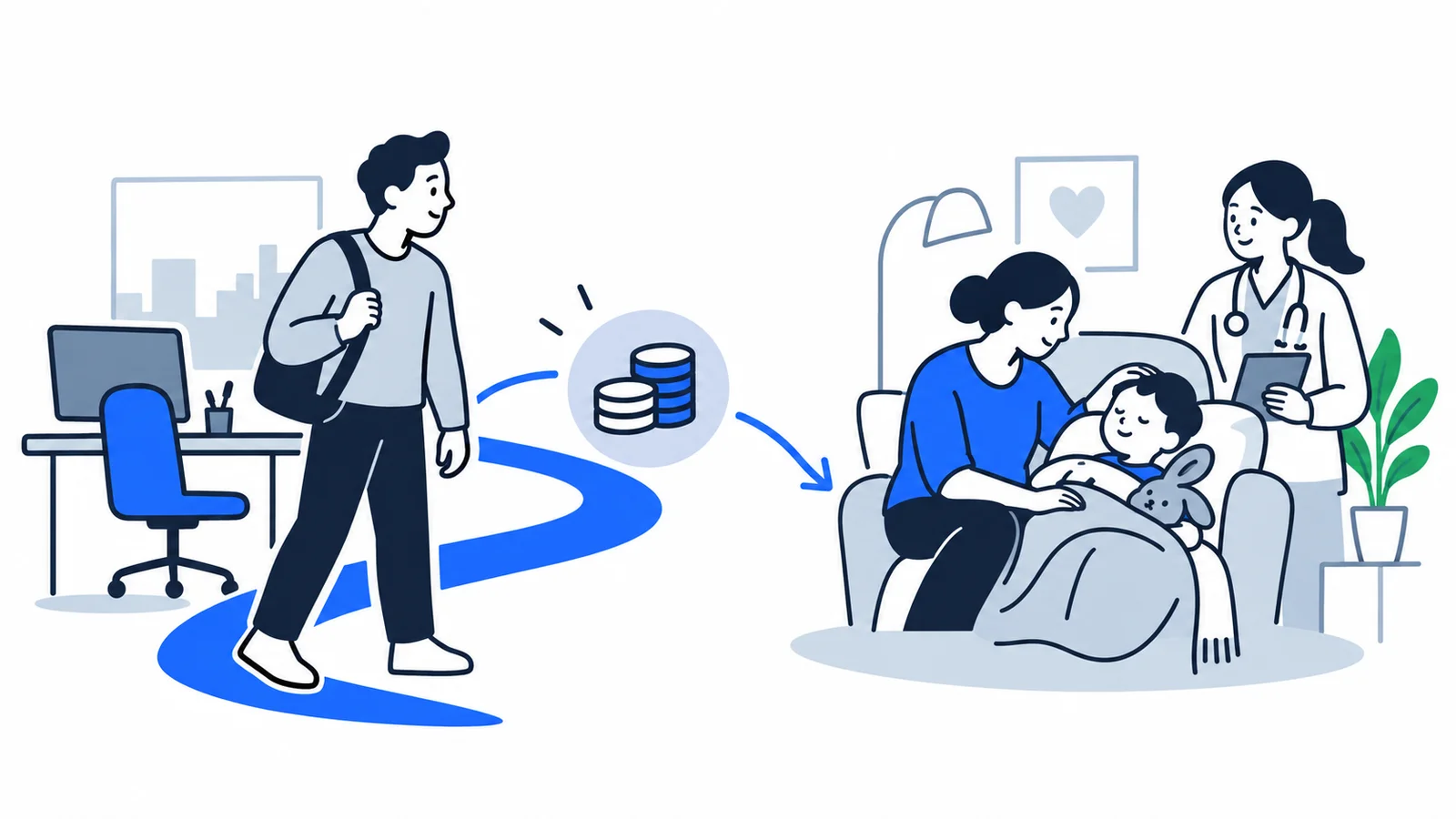

Pleiepenger is a NAV benefit that gives you full salary (100% of your benefit base) when you need to take leave to care for a child with serious or life-threatening illness. It is one of Norway's generous welfare provisions – and applies to all employees regardless of citizenship.
What is pleiepenger and who can apply?
Pleiepenger for sick child (National Insurance Act Chapter 9) applies to parents (or other caregivers) who:
- Have care responsibility for a child under 18 years with serious or life-threatening illness/injury
- Are themselves an employee, freelancer or self-employed with income in Norway
- Are a National Insurance member (pay social security contributions in Norway)
- Have income above 0.5G = 68 275 kr/year (2026)
- Have reduced work by at least 20% to care for the child
Both parents can theoretically receive pleiepenger for the same child if both have reduced working hours, but the total cannot exceed 100%.
What is "seriously ill"? NAV's diagnosis requirement
NAV requires that the child is seriously ill or injured – not just sick in the ordinary sense. Typical cases:
- Cancer or other life-threatening diagnosis
- Serious congenital heart disease requiring surgery
- Premature newborns with life-threatening complications
- Serious neurological conditions
- Traffic injuries or accidents with serious injury
The doctor decides: A doctor (usually a specialist from hospital) must confirm that the child is seriously ill and that the parent's presence is necessary. A GP alone is not sufficient – specialist involvement is required.
Not serious enough: Ordinary childhood colds, influenza, hip surgery without complications, and similar conditions do not give entitlement to pleiepenger. In those cases, care days (sick child days) apply.
Rate: 100% of your benefit base (up to 6G)
The rate in 2026:
- 100% of your normal income, limited to 6G = 819 294 kr/year (from 1 May 2026)
- Calculated based on average income over the last 3 months (employees) or last 3 tax years (self-employed)
- NAV pays directly to you or via your employer who advances the payment
Graduated: You can have graduated pleiepenger (e.g. 50%) if you work part-time and provide partial care.
Duration and extension
Duration:
- No fixed maximum period – pleiepenger is provided as long as the child is seriously ill and the need continues
- A new assessment is made at regular intervals
- The child can receive pleiepenger until age 18 years (in some cases until age 20)
After the child's death:
- Parents who have received pleiepenger can receive it for an additional 30 days (6 weeks) after the child dies
- Parents with continuous pleiepenger for at least 3 years can receive up to 12 weeks additional
The application process with doctor and NAV
Step by step:
- Contact a doctor (specialist): Ask the child's treating doctor (hospital) to confirm serious illness and the necessity of parent presence
- Apply digitally at nav.no – or via paper form NAV 09-35.01
- Attach: Medical certificate from specialist doctor + income information (employer sends A notification)
- Processing time: Normally 12 weeks (you can apply for advance/payment while the application is being processed)
- Can apply retroactively: Up to 3 months back in time
- Contact NAV: 55 55 33 33 (weekdays 09:00–15:00)
For immigrants:
- Pleiepenger applies to everyone regardless of citizenship
- EEA citizens and third-country nationals in permanent employment in Norway are treated equally
- You can request an interpreter via NAV to understand the application process
Read more about care days for sick child (short-term leave) and specialist health services and referral.
Graduated pleiepenger: can both parents share?
Yes, both parents can share pleiepenger for the same child at the same time. This is called graduated pleiepenger or shared leave. The practical reason for this is that when a child is seriously ill, it needs care for several hours per day or in multiple periods, so both parents can share the responsibility.
When you apply for shared pleiepenger, each of you must specify what percentage you want. The minimum requirement is that each parent takes at least 20% of the total care – NAV will not approve arrangements where one parent takes less. If one of you takes 70% and the other 30%, NAV pays out the corresponding percentage of the 100% rate for each of you.
NAV calculates it this way: if ordinary paternity leave or parental benefits would have given you 8 000 kroner per day, and you take 50% pleiepenger, you get 4 000 kroner per day (up to 6G total annually). Your partner simultaneously receives 50% of their calculation. The calculation is based on each parent's own income or basis if one earns more than the other.
Both of you must apply to NAV, either together (if you want to start at the same time) or individually if you start at different times. The application is processed by NAV within 10 working days. You can change the distribution between you by sending new applications to NAV – for example if one child becomes worse or better.
Pleiepenger during hospital admission
Many parents believe that pleiepenger ceases if the child is admitted to hospital. That is not correct. You can continue to receive pleiepenger when the child is in hospital, even though the hospital provides some of the care. The reason is that a seriously ill child needs parental presence and emotional support regardless of where the child is.
NAV requires that you document that the child is admitted and that the child is seriously ill. You must have a medical certificate or discharge summary from the hospital confirming the diagnosis. If the child has a stable condition and hospital staff can meet the daily needs, NAV may reduce or stop the pleiepenger – but this is rare in serious illness.
However, there are exceptions: if child welfare services or the hospital believe that parental presence is not necessary for the care (for example in certain surgical procedures where the child is under sedation for several days), NAV may require that you do not care for the child, and stop payment for that period. This should be clearly communicated in advance.
If you live far from the hospital, you may receive coverage of travel costs as part of the pleiepenger. You must document the cost with receipts. Some hospitals also offer accommodation for parents – contact the social worker on the ward.
What happens when the child is no longer seriously ill?
NAV must regularly assess whether the child is still seriously ill and needs pleiepenger. Assessment usually takes place after 12 months, or when you report a change in health status. If the child improves, NAV can stop the pleiepenger. The process is called "cessation of benefit" and should occur with at least 14 days' notice.
Before NAV stops the payment, your doctor or hospital should provide a new assessment. If the child has regained most functions or needs less care, it can no longer be called "seriously ill" according to NAV's definition. You can appeal the decision if you believe the child still needs care.
Some children need long-term follow-up after serious illness – for example cancer in remission or heart disease that is stabilized. These can still qualify for pleiepenger if they need supervision and therapies that require active parental participation.
If the child no longer receives pleiepenger, you can apply for other benefits: long-term illness can qualify for child pension (if it is work assessment allowance or vocational rehabilitation), or the child can receive dental care, auditory rehabilitation or other health services through the municipality.
Pleiepenger for immigrants and EEA citizens
EEA citizens and immigrants who work in Norway have the same right to pleiepenger as Norwegian citizens – provided they meet the requirements for work and income. You must be an employee or self-employed, and have income that meets a minimum of 2G annually.
Refugees and asylum seekers: if you are approved as a refugee or have been granted collective protection, you are entitled to pleiepenger as soon as you are employed and meet the qualifying requirements. Asylum seekers still under UDI processing are not entitled to pleiepenger.
EEA workers coming from Sweden, Denmark or other EEA countries can receive pleiepenger if the child becomes seriously ill while you live and work in Norway. Work periods in other EEA countries count towards qualifying if you apply Norwegian law with EEA coordination rules.
You must apply through NAV at nav.no with the same documentation as Norwegian employees, plus any residence permit or PDU from the State Authorization Office. Processing time is usually the same as for other applicants.