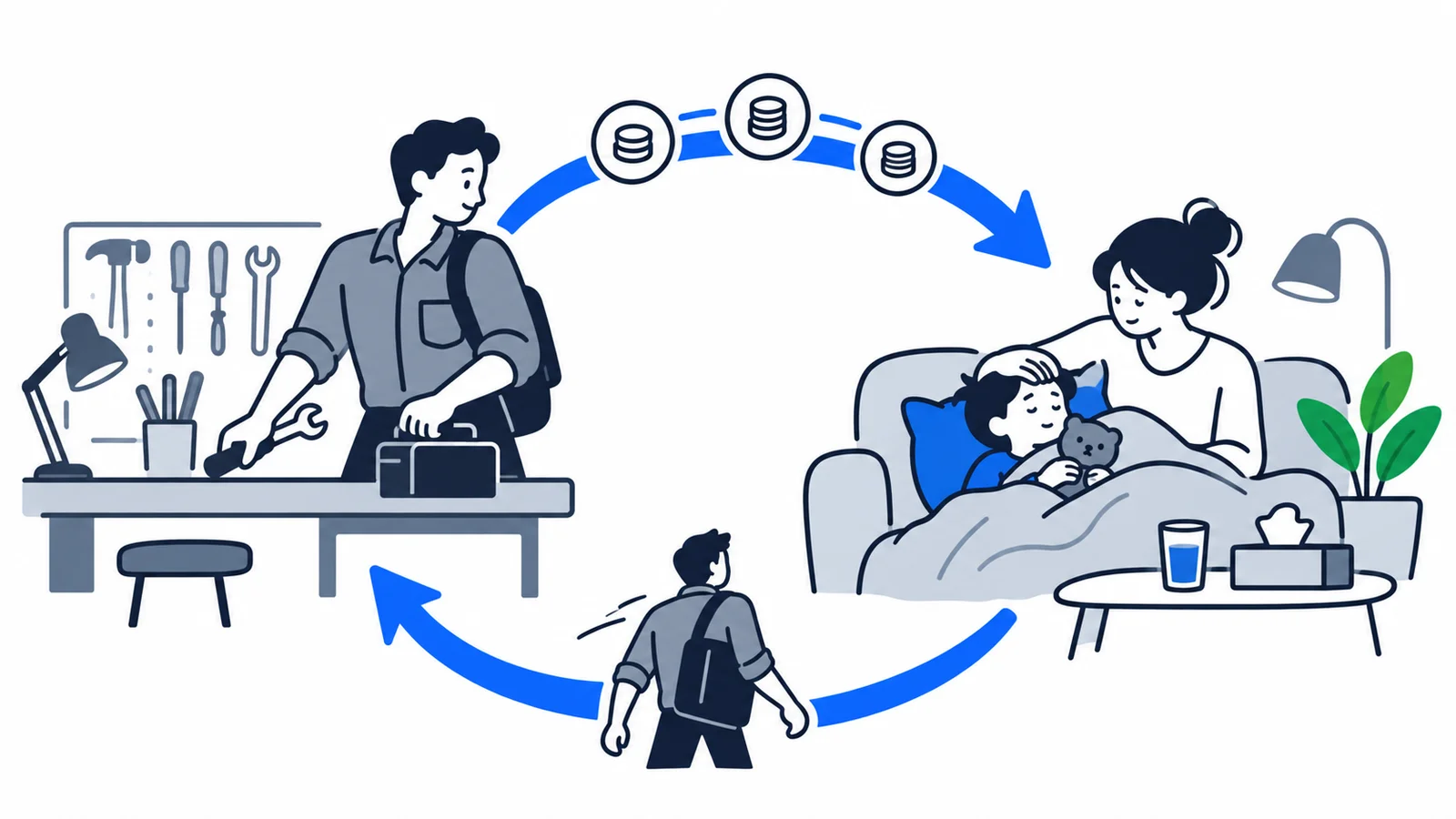

Care days give you the right to paid time off with full pay when your child is sick. In 2026, most parents get 10 days per child per year. The employer pays days 1–10, NAV refunds from day 11. The days reset December 31—use them or lose them.
Care days 2026: what are they and who has the right?
Care days are a statutory right to paid leave when your child is sick, or when your childminder/nanny is sick. The right is anchored in the Working Environment Act (AML) §12-9 and the National Insurance Act (ftrl) chapter 9.
To have the right to care days, you must meet four conditions. You must have been employed by the same employer for at least four consecutive weeks. You must be a member of the National Insurance scheme, which almost everyone who lives and works in Norway is. The child must be under 12 years old. And you must lose pension-contributing income—meaning you must actually have wages to lose. There is a requirement of minimum 0.5 G in income, which equals 68,275 kroner per year in 2026.
Freelancers and self-employed have the same rights under ftrl chapter 9, but with one important difference: sole proprietorships (ENK) cover the first ten days themselves. NAV refunds only days beyond this.
There is no requirement for citizenship or Norwegian language skills. The right applies to everyone employed in Norway who meets the four conditions above. Periods on NAV benefits such as parental leave or sick pay count toward the accrual period.
Quotas 2026: standard quota, extended and chronic illness
Care day quotas for 2026:
| Situation | Days per parent |
|---|---|
| 1–2 children under 12 | 10 days |
| 3 or more children under 12 | 15 days |
| Single parent (1–2 children) | 20 days |
| Single parent (3+ children) | 30 days |
| Child with chronic illness (+10 per child) | Up to age 18 |
A single parent thus doubles their quota. This applies to the person with sole custody—meaning only one parent has parental responsibility, or the child lives permanently with one parent.
If you have a child with a chronic illness or permanent disability, you can apply to NAV for 10 extra days per such child. These days apply until the child turns 18, not just until 12. You need a decision from NAV to use these extra days.
Practical advice: If your child has a chronic condition, apply to NAV for an extended quota now—before you actually need to use the days. The application process takes time, and you cannot use extra days without the decision in place.
Payment: who pays and how much?
You are entitled to 100% of your ordinary wage during care days. However, there is a cap: six times the basic amount (6G) equals 819,294 kroner per year from May 2026. If you earn more than this, NAV refunds do not cover what exceeds the cap.
Payment responsibility is divided:
- Days 1–10: The employer pays full wage.
- Day 11 and onward: The employer continues to pay your wage but requests refund from NAV.
From May 21, 2026, all refund requests from the employer happen digitally via My page—employer on nav.no. The employer's deadline for submitting a refund request is three months after the absence occurred.
Holiday pay on NAV-refunded care days: the employer has a claim to 10.2% holiday pay basis for up to 48 days that NAV refunds per year.
How to notify your employer
Days 1–3 of absence: you can use self-certification without a medical certificate. Most employers accept this by phone or message.
From day 4: the employer can request a medical certificate (doctor's note). This is not, however, an absolute requirement—check your employment contract and any collective agreement. Many employers do not require it in practice.
If you have a child with chronic illness and use extra days from an NAV decision, you should inform your employer in writing that you are using the extended quota. You do not need to contact NAV for regular use of care days—this happens automatically through your employer.
Transfer of care days between parents
The main rule is that care days cannot be transferred between parents. You cannot simply give days to the other parent because you don't need them.
There are exceptions:
- Sole custody: The other parent can transfer up to 10 days of their quota to you if you have sole custody.
- New cohabiting partner: You can transfer up to 10 days to a new cohabiting partner you have lived with for at least 12 months.
- Hospital admission or imprisonment: If the other parent is admitted to hospital or imprisoned for at least 6 months, you can take over all of their care days for that year.
Transfer happens by notifying NAV and documenting the situation.
Care days with shared residence
If the child has shared residence (50/50), both parents have a full, independent quota. This means each of you has the right to 10 days (or more with 3+ children or chronic illness)—the days are not divided between you. Both thus have the right to their own 10 days regardless of each other.
This is an important clarification many parents are unaware of: shared residence does not give half the quota to each—it gives the full quota to both.
Immigrants: accrual and rights
For immigrants, the most important rules to know are:
The four-week rule: You accrue the right after four consecutive weeks with the same employer. Periods on Norwegian NAV benefits (parental leave, sick pay, unemployment benefits) count toward this calculation.
EEA and non-EEA citizens: The rules are the same for everyone. There is no discrimination based on citizenship or background.
No requirement for Norwegian: You do not need to speak or understand Norwegian to have rights or to apply. NAV has information in several languages, and you can request an interpreter.
Population registration: For your child to count toward your quota, the child should be registered in the National Population Register in Norway. Children without a personal identification number may in some cases still give you rights—contact NAV for clarification.
What happens to unused days?
Care days are not a savings account. They reset December 31 each year. You cannot carry unused days over to the next year—they simply disappear.
Practical strategy: Use care days for shorter sick child days instead of self-certification from your own sick leave quota. This preserves your own accrued self-certification right and sick pay for when you yourself are sick. Many forget this and use self-certification when they could have used care days instead.
Remember: Care days also apply if your childminder (nanny, child minder, trainee) is sick and you have no other arrangements for the child.
Want to learn more?
Read also our articles on trade unions and the Norwegian model and benefits for parents of seriously ill children.
Sources: nav.no/omsorgspenger (updated 24.06.2026), arbeidstilsynet.no, National Insurance Act chapter 9.