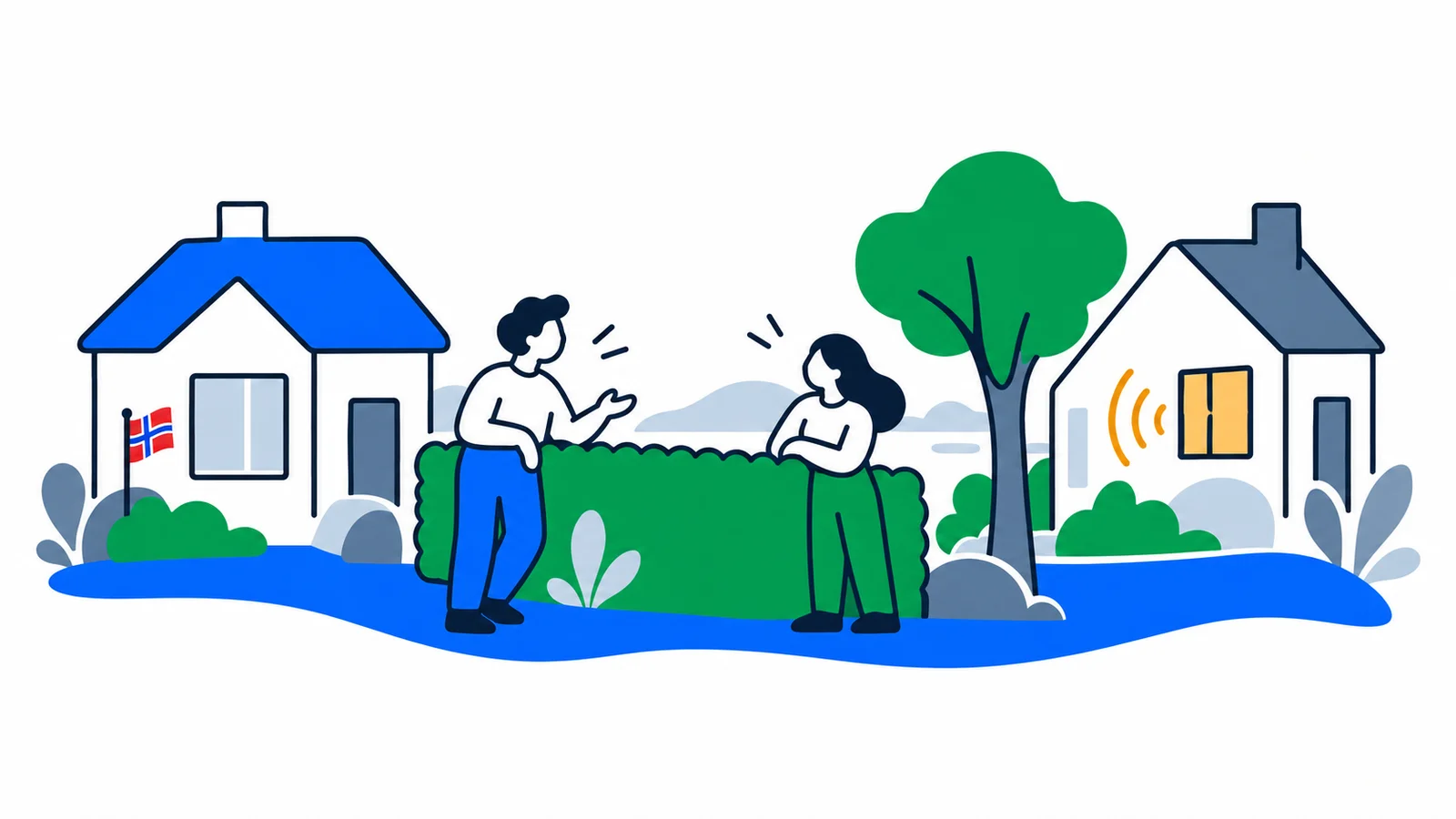

Neighbor Law in Norway protects you against things that are unreasonable or unnecessary as harm or inconvenience. The law covers noise, trees near the boundary and other nuisances. Most neighbor disputes can be solved with a calm conversation.
What is neighbor law in Norway?
Neighbor Law in Norway is officially called grannelova (law on legal relationships between neighbors from 1961). The law determines what you can do on your own property without bothering your neighbor.
The main rule is in § 2: "No one must own, do or carry out anything that is unreasonable or unnecessary as harm or inconvenience to neighboring property." In modern Norwegian, unreasonable or unnecessary means just that—unreasonable or unnecessary.
This is a threshold, not a ban on everything that is a little annoying. You must tolerate normal use of your neighbor's house and garden. The law only steps in when the damage or inconvenience becomes unreasonable or unnecessary. A court then looks at how large the inconvenience is, what is normal in the neighborhood, and whether the neighbor could easily have done something differently.
Neighbor law applies to everyone, whether you own or rent. If you live in a block or apartment building, separate house rules also apply. Read more about the difference between a housing cooperative or owner-occupied home, and what is in a rental contract.
What does neighbor law say about noise from neighbors?
Neighbor Law in Norway has no fixed clock time for when it must be quiet. That surprises many. There is no single national "quiet time" in the law.
Rules about peace and quiet usually come from two other places:
- House rules in the housing cooperative or shared ownership. These are set by the residents themselves. Common quiet hours are often from 23:00 to 07:00 on weekdays, and longer at weekends.
- Police regulations in the municipality. They can ban unnecessary noise at night in public places.
Neighbor law can still be used if noise from neighbors becomes unreasonable or unnecessary over time—for example, very loud music every night. But isolated noise from a birthday party or renovations during the day you normally have to tolerate. Consideration goes both ways.
A good tip is to write down when the noise happens and how long it lasts. Such a log makes it easier to explain the problem, both to your neighbor and to the board or conflict council later.
If you are unsure what is normal custom in Norway, you can read about Norwegian values and unwritten rules.
Trees and hedges near the boundary: the 2-meter rule
Trees and hedges are one of the most common neighbor disputes, and here grannelova has clear rules.
§ 3 says that a tree cannot stand closer to a neighbor's house, garden, yard or cultivated land than one third of the tree's height, if the tree is harmful or particularly inconvenient. A tree that is 9 meters tall must therefore stand at least 3 meters from the boundary so that the neighbor cannot demand anything.
For hedges there is a separate rule: "A hedge that is lower than 2 meters is not illegal under this section." A hedge under 2 meters is thus legal, no matter how close to the boundary it stands. If the hedge is higher than 2 meters and causes inconvenience, rules about trees may apply.
Note two things:
- You cannot simply cut branches or roots hanging into your side without further notice. You should notify your neighbor first.
- You cannot remove your neighbor's tree yourself. If you disagree, the matter must be resolved in another way.
Rules on fences follow from a separate fence law, but a fence or dense hedge can also become a nuisance under neighbor law if it blocks the view or light in an unreasonable way.
How do you resolve a neighbor dispute?
Always start by talking together. Most cases are resolved here, without a lawyer and without cost. Use this ladder, one step at a time:
- Talk to your neighbor. Be calm and specific. Often the neighbor does not know that something bothers you.
- Contact the board in the housing cooperative or shared ownership if you live together. The board can remind about the house rules.
- Report the case to the conflict council. The Conflict Council is a free, state-funded service where a neutral mediator helps the parties find a solution. It is well-suited for neighbor disputes.
- Take the case to the conciliation board or court if you still do not agree. The conciliation board is a low-threshold service with a small fee, and you can attend without a lawyer.
Call the police only for acute, dangerous or illegal behavior. For ordinary noise and disagreement, the police are rarely the right authority. Read more about contacting the police if you are in doubt.
You can find the law itself on lovdata.no, and good explanations on snl.no (Store norske leksikon—the Great Norwegian Encyclopedia).
Good neighborliness is part of Norwegian culture
In Norway, consideration is an important value. One shows consideration for the neighbor, and one expects the same in return.
Many neighborhoods have dugnad—a shared working day where residents clean and maintain the outdoor areas together. Participating is a nice way to get to know each other and build trust. A good neighborly relationship also makes small problems easier to solve.
A small greeting when you meet your neighbor, and a brief warning before you yourself make some noise, counts for a lot in Norway. Such everyday consideration prevents small irritations from growing into a bigger conflict.
Living together with neighbors is part of Norwegian society—practice for the citizenship test for free at SamfunnPrep. At SamfunnPrep you will find tasks about rights, duties and everyday rules in Norway, so that you feel safe both on the test and in your neighborhood.
In short: neighbor law in Norway gives you the right to a reasonable living environment, but it is built on mutual consideration. Talk first, learn the rules about noise and hedges, and use the conflict council if needed.