
When someone dies in Norway, a doctor writes the death certificate, funerals normally happen within 10 business days, you have the right to a free grave in your home municipality, and NAV may provide funeral aid.
Losing someone is difficult. In Norway, the system is orderly, and much happens automatically. This guide from SamfunnPrep explains calmly what you do, step by step. Everything is free to read, and you don't have to do it all yourself.
What Do You Do First When Someone Dies?
The very first thing is to contact a doctor. A death certificate (also called a doctor's statement of death) is a document that confirms that a person has died. Only a doctor can write one.
- If the death occurs at home: call your regular doctor during office hours, or the emergency doctor by phone 116 117.
- In an acute situation: call 113.
- If the death occurs in a hospital or nursing home: staff will arrange this for you.
If you are unsure who to call, read our overview of regular doctors, emergency doctors, and hospitals. You have no deadline in the first few hours. Take the time you need to say goodbye.
In the first few days, do this:
- Contact a doctor so the deceased is examined and the death certificate is written.
- Inform close family and friends.
- Contact a funeral home, or begin planning the funeral yourself.
- Apply to NAV for funeral aid if the estate has little money.
You don't have to do everything at once. The funeral home can help you with most of these points.
Who Reports the Death Further?
The doctor reports the death to the National Population Register for you. Since January 1, 2022, doctors must send this report electronically. This means you don't need to register the death yourself.
When the report is sent, most public agencies are informed automatically. The National Population Register also sends information to the District Court (the court that handles inheritance and estate distribution).
You must inform some private entities yourself, such as your employer, insurance company, and bank. You inform family and friends yourself.
Who Arranges the Funeral?
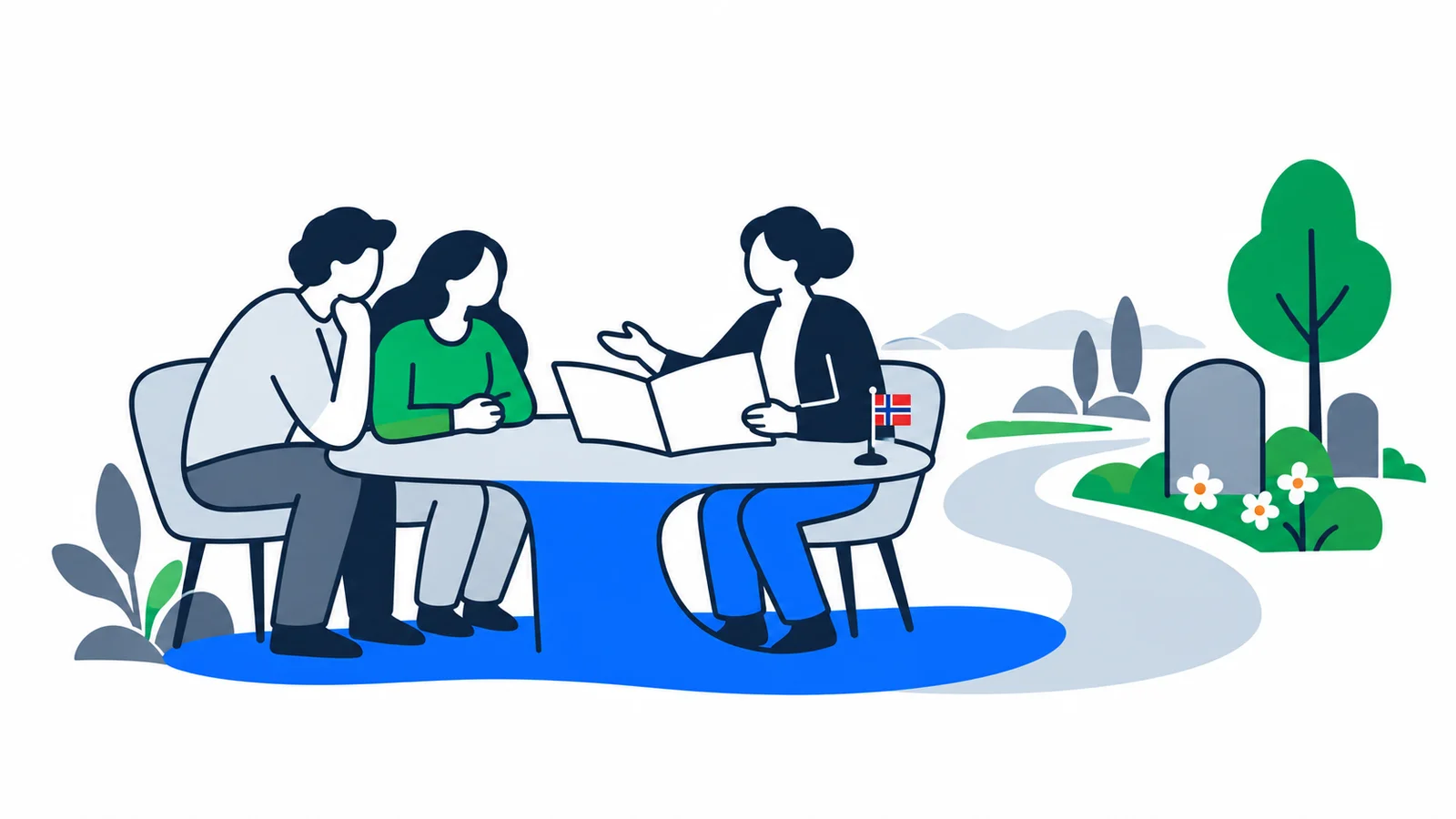
The closest relatives decide and arrange the funeral (burial or cremation). Funeral is a general term for both burial in a coffin and cremation.
Most people use a funeral home — a company that, for a fee, arranges the coffin, transport, documents, and ceremony. The funeral home takes care of the practical matters, so you don't have to face it alone. You are not required to use a funeral home; the family can arrange much themselves if you wish.
According to the Funerals Act (the law on grave sites, cremation, and funerals), burial or cremation should normally take place within 10 business days after the death. Saturday is not counted as a business day. The municipality can grant an extension if there are good reasons.
You choose between burial (the deceased is placed in a coffin in a grave) and cremation (the deceased is burned, and the ashes are placed in an urn). Both are permitted in Norway. If the family wishes to scatter the ashes in nature, you can apply to the state governor for permission. This application is also free.
Do I Have the Right to a Free Grave?
Yes. You have the right to a free grave in the municipality where the deceased lived at the time of death. "Free" means that the grave site itself is free of charge in the home municipality. This applies to everyone who lived in the municipality, regardless of background or citizenship.
Other costs, such as coffin, funeral home, flowers, and transport, you must pay yourself. A typical funeral in Norway often costs tens of thousands of kroner. The price varies greatly between funeral homes, so you are allowed to request a price quote and compare. If the deceased had little money in the estate, there is financial help available from NAV.
How Much Funeral Aid Can I Get from NAV?
NAV can provide funeral aid — a one-time amount that covers funeral expenses. For deaths from January 1, 2026, the maximum amount is 30,898 kroner (as of 2026).
The aid is means-tested. This means NAV looks at the assets of the deceased and at insurance that is paid out because of the death. If the deceased was married or in a civil partnership, NAV also looks at the spouse's finances. The more money the estate has, the less you receive. If the deceased was under 18 years old, the aid is not means-tested, and you receive coverage for documented expenses up to the maximum amount.
You can also apply for transport aid for the coffin when the coffin must be transported more than 20 kilometers. Then you pay a 10 percent co-payment of the full funeral aid, which as of 2026 is 3,090 kroner. NAV covers the rest.
How to apply:
- Collect receipts and invoices for the funeral.
- Fill out the application at nav.no/gravferd. The funeral home often helps you with this.
- Send the application as soon as possible after the death.
To better understand the NAV system, see our guide to NAV for immigrants and the overview of health rights and the National Insurance.
Can the Ceremony Be in My Religion?
Yes. In Norway, you have full freedom of religion and conscience, also at funerals. The ceremony can be Christian, Muslim, Hindu, Buddhist, secular, or without religion at all. You choose yourself.
Many municipalities have separate grave fields for different faiths, and a funeral home can help you find the right solution. If the family wishes to send the deceased to the home country, the funeral home can also arrange that.
What Happens to the Inheritance and Assets?
The inheritance is handled separately, after the funeral itself. The heirs send a form to the District Court and usually choose private estate distribution, where they themselves divide the inheritance and debts. About 1–2 weeks later, they receive an estate certificate. This document shows who the heirs are and gives access to the deceased's bank account and assets.
Remember that the heirs also take over the deceased's debts. If the deceased was married, the surviving spouse has special rights under the law. This is a separate topic, and you have plenty of time — it is not urgent like the funeral is.
Welfare and rights are part of the syllabus for the citizenship test — practice for free on SamfunnPrep. Knowing your rights gives you security in a difficult time, and SamfunnPrep helps you understand how Norway works.