
Screen time guidance for children and young people in 2026 recommends little or no recreational screen use for the youngest children and clear limits for older children. This is expert advice, not Norwegian law.
Screen time guidance for children and young people in 2026
The national screen time guidance sets different time limits for different ages. These limits apply to leisure time. Schoolwork and necessary classroom use should therefore not simply be added to the total as though all screen use were the same.
| Age | Recommended recreational screen time |
|---|---|
| Under 2 years | Should avoid screens |
| 2–5 years | No more than 0,5–1 hour a day, preferably less |
| 6–12 years | No more than 1–1,5 hours a day, preferably less |
| 13–18 years | No more than 1,5–3 hours a day, preferably less |
Helsedirektoratet published the national expert guidance in 2025 and last updated its recommendations on 8 January 2026. The government presented the guidance in a more accessible format on 14 September 2026.
This is a guide for families. It is not a system for monitoring compliance. On SamfunnPrep, you can also read about teenage life, school and leisure in Norway.
Is the screen time guidance legally binding?
No, the screen time guidance is not law. Parents will not be fined if a child uses screens for longer than recommended, and the authorities do not monitor screen time at home.
Helsedirektoratet describes it as national expert guidance. Words such as “should”, “can” and “recommend” indicate that families should use the advice as support. The guidance describes habits that generally leave more room for sleep, play, physical activity and social contact.
Schools and kindergartens may have their own rules for mobile phones and digital devices. These rules are separate from the health advice for families. A school may, for example, collect pupils’ phones during the school day, even though the national guidance is not law.
What is the advice for children under 2?
As a general rule, children under 2 should avoid screens. Young children learn through interaction with adults, movement, play and exploring the world around them.
Helsedirektoratet also emphasises adults’ behaviour. Screens playing in the background and frequent phone use during feeding or play can disrupt interaction. Put your phone away when your child wants your attention.
A short video call with family is different from a child watching random content alone. If screens are used occasionally, an adult should join in and talk to the child.
What is the advice for children aged 2 to 5?
Children aged 2 to 5 should have no more than 0,5–1 hour of recreational screen time a day, preferably less. Content should be age-appropriate, calm and free of advertising.
An adult should watch with the child. Talk about what is happening and help your child stop when the time is up. Screens should not become the default response whenever a child is upset, angry or bored.
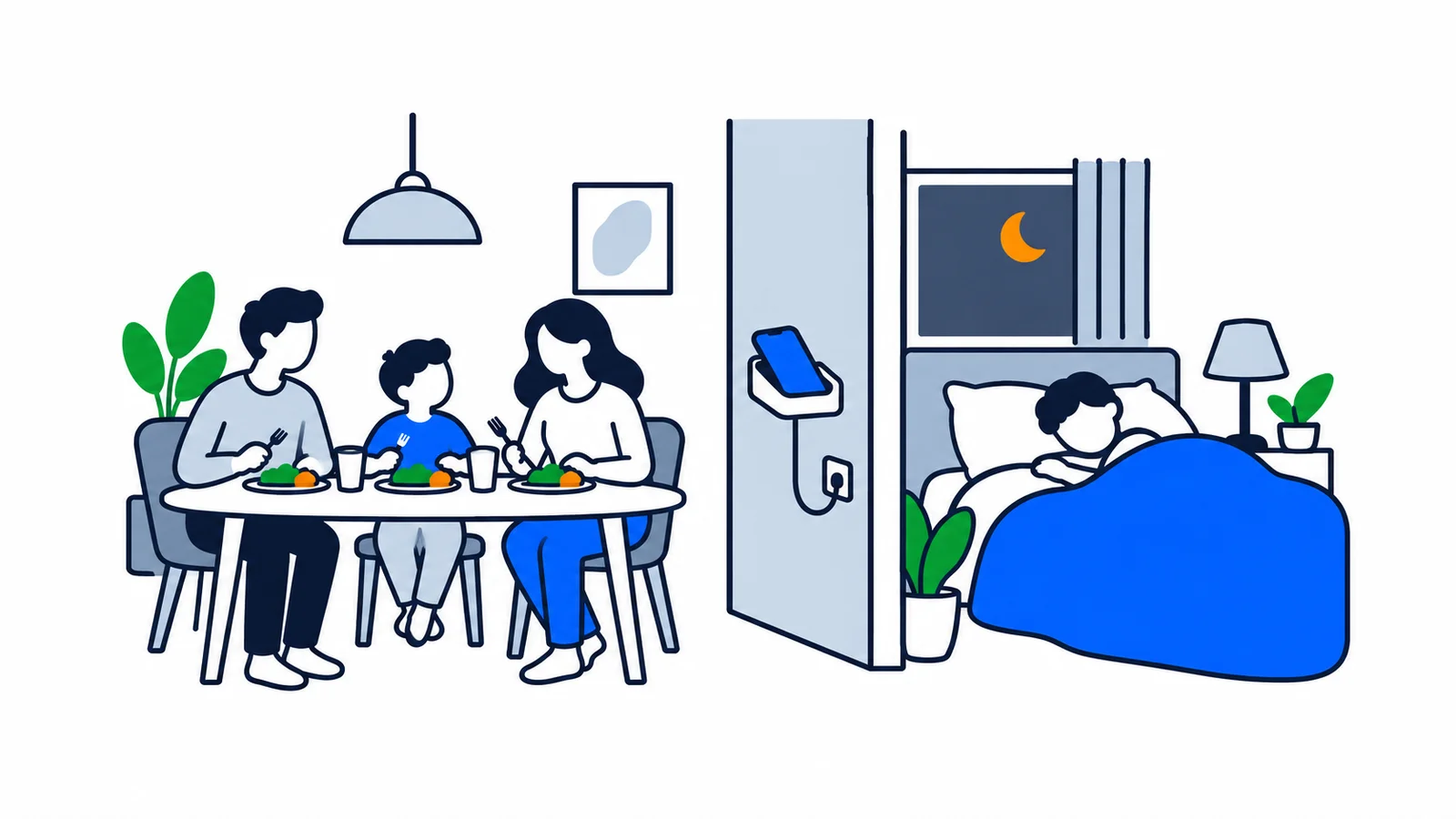
Avoid screens during meals and in the last hour before bedtime. These consistent boundaries are often easier for a child to understand than lots of small negotiations throughout the day.
What is the advice for children aged 6 to 12?
Children aged 6 to 12 should limit recreational screen time to 1–1,5 hours a day, preferably less. A six-year-old may be closer to the lower end of the range, while a twelve-year-old may be closer to 1,5 hours.
Time limits alone are not enough. Adults should also pay attention to:
- which games, videos and services the child uses
- whether the content is suitable for the child’s age
- whether the child encounters advertising or strangers
- whether screens take time away from sleep, play, friends and physical activity
- whether the child becomes angry, restless or sad after using screens
Helsedirektoratet recommends limited internet access, supervision and parental controls. Children in this age group should avoid social media and follow age restrictions.
Digital literacy for children and adults explains how families can assess sources, privacy and online safety.
What is the advice for young people aged 13 to 18?
Young people aged 13 to 18 should limit recreational screen time to 1,5–3 hours a day, preferably less. The aim is balance, rather than parents counting every minute without talking to their teenager.
Gaming, videos, messaging and social media can offer different benefits. Talking to friends is different from passively scrolling through short videos. At the same time, any of these activities can disrupt sleep if the phone is used late at night.
Agree on the rules together with your teenager. Discuss when to put the phone away, where to charge it overnight and which notifications to turn off. The last hour before bedtime should be screen-free, and the phone should not be kept beside the bed.
If screen use is associated with severe anxiety, sleep problems or sadness, young people can contact a public health nurse, their GP or mental health support services.
Does schoolwork count as screen time?
The time limits in the guidance apply to recreational screen use. Digital textbooks, homework and lessons serve a different purpose, but the body still needs breaks.
A child may have spent many hours using screens at school. In that case, the family can choose less recreational screen time that evening. Consider the overall demands on the child, sleep and physical activity, rather than just a single screen time counter on a phone.
Children also need screens for language learning, contact with family in other countries and assistive technology tailored to their needs. Apply the guidance flexibly when screen use meets an important need.
How to make a simple family screen time agreement
A short agreement with set times often works better than rules that change every day. The child should have a say in what matters to them, while the adult is responsible for setting safe boundaries.
The agreement can cover five points:
- Decide how much recreational screen time is appropriate for the child’s age.
- Agree on when screens can be used after school or kindergarten.
- Keep mealtimes and the last hour before sleep screen-free.
- Charge phones outside the bedroom.
- Talk together about content, games and the people the child encounters.
Adults must follow the same basic rules when the family is together. It is difficult to ask a child to put their phone away if the adults are always looking at their own.
When should parents seek help?
Seek help when screen use persistently affects sleep, school, health, friendships or family life. Start with a calm conversation and ask what your child gets out of using screens.
The school can help with online conflicts and bullying at school. A public health nurse or GP can assess sleep, mental health and other needs. Adults must act quickly in cases of serious threats or the sharing of illegal content.
SamfunnPrep writes about rules and guidance that families encounter in Norway. Use SamfunnPrep for free to practise topics covering school, health, children and life in society.