
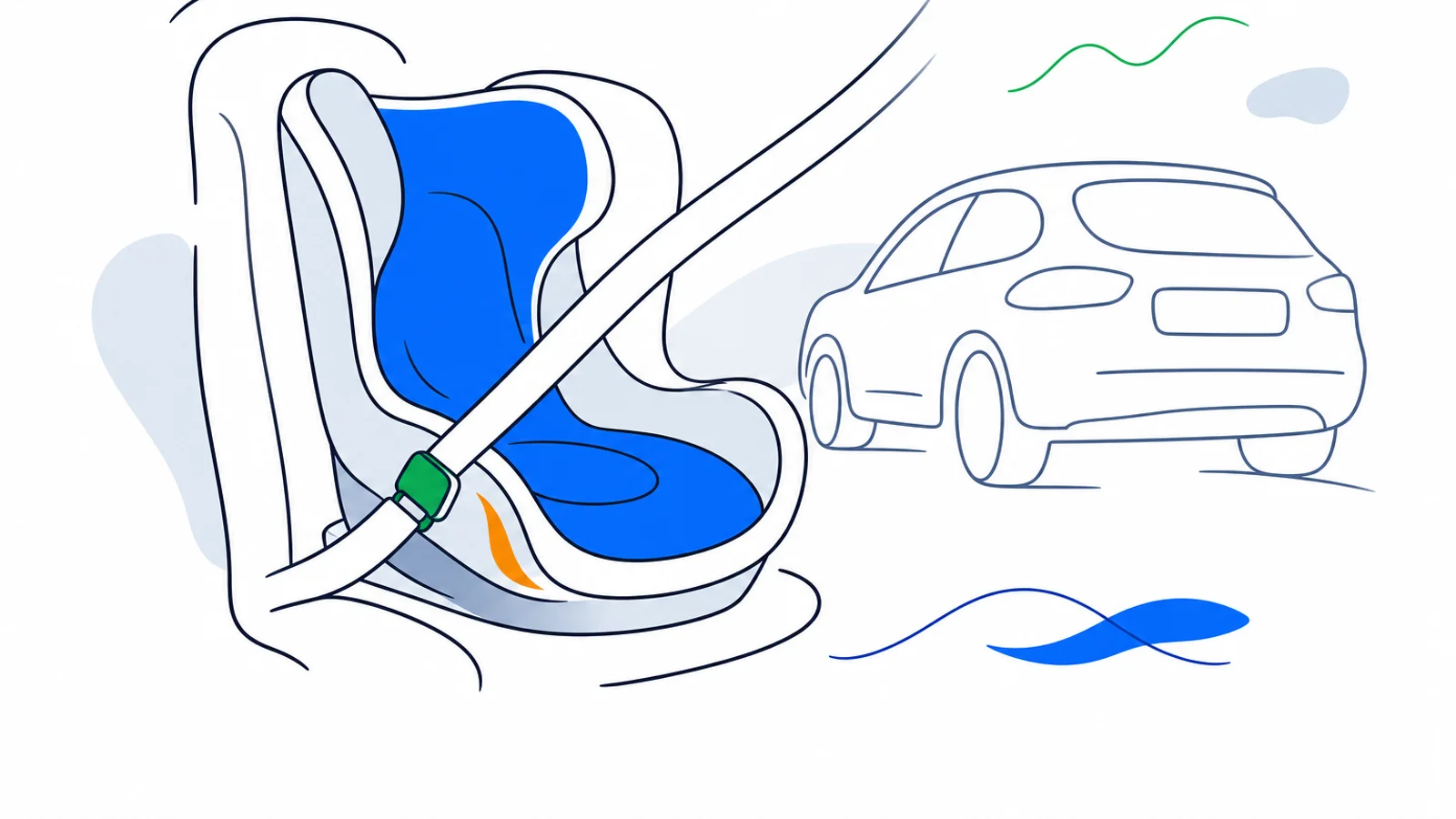

Child car seat safety is more strictly regulated in Norway than in many other countries. Children under 150 cm in height must use approved safety equipment. If you drive with an unsecured child under 15 years of age, the fine is 3,600 kroner as of 26 July 2026.
Child car seat safety: what does the law say?
The main rule is in the Regulation on the Use of Personal Protective Equipment while Driving a Motor Vehicle, Section 1. Where a seatbelt is installed, children under 150 cm in height must use approved safety equipment that is appropriate for the child. Police check this during routine traffic controls, just like other traffic rules in Norway.
Many websites state 135 cm as the limit. This is an oversimplification. The law has two limits:
- Under 135 cm: the child must always use approved safety equipment. There is no exception.
- 135–150 cm: the child may use a standard seatbelt, but only if approved equipment is not available in the vehicle.
If the vehicle has no seatbelts, children under 3 years old must not be transported at all. Children who are 3 years or older, but under 150 cm in height, must not sit in the front row of seats.
Approved equipment is marked ECE R44.03, ECE R44.04, or ECE R129 (i-Size). Trygg Trafikk states that equipment after R44 is no longer sold new after 2024, but seats you already have are still permitted to use.
What equipment does the child need at each stage?
The equipment is based on the child's height and weight, not their age. Measure the child before you buy or borrow.
| Child's Size | Equipment | Key Rule |
|---|---|---|
| 0–15 months | Rear-facing infant seat | Rear-facing is required under R129 |
| Approx. 1–4 years | Rear-facing booster seat | Recommended as long as the seat fits |
| Approx. 4 years to 135 cm | Booster seat with backrest | Approved equipment is always required |
| 135–150 cm | Booster seat or seat cushion | Standard seatbelt only if equipment is unavailable |
| Over 150 cm | Standard seatbelt | No requirement for child safety equipment |
How long should the child sit rear-facing?
Under ECE R129, the child should sit rear-facing until at least 15 months of age. The Norwegian Public Roads Administration (Statens vegvesen) and Trygg Trafikk recommend rear-facing for much longer than this.
Trygg Trafikk states that rear-facing safety reduces injury by 90–95 per cent compared to an unsecured child. Small children have heavy heads and weak necks. A rear-facing seat distributes the force across the entire back instead of the neck.
Most children switch to a booster seat between 5–7 years of age.
When is a child seat in the front seat forbidden?
It is forbidden to place a rear-facing child seat in a front seat where the airbag is active. The airbag must be turned off manually or automatically first.
The Norwegian Public Roads Administration also recommends that children under 140 cm in height do not sit in the front when the airbag is on. The back seat is safest.
The switch for the passenger airbag is described in the vehicle's instruction manual. If you are borrowing or renting a car, check this before installing the seat.
Must children be secured in a taxi?
Yes. Norway has no exception for taxis. A taxi is a passenger car in category M1, and exactly the same rules apply as in your own vehicle.
This surprises many. The EU directive behind the rules allows countries to exempt taxis, but Norway has not used that option. The claim that child seats can be skipped on short trips is not stated anywhere in the regulation.
Order a child seat when you book the taxi, or bring your own. If the taxi lacks approved equipment, only children over 135 cm can legally use a standard seatbelt.
What applies on buses?
The answer is different here. City buses are exempt from the special bus rules. The regulation exempts buses in category M3 class I, that is, standard city buses, from the requirements for child safety equipment. However, the main rule still applies: if a seatbelt is installed in the seat, it must be used.
For coaches, express buses, and other buses, the following applies:
- Children under 3 years of age must use approved safety equipment. If such equipment is not available, a standard seatbelt must be used appropriately.
- Children 3 years and older must use a standard seatbelt appropriately.
Note the difference: on a bus, there is a legal solution when equipment is missing. In a car and taxi, there is no such solution for children under 135 cm. Tickets and child prices are covered in the guide on public transport in Norway.
What does it cost if the child is not secured?
The fine is 3,600 kroner. The amount is set out in the Regulation on Simplified Notices of Prosecution in Traffic Cases, Section 1, Article 13, and was changed effective 15 February 2026.
In addition, two penalty points are recorded on your driving licence. If you have a probationary driving licence, which you have for the first two years, the number doubles to four penalty points. Eight penalty points within three years results in loss of driving privileges for six months.
For a new driver, this means that two such violations are enough to lose the driving licence. The system is explained in the article on penalty points on your driving licence.
The rules for child car seat safety apply regardless of whether you own the vehicle, borrow it from a friend, or rent it.
The driver is responsible. Section 3 of the regulation states that the driver of a motor vehicle is responsible for passengers under 15 years of age using required protective equipment. If you lend out the vehicle, it is the person driving who receives the fine — not the parents in the back seat.
Passengers who are 15 years of age or older receive a fine themselves if they do not use a seatbelt.
Where can you get an affordable child seat?
Approved equipment costs money, and a family may need several seats at the same time. There are legal ways to reduce the cost:
- BUA loans out equipment for free to everyone, without income restrictions. Several BUA lending libraries have car seats in their catalogue. You can find the nearest lending library at bua.no.
- Health clinics in your municipality are free for children 0–5 years and know about local lending and support schemes.
- If you buy used, always ask if the seat has been in a crash. A seat that has been in an accident should not be used again. Check that the mark R44.03 or R129 is on the seat.
Damage to the vehicle and child seat after an accident can be covered by insurance. What applies is set out in the overview of car insurance in Norway.
The most common mistakes
Trygg Trafikk reported on 14 July 2026 that only 25 per cent of parents with children between 3 and 12 years always ensure that an adult secures the child. The survey was conducted by Norsk Gallup/Fifty5blue among 980 parents with children between 3 and 12 years, between 15 May and 1 June 2026.
The most common mistakes are loose, twisted, or misplaced straps. Check these every trip:
- The strap should lie snugly against the body.
- The strap should not be twisted.
- The shoulder strap should lie over the shoulder, not under the arm or behind the back.
- The hip strap should lie low over the hips, not over the stomach.
- The seat should be installed as the instruction manual describes.
SamfunnPrep collects such practical everyday rules in the toolkit.
Many of these rules are part of the curriculum for the social studies test — practise for free on SamfunnPrep.