
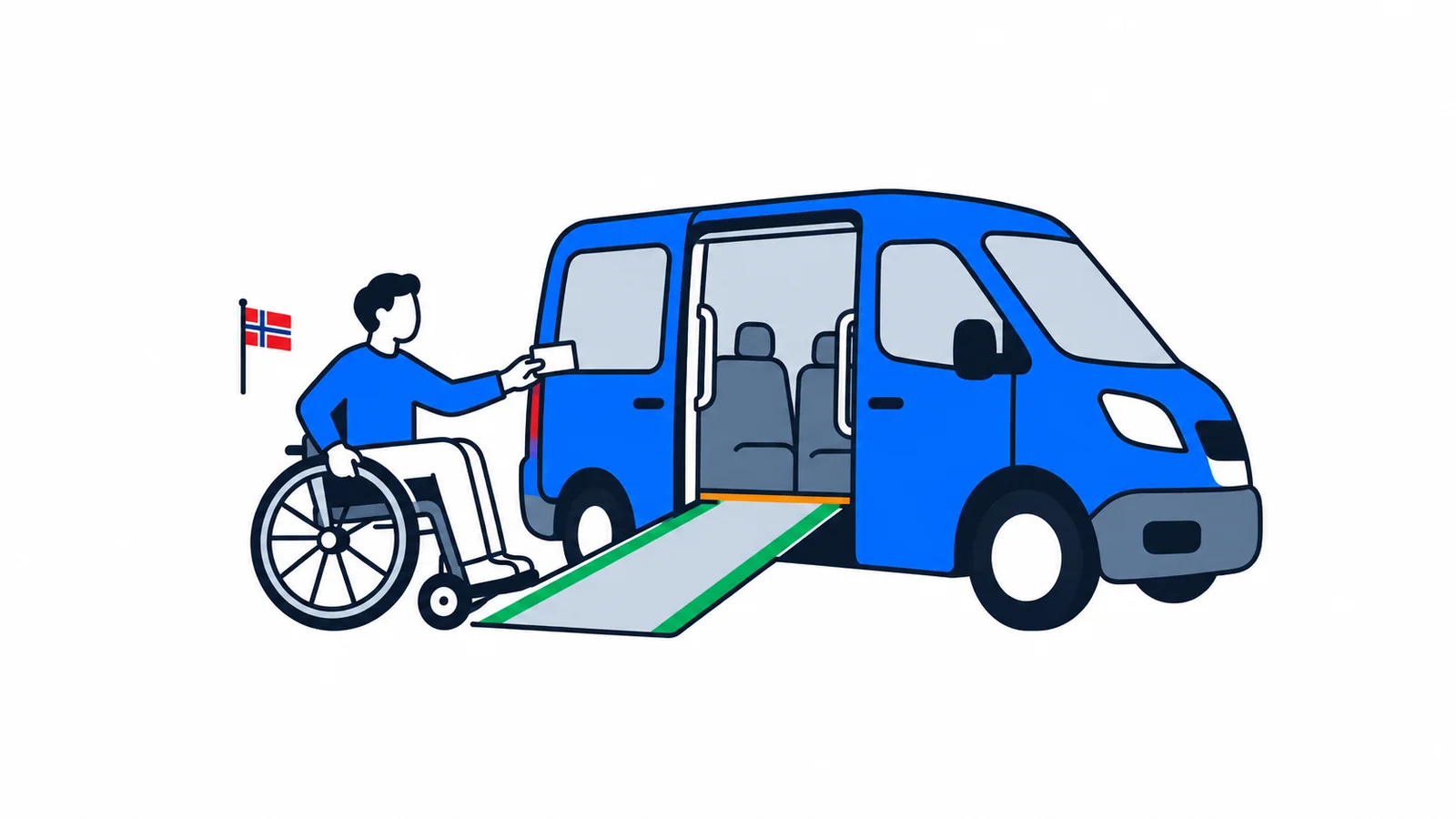

A TT card may help with transport when a disability or illness prevents you from using ordinary public transport. Apply under the rules where you live. Conditions, your contribution and permitted use vary, and a diagnosis does not automatically entitle you to a card.
What is a TT card, and who can apply?
TT means tilrettelagt transport, adapted transport. The scheme provides alternative transport for people who cannot use ordinary public transport because of a disability or illness.
There is no statutory individual entitlement to TT for everyone. The overview from Samferdselsdepartementet, the Ministry of Transport explains that rules are made locally. The TT-card guidance from Helsenorge, the public health portal describes the national framework. The rules and examples here were checked on 7 October 2026.
In Trøndelag, the conditions include a disability that is lifelong or lasts longer than two years. You must be registered in the population register and living there. The disability must make public transport impossible or substantially difficult to use. These are Trøndelag's rules, rather than a complete national checklist.
Trøndelags TT-forskrift §§ 3–4, Trøndelag's TT regulations, also state that poor transport services alone are insufficient. Certain groups, including children under ten and people who can drive their own car, may be assessed individually. They must have a specific unmet need for leisure journeys and otherwise meet the criteria.
Where do you apply for a TT card?
Start on the website of the county authority where you live. It shows who receives the application and which forms to use.
These two examples show why you need local information:
| Place | Who processes the application? | What must you send? |
|---|---|---|
| Oslo | Your borough in Oslo kommune, Oslo's municipality. | A signed application and medical certificate, plus any additional attachments. |
| Trøndelag | Trøndelag fylkeskommune, the county authority. | Your application and a separate statement submitted by your doctor. |
Use the application guidance from Oslo kommune or Trøndelag fylkeskommune's TT page if you live there. A form from another municipality may have unsuitable questions and the wrong recipient.
SamfunnPrep also has a guide to ledsagerbevis, companion cards. This is a separate scheme with its own application, although you may need both.
What should the application and medical certificate explain?
Describe how the disability prevents specific journeys. A clear connection between your health and transport problems matters more than the diagnosis name alone.
Trøndelag's guidance for doctors asks for precise information about this connection. Before your appointment, you can write down:
- What happens when you try to reach the stop.
- What is difficult about boarding, sitting in or leaving the vehicle.
- What assistance or adapted vehicle you need.
- Which specific leisure journeys you cannot make.
These examples help you describe your needs; they are not separate conditions that automatically secure approval. The doctor documents your health; the authority processes the application.
In Trøndelag, the doctor must use the new digital form. Old paper medical certificates are not accepted. This differs from the applicant's paper form, which can still be used.
How do you send a complete application?
Follow the local guidance for both your application and the doctor's evidence. Check that both have been sent to the correct recipient.
In Trøndelag, the application is not processed until the medical certificate has arrived. The doctor's guidance says the doctor submits the statement first, and you apply afterwards. If you do not have BankID, electronic identification, you can use a paper form for your own application. You can apply throughout the year.
Oslo may require additional attachments, such as information from an eye specialist for a visual impairment. Regular scheduled journeys also require evidence of the activity. Read the requirements for your application; do not send only an old decision from another scheme.
Save a copy of the application and the date you sent it. Note whom to contact if attachments are missing. Ask the recipient to explain the correct procedure if you need help with the form.
Can TT be used for medical appointments, work and leisure?
TT is separate from patient travel and other transport schemes. Check the purpose of your journey before using the card.
| Scheme | What does it cover? |
|---|---|
| TT | Adapted transport under local conditions and allocations. |
| Pasientreiser, patient travel | Support or organised transport to and from treatment covered by the scheme. |
| Ledsagerbevis, companion card | A free or reduced-price ticket for the person helping you, where the card is accepted. |
Pasientreiser is the service that organises patient transport. The treating healthcare professional assesses health-related needs for organised travel. Pasientreiser assesses needs caused by a lack of public transport. A TT card does not replace this assessment.
Trøndelag's TT scheme is intended for leisure journeys. You must not use it for journeys covered by other public transport schemes, such as journeys to work, school transport or patient transport. Oslo also offers certain regular scheduled journeys. Follow your local decision.
A Ledsagerbevis (companion card) does not automatically give you a TT card. A parking permit for people with mobility difficulties concerns parking and has its own requirements too.
What do journeys cost, and how do you check your balance?
You must check both your contribution and how much of your allocation remains. Some schemes use a number of journeys; others use an amount of money that is spent.
Oslo example for 2026: The ordinary allocation is 150 one-way journeys. If you apply after 1 July, you receive half that year. Unused journeys do not carry over to the following year. For leisure journeys within Oslo, the contribution is 57 kroner for adults and 29 kroner for children under 18, according to the municipality's prices and allocations page.
Trøndelag example: The card has an allocated amount. Under § 7 of the regulations, it is topped up on 1 January and 1 July. The balance from the previous six-month period is removed. The amount and your contribution are set through local budget decisions; use the current overview before travelling.
Check the balance through the local service or ask the driver to check it. Do not plan a long journey without establishing whether your allocation covers the cost.
How do you book and cancel?
Use the booking method for your scheme and vehicle type. Explain any need for a wheelchair-accessible vehicle and assistance when booking.
Ruter, the public transport company for Oslo and Akershus, has separate guidance for TT in Oslo. Leisure journeys by ordinary taxi can be booked directly with a suitable taxi company. Special vehicles and regular scheduled journeys have their own booking methods.
In Oslo, you must cancel journeys at least one hour beforehand. Late cancellation may mean you have to pay for the whole journey. You can view and cancel journeys in the «Min TT» service. Be ready for collection and show identification if the driver asks.
Trøndelag's card can be used elsewhere in Norway when the transport provider can read the card. Contact the taxi company beforehand and check that it accepts the card. This does not mean all Norwegian TT cards cover the same travel area.
When must you renew the card or report changes?
Check the end date in the decision and find out how to reapply. Approval in one county does not automatically transfer when you move.
In Trøndelag, the right to travel can be granted for up to four years. You must report changes affecting your need. If you move out of the county, you lose the right to travel there and must apply in the new county. In Oslo, most people receive approval for two years; the period may be longer for a permanent disability.
If you lose your card in Oslo, contact your borough for a replacement. If you move between boroughs, notify the new borough. Oslo kommune's information about lost cards explains this.
What do you do if your application is refused?
You must normally be given a written decision on your application. A refusal must give reasons, and you can appeal to the authority that decided your application. Read the appeal information in the letter.
Forvaltningsloven §§ 27–29, the Public Administration Act, governs appeal information and the time limit. This is normally three weeks from when you received notification of the decision. Explain which information you believe is incorrect and attach relevant evidence.
Under § 11 of the TT regulations, you can appeal a decision on the right to travel in Trøndelag, but not the allocated amount itself. A complaint about poor driving or a late vehicle should instead go to the transport service. In Oslo, Ruter directs decision enquiries to the borough and transport complaints to its own customer service centre.
Keep decisions, deadlines and contact details together. SamfunnPrep's tools overview provides more practical resources for everyday life in Norway.