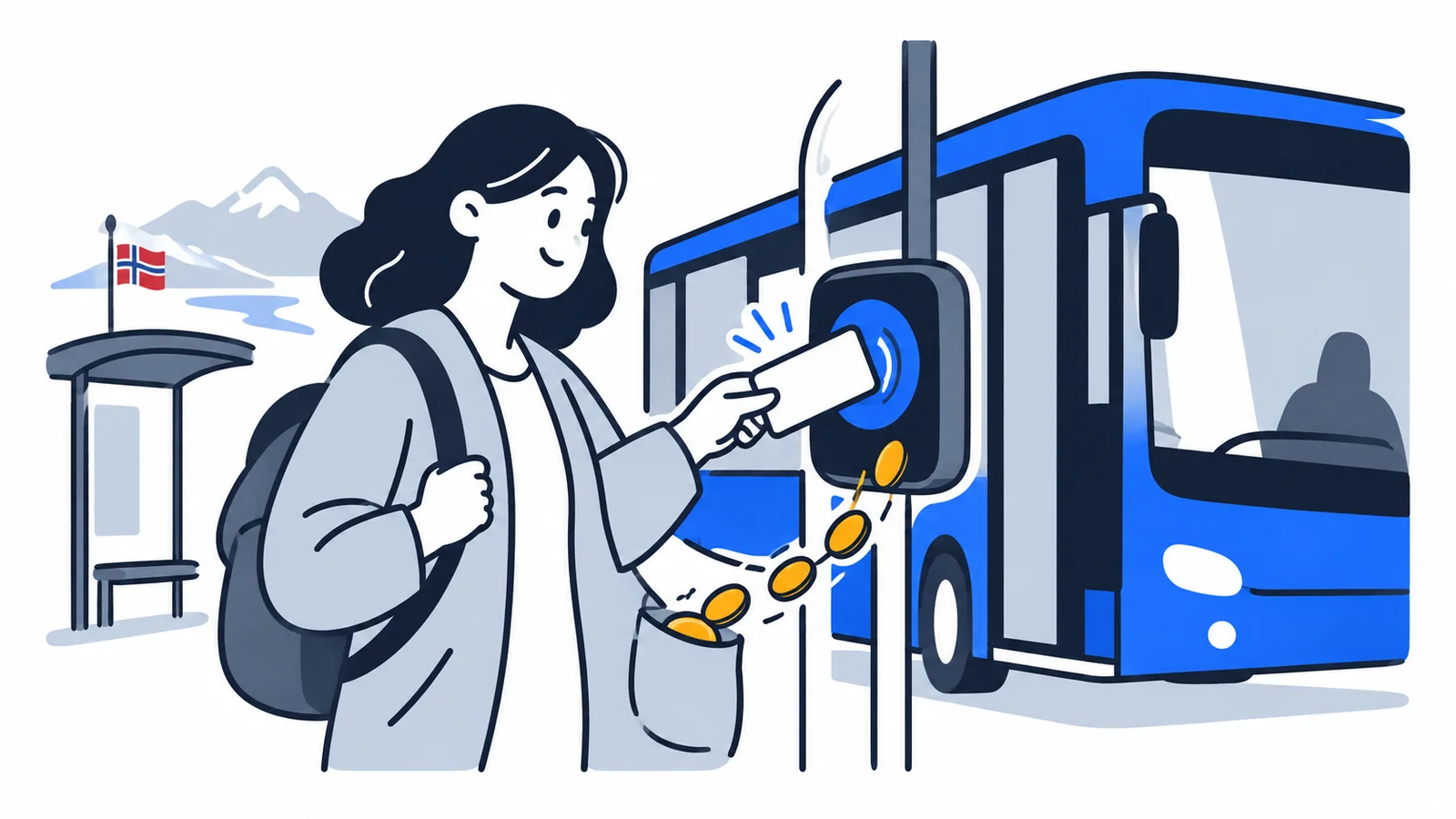
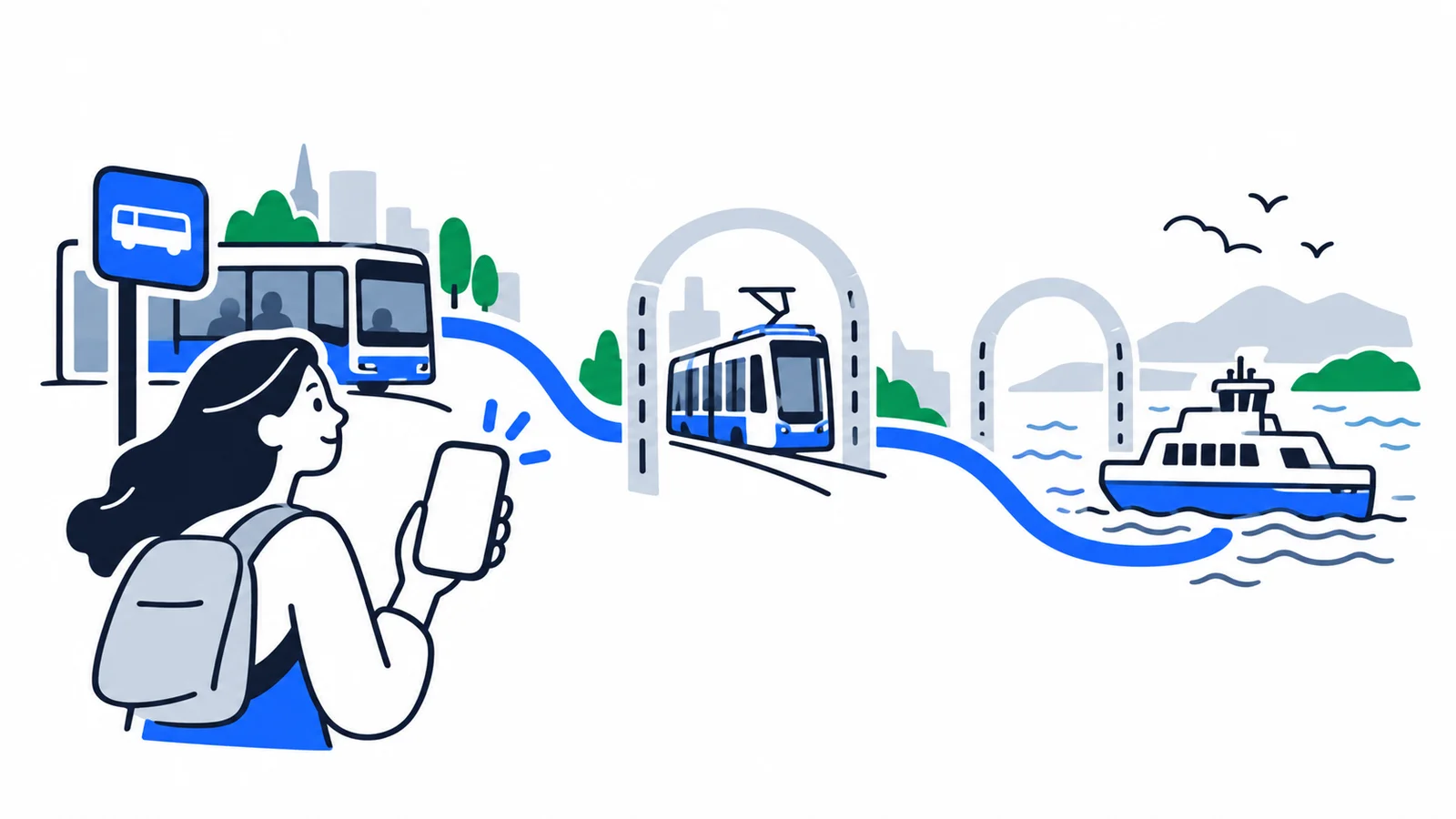

Norwegian collective transport is not a single national company — it is a regional system where each county has its own traffic company with its own prices, apps and zones. This guide shows you who operates where, how tickets work, how to save money with monthly passes and discounts, which laws regulate the industry, and special arrangements for mobility-impaired people and immigrants in 2026.
Legal basis for collective transport
Collective transport is regulated by several key laws:
- Road Transport Act (2002) — regulates buses, taxis and speedboats
- Railway Act (1993) — regulates railway transport
- Road Traffic Act (1965) — traffic rules in general
- Municipal Act — county responsibility for collective transport
The county municipality has a legal responsibility for local collective transport — it determines routes, fares, schemes and financing. The state (Ministry of Transport) regulates railways and long-distance traffic.
Regional operators: Ruter, Skyss, AtB — who applies where?
There is no national Ruter app. Use the company that operates where you travel:
| Company | County / region | Traffic |
|---|---|---|
| Ruter | Oslo and Akershus | Subway, tram, bus, ferry |
| Skyss | Vestland (Bergen) | Light rail, bus, speedboat |
| AtB | Trøndelag (Trondheim) | Tram, bus, speedboat |
| Brakar | Buskerud (Drammen) | Bus |
| Kolumbus | Rogaland (Stavanger) | Bus, boat |
| VKT / Farte | Vestfold and Telemark | Bus |
| Agder Kollektivtrafikk | Agder (Kristiansand) | Bus |
| Troms fylkestrafikk | Troms (Tromsø) | Bus, speedboat |
| Nordland fylkeskommune | Nordland (Bodø) | Bus, ferry, speedboat |
| Vy | National | Train |
| Nor-way Bussekspress | National | Long-distance bus |
| Flixbus | National/international | Long-distance bus |
Ruter alone accounts for over half of all public transport trips in Norway. Skyss covers Bergen with the popular Light Rail (light rail with 3 lines). AtB has tram in Trondheim (Gråkallbanen). National train trips are Vy's responsibility — see vy.no.
Zone division: how you calculate the price
Most cities use zone-based ticketing. The price depends on how many zones you travel through.
Ruter (Oslo/Akershus) — 7 main zones
Zones 1 to 4V (and further to 4S etc.). Zone 1 covers Oslo city centre. To reach Lillestrøm you must buy a ticket through multiple zones.
Single ticket price 2026:
| Zone | Adult | Child (6–17) / student | Senior (67+) |
|---|---|---|---|
| 1 | 45 kr | 22 kr | 22 kr |
| 1 + 1 | 60 kr | 30 kr | 30 kr |
| Entire Ruter area | 130 kr | 65 kr | 65 kr |
A single ticket in one zone is valid for 90 minutes — you can transfer freely between tram, bus, subway and ferry within the zone.
Skyss (Bergen) and AtB (Trondheim) — 3–4 zones each
Skyss divides Vestland into 3 main zones. AtB has similar division. Single ticket adult 2026: approx. 42 kr at Skyss, approx. 45 kr at AtB.
Kolumbus (Stavanger) and others
Kolumbus has a flat rate in central Stavanger: approx. 42 kr. Other operators follow similar price levels.
Buy ticket on mobile: which apps are used?
All regional companies have their own apps:
- Ruter app — Oslo/Akershus
- Skyss Ticket app — Vestland
- AtB Travel app — Trøndelag
- Vy app — National train
- Kolumbus app — Rogaland
- Brakar app — Buskerud
- Entur app — national journey planner
You log in with phone number or email, add a bank card, Vipps or BankID. The ticket displays as a QR code or barcode and activates when you start your journey.
Travel card
Physical travel card you top up at machines or sales outlets. Useful if you don't have a smartphone yet or open bank account. Ruter's travel card is contactless and can be used immediately.
Cash and NFC
Most operators have removed cash payment on board. If you buy a ticket from the driver, there may be an on-board surcharge of 10–20 kr. Contactless bank cards (NFC) now work on Ruter subway and some buses.
Monthly pass and period tickets: is it worth it?
Ruter Oslo — prices 2026
| Ticket | 1 zone (adult) | 2 zones | All zones |
|---|---|---|---|
| 7-day | 280 kr | 400 kr | 700 kr |
| 30-day | 880 kr | 1 300 kr | 2 200 kr |
| 365-day | 8 800 kr | 13 000 kr | 22 000 kr |
Calculation: 20 working days × 2 trips × 45 kr = 1 800 kr per month with single tickets. Monthly pass at 880 kr saves over 900 kr. Annual pass is even more economical per day.
Skyss and AtB
Skyss monthly pass zone A: approx. 850 kr. AtB monthly pass Trondheim: approx. 850 kr. Check updated prices with the operator.
Discounts: student, senior, child and youth
| Group | Discount | Source |
|---|---|---|
| Child 0–5 years | Free | Automatic |
| Child 6–17 years | 50 % | ID/passport |
| Youth (Oslo, 6–19 years) | Youth card — heavily reduced | Automatic in Ruter app |
| Student under 30 | 50 % | Student card |
| Senior (67+) | 50 % | ID/passport |
| Military conscript | 50 % | Military card |
| Companion to mobility-impaired person | Free | Companion certificate |
Student discount requires a valid student card. Lånekassen students and exchange students qualify.
Ruter Youth card (6–19 years): approx. 300 kr for 30-day pass — the cheapest offer in Norway.
Companion certificate
Proof that you are entitled to a free companion due to mobility impairment or cognitive challenge. Issued by the municipality. See also disability benefits.
TT-transport: collective transport for mobility-impaired people
TT scheme (Transport Service for Disabled People) gives mobility-impaired people the right to door-to-door transport when regular public transport is not accessible:
- Registration: at the county's TT office
- Assessment: medical documentation required (medical certificate)
- User fee: approx. 50–100 kr per trip in 2026
- Number of trips: varies per county (often 50–200 per year)
- Booking: normally 1–2 days in advance, emergency service available
The scheme is financed by the county under the Road Transport Act.
Long-distance and long-range transport
Vy (train)
Vy operates the main railway network. Popular routes:
- Oslo–Bergen (Bergen Railway) — 7 hours
- Oslo–Trondheim (Dovre Railway) — 7 hours
- Oslo–Kristiansand–Stavanger (Southland Railway) — 7.5 hours
- Oslo–Åndalsnes (Rauma Railway) — 6 hours
- Bergen–Flåm (Flåm Railway) — tourist route
Prices: increased flexibility with Vy Express (save 50–70 % with advance purchase).
Nor-way Bussekspress and Flixbus
- Nor-way Bussekspress — Norwegian long-distance bus
- Flixbus — European budget bus with lines to Sweden, Denmark, Germany
Airport bus (FlyBussen)
Covers most Norwegian airports. Around 200–250 kr single trip to Oslo Airport Gardermoen.
Ferries and speedboats
- Fjord1, Torghatten — passenger ferries along the coast
- Speedboats — Rogaland, Vestland, Nordland
- Hurtigruten — combined cruise/transport Bergen–Kirkenes
What happens if you travel without a valid ticket?
Inspectors have authority under the Road Transport Act § 20 to demand ticket control. If you travel without a valid ticket, you are issued a control fee:
- Ruter Oslo: 1 200 kr, reduced to 900 kr if paid within 3 weeks
- Skyss Bergen: approx. 1 200 kr
- AtB Trondheim: approx. 1 200 kr
- Vy train: 1 200 kr (if paid on train: 300 kr surcharge)
The fee may be increased in case of repetition. Missing ID may result in police report — see report to police. The fee can be collected by a bailiff if not paid — see debt settlement and payment note.
Appeal a fee
You can appeal in writing within 3 weeks. If disagreement continues, the matter can be brought to Conciliation Board. See also rule of law and courts.
Timetables and planning
- Ruter app and Vy app have built-in journey planners
- Entur.no — national journey planner covering all operators
- Google Maps shows timetables and prices from most operators
- Rome2rio — for international connections
Rush hour in Oslo (07–09 and 15–18) has more frequent departures. Some routes run all night (Night bus / N-bus), with Saturday–Sunday especially frequent.
Strikes and cancellations
Check the operator's website or SMS alerts. In case of strike: alternative transport or refunds from period tickets may be provided.
Special offers for newcomers and low income
Ukrainian refugees
Ukrainians with collective protection (aliens § 34) have received free collective transport in many municipalities during the introductory period. Check with NAV and the municipality. See Norway and Ukraine.
Social assistance and low income
Some municipalities offer discount or free monthly pass for:
- Recipients of social assistance
- People in debt settlement
- Recipients of AAP or disability benefits
Ask NAV or the municipality's service office.
Introduction programme
Introduction programme participants normally have travel costs covered as part of the programme. See Norwegian level and residency.
Environment and climate policy
Ruter, Skyss and AtB aim for climate-neutral operations by 2028. Fossil-free buses and battery-electric operation are established in Oslo and Bergen. Tram and subway have always been electric.
Frequently asked questions
Can I use one card in multiple cities?
No, each operator has its own system. You must buy a ticket in the city where you travel.
Is it cheaper to travel on weekends?
Ruter has special weekend tickets — Oslo has a weekend pass. Otherwise the same price.
Can I get a refund for delays?
Yes — for delays over 60 minutes you can claim a refund or taxi compensation. File complaint with the operator.
Does a foreign bank card work?
Yes, in the apps and on NFC terminals. Cash is rarely accepted.
What if I lost my ticket?
Digital ticket is always in the app. Physical travel card can be blocked and replaced by contacting the operator.
Summary
Norwegian collective transport is administered by regional companies — Ruter in Oslo/Akershus, Skyss in Vestland, AtB in Trøndelag and others. Regulated by the Road Transport Act (2002) and county responsibility. Price depends on zones: a single ticket in Oslo zone 1 costs 45 kr in 2026 with 90 minutes transfer. Monthly pass at 880 kr saves approx. 900 kr per month. Students, seniors and children get 50 % discount; Ruter's Youth card costs only 300 kr for 30 days (6–19 years). TT scheme gives mobility-impaired people door-to-door transport with user fee 50–100 kr. Long-distance traffic: Vy train, Nor-way Bussekspress, Flixbus, Airport bus. Ferry and speedboat along the coast. Control fee for travel without ticket: 1 200 kr (900 with quick payment). Use the operator's app or Entur.no for planning. Ukrainians with collective protection and NAV recipients can get free or reduced transport. Climate goal: climate-neutral by 2028. Check updated prices with your local operator — they are normally adjusted each year in January.