
First Steps: Your Primary Care Physician and Open Conversation
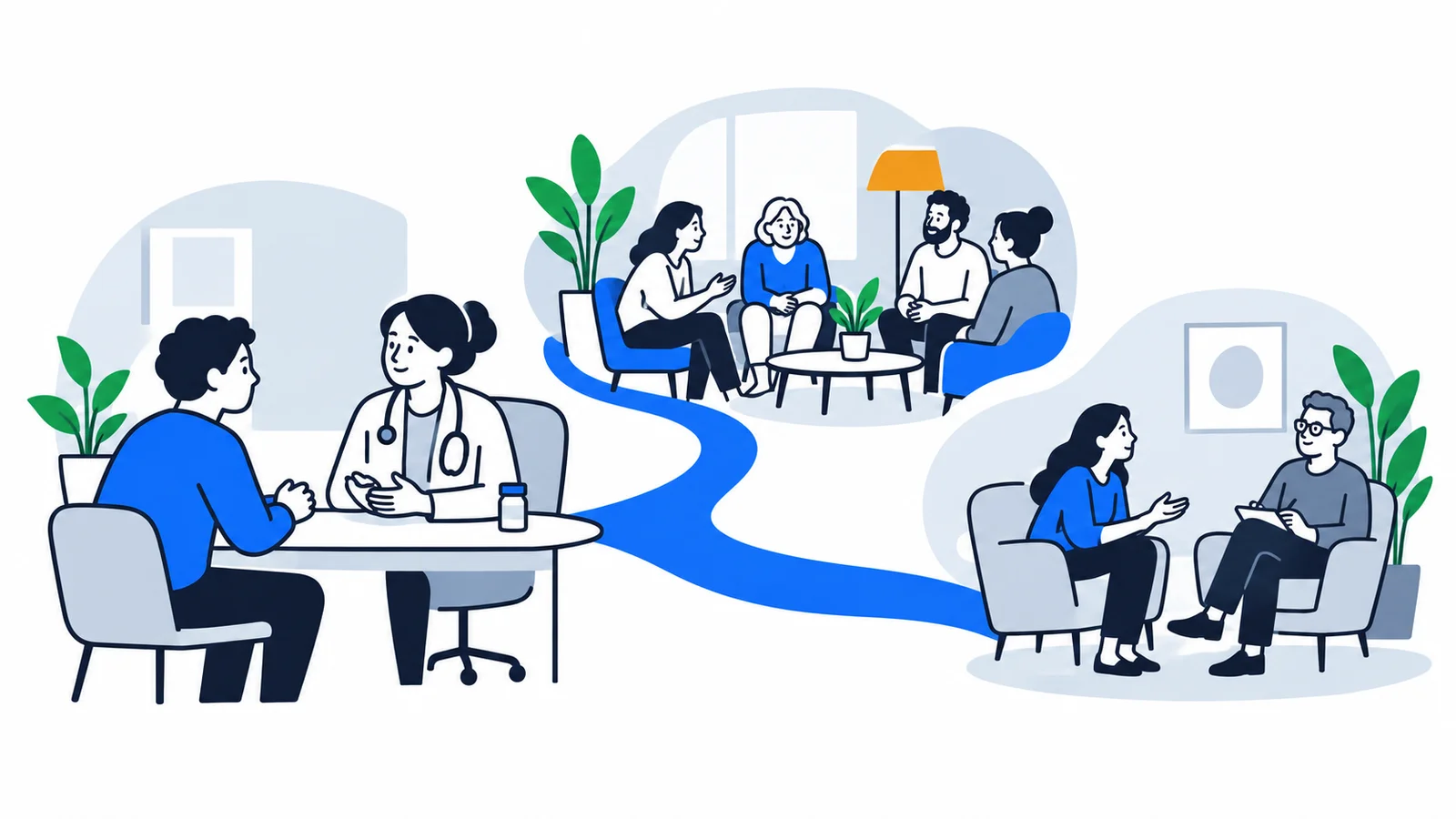
Your primary care physician is often the best first place to turn when you or someone you know is struggling with substance use. An open conversation with your doctor is confidential: physicians have legal duty of confidentiality and cannot share information with family, employers, or immigration authorities without your consent.
What to tell your primary care physician: It is enough to say that you are concerned about your own use of alcohol, medication, or drugs, or that you have lost control. You do not need to know medical terminology. Your doctor will use screening tools such as AUDIT (Alcohol Use Disorders Identification Test) for alcohol and DUDIT for drugs to assess the severity.
Your primary care physician can:
- Provide advice and short-term treatment for mild to moderate problems
- Prescribe medication if needed (for example, Antabuse for alcohol)
- Refer you to specialized multiprofessional substance use treatment services (TSB)
- Work together with NAV and municipal services
Patient rights apply to everyone: The right to assessment and treatment does not depend on nationality, residence status, or social background. Everyone legally living in Norway and registered in the National Registry has the right to necessary health care.
Are you afraid of being judged? Remember that your doctor's confidentiality is protected by law (Health Personnel Act § 21). There are exceptions only in case of acute danger to others' lives. Your medical records are secure.
Municipal Low-Threshold Services
Municipalities offer a range of low-threshold services that do not require a referral and can sometimes be used anonymously:
Meeting places and drop-in centres are open meeting spaces where you can come without an appointment. Many places offer food, social fellowship, conversations with staff, and referrals to further services. Examples: Blue Cross centres, Church City Mission, Salvation Army services.
Youth health stations (up to 24 years old) offer free and anonymous advice on substance use, mental health, and sexuality. No appointment necessary at most municipalities.
ROP clinics (Substance Use and Mental Health Problems) are municipal or inter-municipal services for people with both substance use problems and mental health disorders. These have specialized expertise in dual diagnoses.
Municipal substance use clinics exist in many municipalities and offer conversations, assessment, and short-term treatment. Some accept patients without a referral.
What do these services offer?
- Assessment conversations
- Motivation work and brief counselling
- Help applying for further treatment
- Practical assistance (finances, housing, work)
- Contact with NAV
Find services in your municipality on helsenorge.no or call your municipality's service centre.
Specialized Multiprofessional Substance Use Treatment Services (TSB)
TSB is the specialist health service's offer to people with serious substance use problems. It is run by health trusts (hospitals) and by private institutions with public contracts.
Your rights in TSB:
- Right to assessment within 30 working days after your referral is received
- After assessment, an individual treatment deadline is set based on medical need
- If the deadline is not met: right to treatment elsewhere, paid for by the health trust
- Right to choose treatment location among all approved TSB institutions in Norway
How you access it:
- Your primary care physician or another doctor writes a referral
- You can also apply directly to some TSB institutions (check with your region)
- The intake team assesses your application and sets a deadline
Types of treatment in TSB:
- Outpatient treatment: Weekly conversations, no hospitalization
- Day treatment: Intensive programmes several days per week
- Inpatient treatment (hospitalization): From several weeks to over a year
- Detoxification: Medically supervised withdrawal
Waiting times vary between regions and institutions. Check waiting times on velgsykehus.no to find the fastest available treatment.
Medication-Assisted Treatment (LAR)
LAR is a treatment programme for people with severe opioid dependence (heroin, morphine, oxycodone, etc.). It is part of TSB and offered at specialized LAR centres in all health regions.
Medicines used in LAR:
- Methadone (liquid, daily dispensing)
- Buprenorphine (Suboxone, Subutex) – sublingual
- Buprenorphine-naltrexone is most common and reduces abuse potential
Criteria for entering LAR:
- Documented opioid dependence (ICD-10 diagnosis F11.2)
- Previous treatment attempts without sufficient effect
- Age usually 18+ (exceptions exist)
- Medical and psychosocial assessment
Why LAR works: Research shows that LAR reduces overdose death by up to 50%, reduces crime, and improves quality of life. Treatment is not 'just swapping one drug for another' – it stabilizes neurochemistry so that daily life functions.
Stigma: Many patients experience prejudice, even from health professionals. You have the right to respectful treatment regardless of diagnosis.
Application: Via primary care physician referral to TSB, which assesses LAR suitability. You can specifically ask about LAR.
Family Members: Your Right to Help and Information
Family members are often those who bear the heaviest burden when a loved one struggles with substance use. You have independent rights to help, regardless of what the person with substance use chooses.
Your rights as a family member:
- Right to information about available help services (not about the patient's medical records without consent)
- Right to family conversations and family therapy
- Right to individual guidance from municipal services
Services for family members:
- Family School: Free courses on substance use and mental health, arranged by Adults for Children and local organizations. Provides knowledge and community with other family members.
- SIFA (Centre for Substance Use and Addiction Research) and KoRus offer expert-updated information
- Young Family Members: Support for children and young people growing up with substance use in the family. Many municipalities have separate youth programmes.
- Al-Anon / Nar-Anon: Self-help groups for family members of people with alcohol and drug dependence
What do you do if your family member refuses help?
- You can contact the help system on your own behalf
- In case of acute danger: call 113 or on-call doctor 116 117
- Compulsory admission (§ 10-2 and § 10-3 of the Health and Care Services Act) is possible in serious cases, but is a last resort
- Contact the Patient and User Ombudsman for guidance
Anonymity and Privacy in Substance Use Treatment
Many are concerned that what they tell in treatment will spread. Here is what you need to know:
What is anonymous? Municipal low-threshold services (meeting places, drop-in centres) can be used without giving your name. No medical records are kept.
What is recorded in medical records? At your primary care physician and in TSB, records are kept according to the medical records regulations. Records may contain diagnoses, medicines, conversation notes, and discharge summaries.
Who can see your records? Only treating health personnel involved in your treatment. You can ask to see your entire medical record (Patient Records Act § 5). You can reserve against certain information being shared further.
Special rules for substance use treatment: Substance use-related diagnoses are subject to the same legal duty of confidentiality as other health information. They cannot in principle be shared with police, employers, or immigration authorities without your consent.
Digital records: You can read your own medical record on helsenorge.no. Log in with BankID or MinID.
Immigrants and Substance Use Treatment: Cultural Barriers and Solutions
Immigrants seek help for substance use problems at much lower rates than the rest of the population. This is often due to shame, fear, and cultural expectations – not lack of need.
Common concerns – and the answers:
'What happens to my residence permit?' Substance use treatment does NOT affect your residence permit or application for citizenship. Health information is not shared with the Immigration Authority (UDI) without your consent.
'What if someone in my community finds out?' Confidentiality protects you. No one in your family, your religious community, or your national network will know anything unless you tell them yourself.
'Do they understand my culture?' Many health trusts and municipalities have staff with multicultural competence. You have the right to an interpreter at all health contacts – the interpreter is also bound by confidentiality.
Organizations with experience with immigrants:
- Church City Mission in many places has multicultural focus
- Red Cross has volunteers in many languages
- SERAF (Centre for Substance Use and Addiction Research) publishes research on immigrants and substance use
- Local immigrant organizations can provide support and contacts
Practical advice: Ask for an interpreter when you book an appointment. It is free and your right. The interpreter cannot be a family member for sensitive health communication.
Help Services and Contacts
Working life:
- AKAN (Working Life Competence Centre for Substance Use and Addiction Problems): Directed at employees and employers. Helps with managing substance use problems at work without losing your job. akan.no
User organizations and self-help:
- RIO (Organization for Drug Users' Interests): User-led organization working for the rights of people with substance use. rio.no
- AA (Alcoholics Anonymous): 12-step programme, meetings throughout Norway. aa.no
- NA (Narcotics Anonymous): Similar for people with drug addiction. nanonorge.org
- Blue Cross: Treatment, support, and low-threshold services. blakors.no
Crisis lines and emergency support:
- Substance Use Telephone: 08588 (weekdays 09–21, weekends 12–20) – free and anonymous
- Mental Health Help Telephone: 116 123 (24 hours)
- On-call doctor: 116 117
- Ambulance/emergency: 113
Religious and humanitarian organizations:
- Church City Mission: Meeting places, treatment, accommodation services. bymisjon.no
- Salvation Army: Substance use treatment and housing. frelsesarmeen.no
Online support:
- Snakkomrus.no – information and chat
- Helsenorge.no – find services in your region
Substance Use and Finances: Social Security Rights
Substance use problems can affect work capacity, but you do not lose your social security rights even if the cause is substance use-related.
Sick leave during treatment: If a doctor signs you off sick in connection with substance use treatment, you have the right to sick pay under normal conditions (employer period 16 days, then NAV). The diagnosis on the sick note does not have to be 'substance use dependence' – the doctor can use a more neutral code.
Work Assessment Allowance (AAP): If substance use problems mean you cannot work over time, you may be entitled to AAP. NAV cooperates with TSB on individual plans (IP) that coordinate treatment and work measures.
Disability Benefit: In serious cases where the substance use disorder is chronic and permanently reduces work capacity, disability benefit can be granted.
Individual Plan (IP): You have the right to an IP if you need long-term and coordinated services. IP coordinates health, NAV, and housing. Demand this if you have not received it.
Housing: NAV can assist with temporary housing and applications for municipal housing. People with substance use problems are a priority group in many municipalities' housing schemes.
Remember: Seeking help is a strength, not a weakness. Treatment works – and you have the right to it.