
What is care allowance?
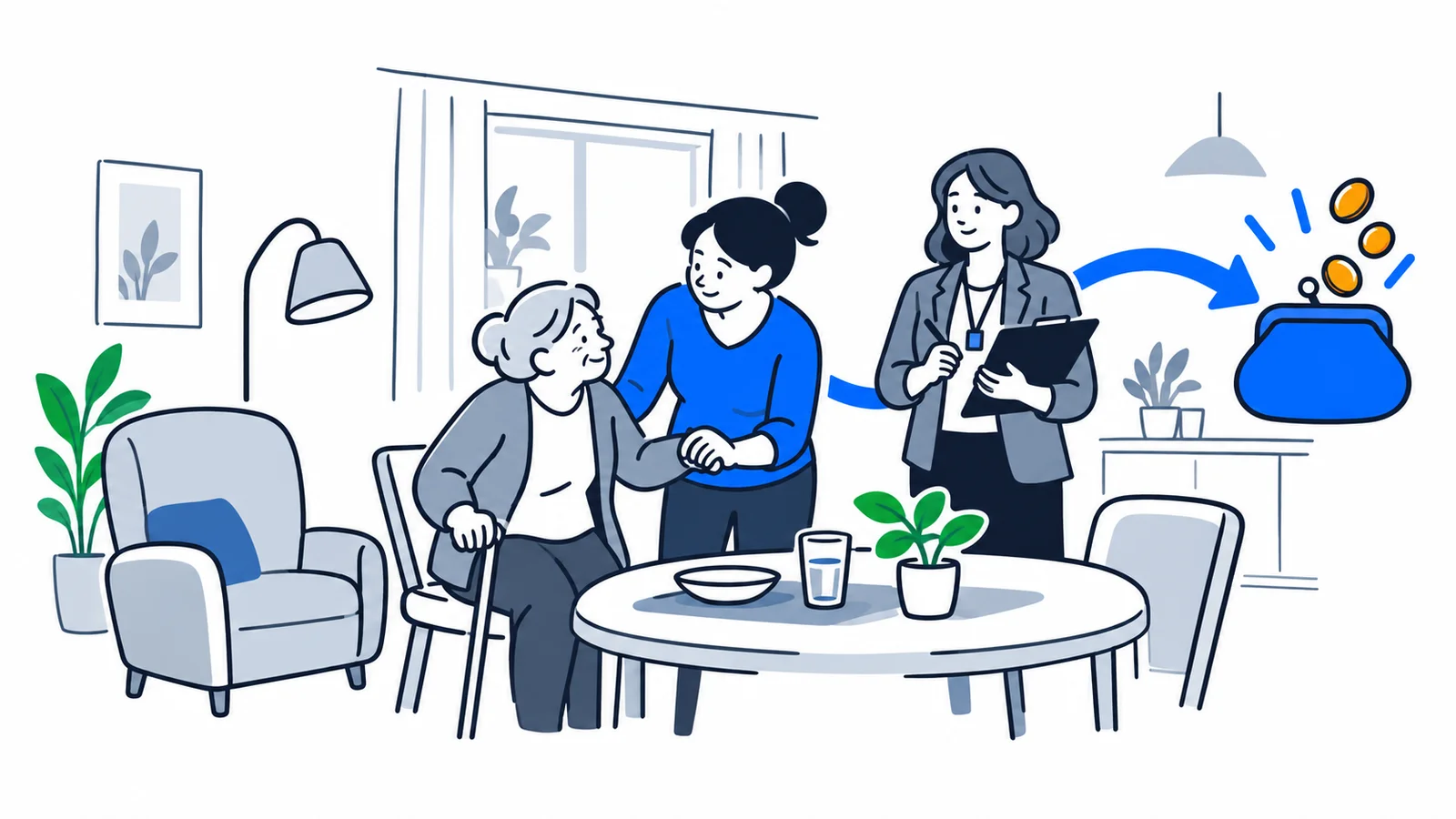
Care allowance is a payment from the municipality to private individuals who perform significant care work for a sick, disabled or elderly person. The care work must be work that the municipality would otherwise have to perform itself – through home help, home nursing or institutional care.
Care allowance is not a right – the municipality makes a discretionary assessment, and it is the municipality that decides whether you get it and how much you get. The amount varies from municipality to municipality.
Who can get care allowance?
As a rule, it is family members who apply for care allowance:
- Spouse or cohabiting partner
- Adult children
- Siblings
- Other close relatives who live together with the person requiring care
You can also get care allowance if you are not related to the person, as long as you perform the care work.
What is meant by "significant care work"?
The municipality assesses:
- The number of hours of care work per week
- The type of care (personal hygiene, feeding, medication administration, supervision)
- Whether the care is particularly taxing
- Whether the care work is socially isolating
- The age and condition of the child or person requiring help
There is no fixed limit, but as a rule at least 20–25 hours of care per week is required for the municipality to consider care allowance.
How to apply for care allowance
Care allowance is applied for at the municipality, not NAV. This is how you do it:
- Contact the municipality's health and care service or service office
- Request the application form for care allowance
- Fill out the form and describe the care work as accurately as possible
- Attach documentation: medical certificate, medical records, confirmation from other health services
- The municipality processes the application and may visit your home
- You receive a written decision
If you are denied, you have the right to appeal. The appeals body is the County Governor in your region.
Tax and pension rights for care allowance
Care allowance is taxable income. This means that:
- You pay income tax and social security contributions on the amount
- The municipality deducts tax and reports to the Tax Authority
- Care allowance counts as income giving pension rights – you earn pension credits
The amount varies greatly between municipalities. Some municipalities pay hourly wages corresponding to home help rates, others pay a fixed monthly amount. Check with your municipality for current rates.
Care support from NAV
Care support from NAV is different from care allowance from the municipality. The NAV scheme provides pension credits (care accrual) for years in which you perform unpaid care work – not a direct payment.
What is care accrual?
Care accrual is a scheme where the state credits you with pension points for years in which you do not have paid work because you care for:
- Children under 6 years old
- Sick, disabled or elderly family members who receive help allowance from NAV
You do not need to apply for this – NAV registers it automatically if you are registered as a caregiver.
Minimum requirements for full care support
To build up full pension rights through care work:
- You must have performed care work for at least 6 years during your working life
- You must have been registered as the primary caregiver
- Care accrual gives a pension credit equivalent to an income of 4.5 G (base amount)
Care benefits vs. care allowance: what is the difference?
It is important to distinguish between:
| Scheme | From | For whom | Amount | Tax |
|---|---|---|---|---|
| Care allowance | Municipality | Relatives who care for sick/disabled person | Varies (municipality's assessment) | Taxable |
| Care support (NAV) | NAV | Pension credits for care years | Pension accrual, not money | N/A |
| Care benefits | NAV | Parents of seriously ill child under 18 | Up to 100% of salary | Taxable |
Care benefits
Care benefits is a NAV benefit for parents who must stay away from work because their child under 18 years old is seriously ill and requires continuous supervision. Care benefits:
- Are given by NAV, not the municipality
- Are income replacement (up to 100% of salary, up to 6G)
- Require that you actually have paid work you are missing
- Assume serious illness – not long-term disability
- Have time limitation (but can be extended)
See separate articles on care benefits for seriously ill child and leave for sick child.
What if you combine care work and a job?
You can have care allowance and regular work at the same time. The municipality will assess:
- How many hours you actually spend on care work
- What is reasonable compensation
You can also combine care allowance with various NAV benefits, depending on the situation. Contact NAV or the municipality for advice in your specific situation.
Relief measures
In addition to care allowance, the municipality can provide:
- Relief care: Temporary placement of the person requiring care in an institution or other housing, so that the caregiver gets a break
- Support contact: A person who helps the person requiring care with social activities
- User-controlled personal assistance (BPA): The person requiring care hires their own assistants
These services can be combined with care allowance.
Tips for your application
- Write down precisely all the tasks you do, with the number of hours per day/week
- Get a doctor or other health professional to confirm the need in writing
- Compare what equivalent help would cost the municipality (home nursing, institutional care)
- Appeal a denial – many appeals result in reversal
- Seek advice from Pårørendesenteret.no or your local caregiver organization
Care allowance and tax: what is deducted automatically?
Care allowance from the municipality is taxable income – this means that you should pay tax on the amount you receive. The municipality often sends care allowance directly to your account, and you are responsible for reporting this to the tax authority when you submit your annual tax return.
Holiday pay basis: Care allowance counts as wage income, so you earn the right to holiday pay on the amount – normally 12% or more, depending on the agreement. If you stop being a caregiver, the municipality should pay out accrued holiday pay.
Pension accrual: This is important – care allowance gives pension rights. Both NAV care allowance and municipal care allowance are registered as income with NAV, and count when your old-age pension is calculated later. You build up points like private employees.
Tax return: You must yourself report care allowance in the tax return to the Tax Authority. The municipality often sends a tax return notification (or message in the Tax Authority's system "My tax"). The easiest way is to use the website skatteetaten.no and "Edit tax return" if care allowance is not reported correctly. Remember that if you have lower income than the amount that gives tax exemption, you can get a refund.
Advice: Contact the municipality's care allowance office or NAV if you are unsure about tax consequences – they can guide you.
Combination with other benefits
Many ask whether they can have care allowance at the same time as other income or NAV benefits.
Care allowance + disability pension: Yes, this usually works fine. If you are on disability pension and you care for a close family member, you can receive both – care allowance from the municipality and disability pension from NAV. However, NAV may assess how much work you do as a caregiver; if it becomes too much work, it can affect your disability pension. Contact NAV before you start.
Care allowance + work assessment allowance (AAP): The combination is possible, but AAP has strict conditions. If you receive AAP because you cannot work full-time, care work can be counted as work and affect your right to AAP. NAV must approve the combination.
Care allowance + child allowance: These do not affect each other. Child allowance is a benefit to the child based on age; care allowance is payment to you as a caregiver. You can receive both.
Care allowance + pension: If you are a pensioner and a caregiver, you can receive both old-age pension and care allowance. The pension is not affected. Remember that care allowance is taxable, so total income increases.
Rule: Care allowance does not prevent other benefits – but always notify NAV if you start care work while receiving AAP or other activity-based benefits. NAV must approve and recalculate.