
Toll charges (bompenger) are fees you pay when you drive through a toll station in Norway. With a free AutoPASS tag (bombrikke) and a valid agreement, cars get a 20 percent discount. Without a tag, you pay the full price and receive an invoice by post.
What are toll charges and AutoPASS?
Toll charges (bompenger) are payments you make to use certain roads, bridges and tunnels. AutoPASS is the national system that manages payment. The money goes toward building and maintaining roads.
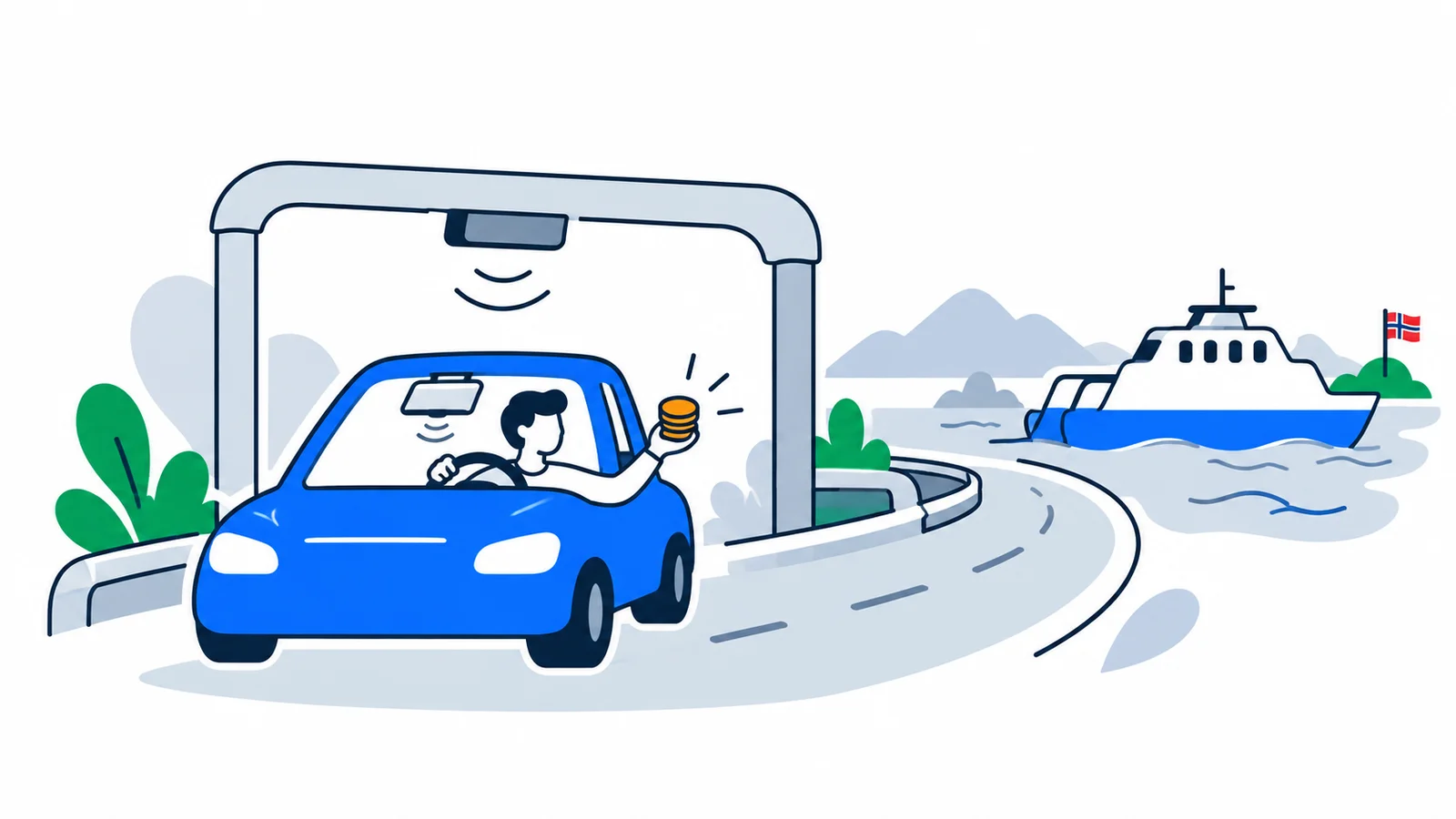
At a toll station there are no physical barriers and no staff. A camera reads your license plate, and a small AutoPASS tag (bombrikke) in your windscreen registers the passage automatically. You do not stop, and you do not pay cash.
Understanding toll charges is useful when you get a car in Norway. Read more about buying and owning a car in Norway. If you are new to the country, find simple steps for your first week in SamfunnPrep's guide to the first week.
How do I get a free toll tag?
The tag itself is free to order. You choose a tag issuer and create an AutoPASS agreement online. Popular issuers include Flyt, Fremtind Service (AutoSync) and Skyttel.
Here is how to do it:
- Choose a tag issuer and create an AutoPASS agreement on their website.
- Register your vehicle and the correct takstgruppe (passenger cars under 3500 kg are takstgruppe 1).
- Attach the tag securely behind your windscreen, as the issuer explains.
You need one tag per vehicle, and it must be registered to the correct car. If the tag is positioned wrong or registered to the wrong vehicle, you will often receive an invoice based on the license plate without discount. Some issuers charge a small deposit that you get back, or a small monthly fee. Compare before you choose, but the discount is usually much larger than such a fee.
What discounts does the toll tag provide?
With a valid AutoPASS agreement and tag, passenger cars and other light vehicles (takstgruppe 1, under 3500 kg) receive a 20 percent discount on toll charges. This applies at most toll stations across Norway (as of 15 July 2026).
In addition, you get two important benefits:
- Timesregel (hourly rule): you pay for only one passage per hour in the same toll project.
- Månedstak (monthly cap): you pay for a fixed maximum number of passages per month. The rest is free.
The discount is automatic. You do not need to apply for it, but you must have a tag and agreement to receive it. Without a tag, you lose the 20 percent.
How the hourly rule and monthly cap work
The timesregel (hourly rule) means you pay for only one passage within one hour (60 minutes), even if you drive through multiple toll stations in the same toll ring. If you drive back and forth in a short time, you pay only once.
Since 1 September 2023, the timesregel applies to all vehicles, including cars without an AutoPASS agreement. The månedstak (monthly cap), however, still requires a valid AutoPASS agreement in most projects.
The monthly cap varies by location. In Oslo, the cap is 120 paid passages per month in the inner ring and outer ring, and 60 in the city boundary zone (as of 15 July 2026). Other cities have different numbers, so check the website of the toll company for your area.
Electric vehicles: how much do you pay in toll charges?
Electric vehicles (elbil) pay less than fossil-fuel cars, but not zero. The rule is that a zero-emission vehicle may pay at most 70 percent of the full rate. The actual price varies between toll projects.
To receive the electric vehicle rate, you must have a valid AutoPASS agreement and tag. Without a tag, electric vehicles are charged the full price without discount in many places. A properly registered tag tells the toll station that the vehicle is electric. In some cities, the price is also higher during rush hour than at other times of day.
Ferry discount with AutoPASS
Many ferries in Norway also use AutoPASS. If you have a regular AutoPASS agreement with a tag, you get a 10 percent discount on ferries. If you want to save more, you can create a separate prepayment agreement in AutoPASS for ferries.
With a prepayment agreement, you pay an amount in advance and receive a 50 percent discount as a private person (40 percent for a business). For short vehicles (takstgruppe 1), the prepayment amount is 2 200 kroner (as of 15 July 2026). When the balance runs low, you automatically receive a new invoice for refill. Without an agreement, you pay the full price plus an invoice fee.
With a tag or without a tag?
The difference is significant over a full year. This table shows the main points for a typical passenger car:
| With tag and agreement | Without tag | |
|---|---|---|
| Toll discount | 20 % | 0 % |
| Hourly rule | Yes | Yes (from 2023) |
| Monthly cap | Yes | No in many places |
| Electric vehicle rate | Yes | Often no |
| Ferry discount | 10 % (50 % with prepayment) | 0 % |
| Payment | One combined invoice | Invoice per company, may have fees |
Without a tag, the camera reads only the license plate, and the toll company sends you an invoice by post without discount. If you pass toll stations from multiple companies, you receive one invoice from each company, and some add an invoice fee. With a tag, everything is combined on one invoice, and you receive the discount automatically.
What if the car is registered abroad?
If you drive a foreign-registered vehicle, you are billed by the company Euro Parking Collection (EPC). You receive the invoice by post or email, in Norwegian currency based on the exchange rate on the invoice date.
Register your vehicle and the correct emission class with EPC before you drive, so the price is correct. If you drive often in Norway, you can also get an AutoPASS tag that works in multiple countries.
How to avoid overpaying
In short: get a free tag, register the correct takstgruppe, and set up a prepayment agreement if you use ferries often. Then you receive the discount automatically and avoid unnecessary fees. If you drive through a toll ring every day, the 20 percent discount and monthly cap can save you thousands of kroner per year.
If you travel rarely by car, public transport in Norway may be cheaper. Also remember to have valid car insurance in place.
Many of these rules are useful knowledge about Norwegian society, and some are part of the curriculum for the samfunnskunnskapsprøven (civics exam). On SamfunnPrep you can practice for free and learn more about everyday life in Norway.