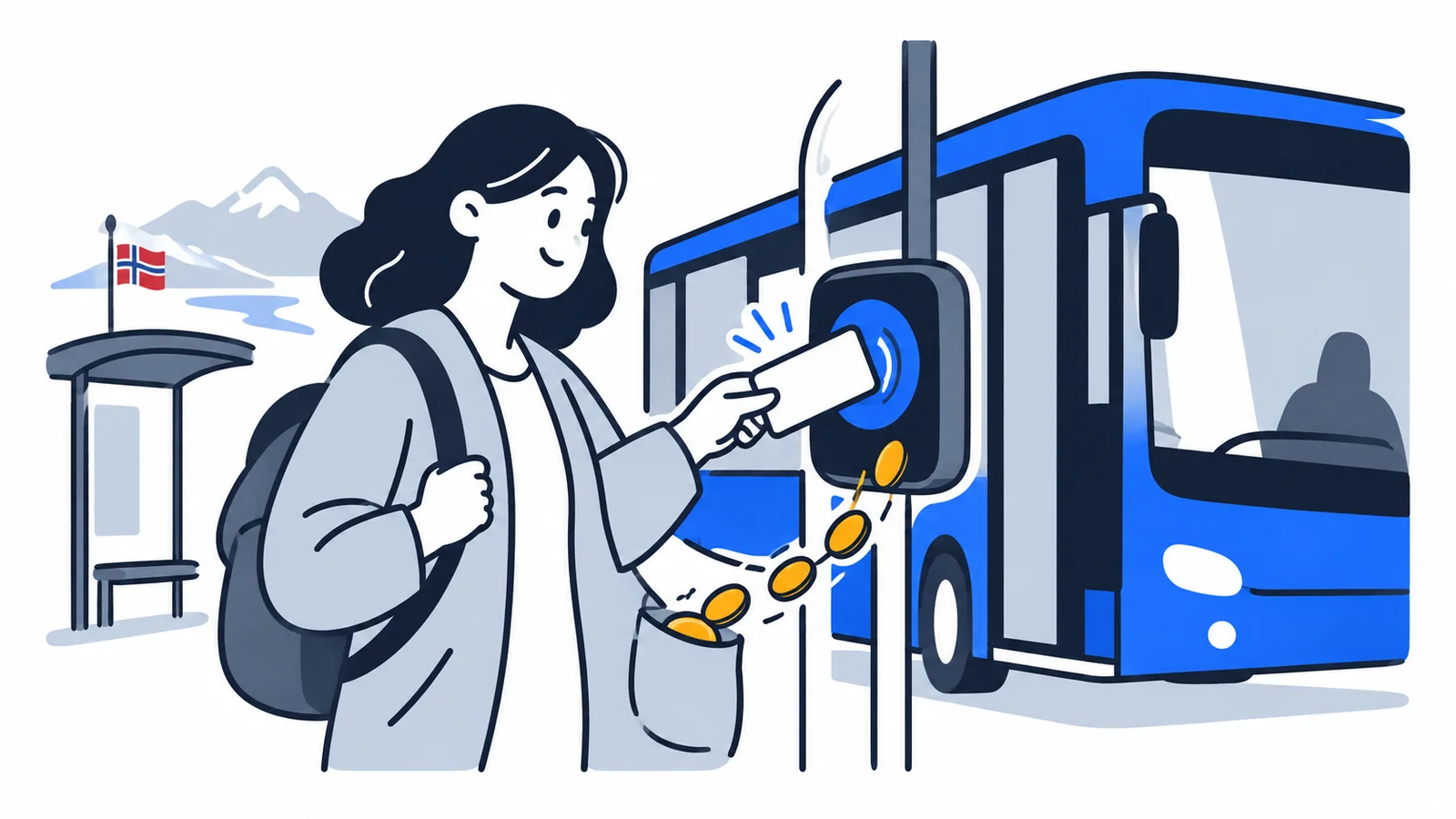

The monthly transit pass gets about 260 kroner cheaper in 2026 – over 3,000 kroner a year for one person, and more for families who commute. The state is spending over 1.1 billion kroner on lower prices in every county. The discount sits right in the price: no application, residency or citizenship required.
What happened
On Wednesday 11 June 2026 the governing party reached a deal with SV, MDG, Sp and Rødt on the revised national budget. One of the breakthroughs is 495 million kroner extra for cheaper public transport. The money lets the county authorities cut the price of the monthly pass by a further roughly 160 kroner – on top of the cut of about 100 kroner rolled out earlier this year.
The background is the 2026 state budget, which set aside 620 million kroner for lower monthly-pass prices, plus over one billion kroner to secure the public transport service itself in the counties. Together, over 1.1 billion kroner now goes directly to lowering the price of your monthly pass.
For many newcomers this is no small line in a budget. The bus, tram and train are the lifeline to work, language courses and the introduction programme – and now it gets noticeably cheaper.
How the money is split between the counties
The split follows the number of period tickets sold in each county in 2025. The point is that the discount per pass should be roughly equal across the country – Oslo gets the most money because the most people travel by public transport there, not because people in Oslo get a bigger discount.
| County | State budget 2026 (1,000 kr) | RNB 2026 (1,000 kr) |
|---|---|---|
| Oslo and Akershus | 342 110 | 273 235 |
| Vestland | 81 082 | 64 845 |
| Rogaland | 48 035 | 38 115 |
| Trøndelag | 46 700 | 37 125 |
| Agder | 19 287 | 15 345 |
| Troms | 19 154 | 15 345 |
| Buskerud | 12 133 | 9 900 |
| Innlandet | 11 395 | 8 910 |
| Møre og Romsdal | 9 763 | 7 920 |
| Vestfold | 9 608 | 7 425 |
| Østfold | 7 672 | 5 940 |
| Telemark | 6 120 | 4 950 |
| Nordland | 5 160 | 3 960 |
| Finnmark | 1 780 | 1 485 |
| Total | approx. 620 000 | 495 000 |
The amounts show how many people travel by public transport in each county – not the size of the discount. The discount is meant to be the same everywhere, about 260 kroner a month.
How much you save
Figures from Ruter (Oslo and Akershus) show what the cuts mean in practice. In Oslo (zone 1) the 30-day ticket fell from 805 to 655 kroner already on 3 May 2026. With the new cut the price could approach 495 kroner through the autumn – the lowest level in many years. In Akershus the monthly pass could fall from 919 to 759 kroner.
| Who | Before | After first cut (May 2026) | Saved per year* |
|---|---|---|---|
| Adult, Oslo zone 1 | 805 kr | 655 kr | approx. 1,800 kr |
| Adult, Akershus | 919 kr | 759 kr | approx. 1,900 kr |
| Child and youth, Oslo | 338 kr | 238 kr | approx. 1,200 kr |
*The figures are before the new cut of about 160 kr/month is included. With the RNB cut on top, the yearly saving rises by up to 1,920 kroner extra during the six-month period.
Example – living alone in Oslo: You save 150 kr/month now, probably around 310 kr/month once the new cut takes effect. That is around 3,100 kroner a year – enough for a month's food budget for one person.
Example – a family in Lillestrøm: Two adults commute to Oslo and one child has a youth pass. The family already saves several hundred kroner a month and could end up at over 900 kroner a month – more than 7,000 kroner a year.
And a bonus many families will like: from August Ruter removes the zone boundaries for children and young people. Then youth travel freely across all of Oslo and Akershus for 238 kroner a month.
Why this matters extra for you as a newcomer to Norway
Immigrants make up around 15 percent of the population, according to Statistics Norway (SSB) – and as a group, newcomers are far more dependent on public transport than the average. There are several reasons.
A car is expensive and complicated at the start. A driving licence from many countries must be exchanged or retaken in Norway, and a Norwegian licence quickly costs 30,000–40,000 kroner. Add insurance, toll roads and parking, and a car is out of reach for most in the first years. The bus and train are not a choice – they are the way to work, NAV, kindergarten and language classes.
Every hundred-krone note counts in the settling-in phase. Many labour immigrants and refugees work in cleaning, retail, construction and health, often with shifts across town. For a household on a tight budget, 3,000–7,000 kroner a year is real money. See how you can save money the way most people in Norway do, and check the deductions immigrants often forget – the travel deduction may be one of them.
The discount asks nothing of you. No application, no documentation, no requirement of residency or citizenship. The price is simply lower – for everyone.
Useful to know if you are new to Norway
- Asylum seekers in Oslo travel free with Ruter in zone 1 with a valid asylum seeker card. Asylum seekers at reception centres in Akershus get tickets for local journeys.
- Student under 30? You get a 40 percent discount on the 30-day ticket with Ruter – including as an international student.
- Children under 6 always travel free, and children and young people have their own low prices.
- The discount applies to period tickets (monthly and annual passes), not single tickets. If you travel more than about 30 times a month, the monthly pass almost always pays off.
Positive or negative?
The plus side is heavy. This is one of the most direct purchasing-power measures in this year's budget, and it hits precisely those with the lowest income – public transport users earn less on average than drivers. It is also unbureaucratic: the price simply falls. For the climate it is good news, as car use has risen in recent years.
But there are flaws in the joy:
- The districts get crumbs. Finnmark receives under one percent of the pot. The split is mathematically fair per ticket, but helps little where the bus runs twice a day. This is in practice urban policy.
- The scheme is temporary. The state subsidy applies for one year to begin with. If it is not extended, prices may bounce back – and a cut that disappears feels like a price increase.
- Uneven timing creates confusion. The new cut of 160 kroner applies to the last six months of the subsidy period – that is, from around 3 November 2026 – but the counties choose when themselves. Keep an eye on your local company: Ruter, Skyss, Kolumbus, AtB, Brakar and the others.
What happens next?
The government is now studying a national monthly pass – one pass for all public transport across Norway – with possible introduction in 2027. MDG has demanded a price of 499 kroner, on the Swedish model. If it happens, the 2026 cuts may turn out to be just the start.
Our advice: If you have dropped the monthly pass because it has been too expensive, do the maths again now. With prices heading toward the 500 mark in Oslo and similar cuts across the country, the threshold for leaving the car at home – or not buying one – has never been lower.