
Work from home is not a legally established right in Norway. You cannot demand to work from home – it is up to the employer. But when you do work from home, clear rules apply regarding working conditions, equipment, and workplace accidents.
Do you have the right to work from home?
No. Neither the Working Environment Act nor the Work from Home Regulation (FOR-2002-07-05-715) gives you the right to demand work from home. The decision belongs to the employer through what is called employer's management prerogative.
Whether you can work from home depends on:
- What is agreed in your employment contract or a separate work from home arrangement
- What is agreed in the collective bargaining agreement (if you are unionized)
- What the employer decides
The Work from Home Regulation applies only to permanent, regular work from home arrangements – typically at least one day per week. Sporadic work from home (occasionally) is normally exempt from the regulation.
Employer's duties: equipment, ergonomics and oversight
When you have a work from home arrangement, the employer is responsible for ensuring that working conditions are fully satisfactory – insofar as is practically possible (Work from Home Regulation § 3):
- Ergonomics and physical working conditions: The employer must ensure adequate lighting, a work chair, a screen, and a satisfactory overall working environment
- Psychosocial working environment: From 1 January 2026, the Working Environment Act's requirements for psychosocial conditions have become more explicit – employers must now actively prevent isolation and unclear expectations for remote workers
- Working hours: All rules on working hours under Chapter 10 of the Working Environment Act apply fully when working from home – this came into effect on 1 July 2022. You cannot be ordered to work evenings or Sundays without statutory authority
- Equipment and costs: The law does not specify who pays for equipment. This must be clarified in the written work from home agreement. In practice, the employer is expected to cover necessary equipment
Note: The Labour Inspection Authority does not have automatic access to your home for inspection – this requires a separate agreement with the employee and safety representative (Work from Home Regulation §§ 5–6).
Work from home and tax: what can you deduct?
For most employees (salaried workers), the work from home tax deduction is limited:
- Standard deduction: 2,240 kr per year (2026). This is already included in the standard deduction (46% of salary, max 92,000 kr). Most employees will not receive additional tax savings by claiming the work from home deduction separately
- For actual tax benefit, total actual work expenses (work from home + other) must exceed the standard deduction
Tax-free allowance from the employer:
- The employer can provide a tax-free allowance of 2,240 kr per year if the room you use is exclusively an office – not a bedroom, living room, or multi-purpose room
- If the room is used for other purposes (bedroom, living room), the allowance is taxable income
Self-employed and sole proprietors have more favorable rules – actual expenses can be deducted based on the portion of the home used for business.
Learn more about tax matters for freelancers and self-employed and unions and the Norwegian labor model.
Accident at home = workplace accident?
If you are injured while actively working from home, you are normally covered by occupational injury insurance – the same as in the office.
But the Supreme Court ruled in 2024 (HR-2024-1571-A) that injuries sustained during breaks at home are not covered as workplace injury. The case involved a hospital doctor on on-call duty who was injured during lunch break. The Supreme Court ruled 3–2 that the private nature of the home and the lack of distinction between private time and work time means that break injuries are not workplace injuries.
From 1 January 2026: All accident reports to NAV for workplace accidents must be submitted digitally.
Practical consequence: If you are injured during a break at home – even if you are on on-call duty – NAV will most likely reject a claim for occupational injury compensation. Consider whether your employer offers leisure accident insurance or similar.
How to create a written work from home arrangement
A written agreement is mandatory if you have a regular work from home arrangement (Work from Home Regulation § 2). The agreement should contain:
- Scope: Number of days/hours of work from home per week
- Working hours: What times you are available at home
- Availability: When you should be reachable
- Duration: Is the arrangement temporary or permanent?
- Changes and termination: Terms for ending the arrangement
- Probation: If applicable
- Equipment: Who owns, operates, and maintains equipment and network
- Document handling: Rules for confidentiality and storage
The Labour Inspection Authority provides official agreement templates in Bokmål and Nynorsk (arbeidstilsynet.no).
Immigrants and work from home
- No discrimination: The right to (and rules for) work from home apply regardless of citizenship
- The Work from Home Regulation applies in Norway: Whether you are an EU/EEA citizen or a third-country national working for a Norwegian employer in Norway
- Questions about rights: Contact the Labour Inspection Authority (73 19 97 00) or the Service Centre for Foreign Workers (SUA) for free guidance
The Work from Home Regulation: what does it say?
Although there is no separate 'work from home law' in Norway, work from home is primarily regulated through the Regulation on work performed in an employee's home, established in 2002 and updated several times. This regulation specifies the employer's duties when you work from home.
When the regulation applies: The regulation applies when an employee carries out their ordinary job from home, and when the employer has given permission for this (or requires it). It does not apply if you voluntarily take work home or do extra work, but it does apply if working from home is your normal workplace.
Employer's duties under the regulation:
-
Overview of dangers and risks: The employer must assess the dangers and risks of working from home. What is the risk of psychological pressure, stress development, or isolation? How is the employee protected against overwork?
-
Working environment measures: The employer must establish measures to ensure that the work from home environment is safe. This can include: regular meetings at the office, social contact with colleagues, and oversight of workload.
-
Health and safety inspection: The employer can inspect the home office to ensure proper ergonomic setup. You have the right to refuse inspection if you consider it unreasonable, but the employer has the right to insist if it is safety-critical.
-
Insurance: The employer must ensure that employees are insured against work injuries even when working from home.
-
Employment agreement or written practice: The employer should have a written agreement or practice that describes the terms for working from home. This should be clear to the employee.
Practical interpretation: If you work 50% from home and 50% at the office, the regulation applies to both workplaces. If you work 100% from home permanently, it applies fully. The employer cannot simply send you home without considering the duties that apply.
Labour Inspection Authority oversight: The Labour Inspection Authority can control that the employer fulfils duties under this regulation. If you experience that the employer does not respect work from home rules, you can report it to the Labour Inspection Authority (arbeidstilsynet.no, 'report').
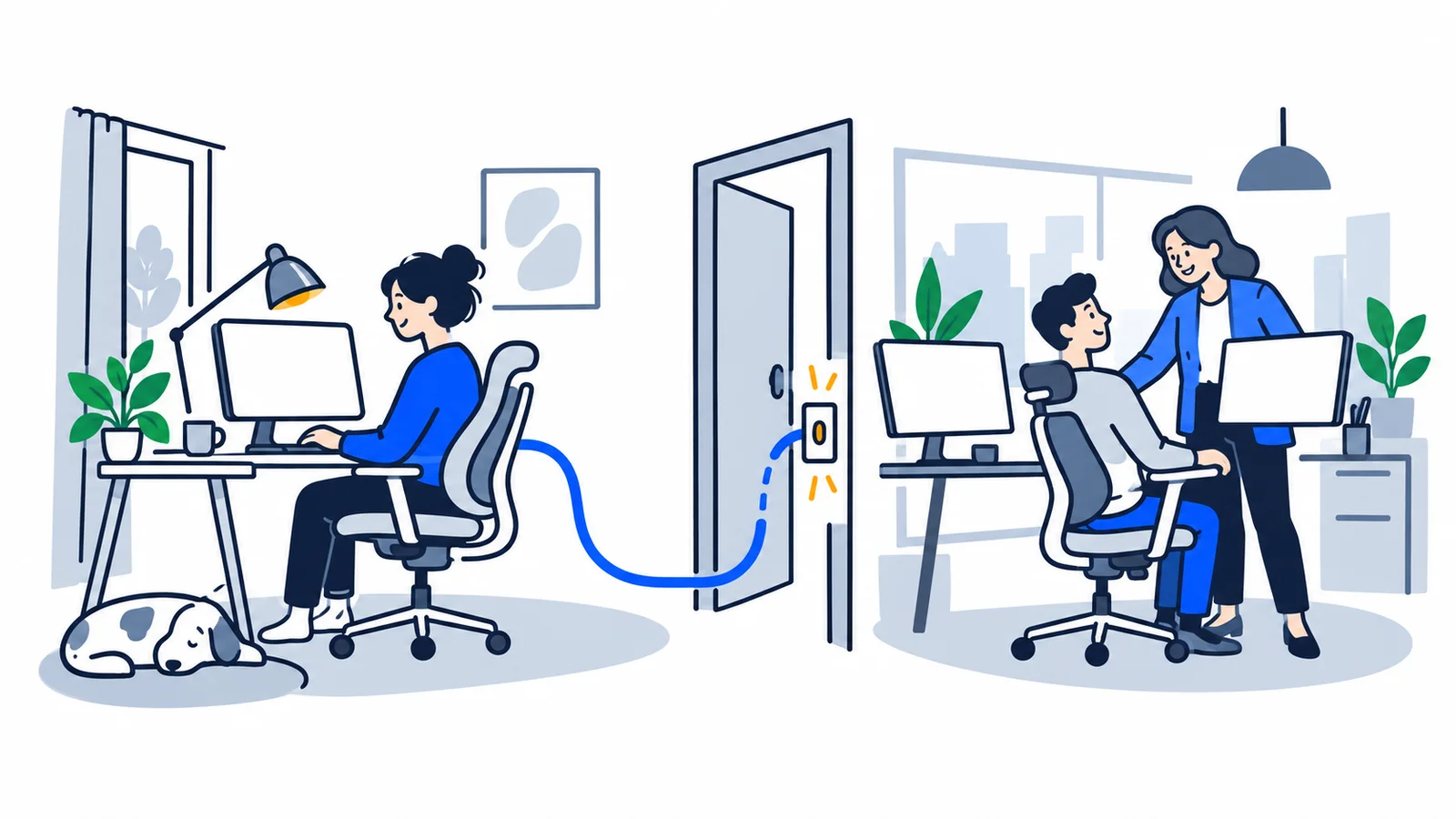
The boundary between working from home and the workplace: An important distinction: working from home is not the same as working in the office. You have the right to close the door when the working day is over. The employer cannot expect that you are always available or work evenings and weekends, even if you are at home. This is regulated by working time rules.
International workers and work from home: tax consequences
If you are a foreign worker or a Norwegian employee working for a Norwegian employer while abroad, complex tax issues arise. This is an area where many people make costly mistakes.
Tax liability in Norway: If you live and work in Norway, you pay taxes to Norwegian authorities regardless of where you actually work. If your employer is in Norway, it is normal that you pay Norwegian tax. This happens automatically through the A-scheme (the employer withholds tax).
Worker residing in another country: If you reside in, for example, Sweden, Germany, or Poland, but work from home for a Norwegian employer, tax problems arise. Generally, you must pay tax where you live – that is, in Sweden/Germany/Poland. But the Norwegian employer must also withhold Norwegian tax (because the income arises from a Norwegian source). This can lead to double taxation.
Double taxation agreements: Norway has double taxation agreements (DTA) with most countries. These agreements regulate where you must pay tax and how. For example: the Norway-Sweden agreement states that if you reside in Sweden, you primarily pay Swedish tax. But because the income comes from a Norwegian employer, Norway must also withhold tax – and you can later claim compensation in Sweden.
Practical example: You are Norwegian but have moved to Sweden. You work from home for a Norwegian company. Your salary is 500,000 kroner per year.
- The Norwegian employer withholds approximately 90,000 kroner in Norwegian tax
- You must also report the income to the Swedish tax authority
- Sweden will also withhold tax of approximately 100,000 kroner
- You suffer from double taxation and must seek compensation
What should you do:
-
Inform the employer: Before you start working from home from abroad, tell the employer where you live. They need this information to calculate the correct tax and report correctly to Norwegian authorities.
-
Contact the Norwegian Tax Authority: Call the Norwegian Tax Authority (or chat on skatteetaten.no) and ask how your tax situation will be. They can confirm whether you must pay Norwegian tax or not, based on your residence status and employment relationship.
-
Present the double taxation agreement: Ask the employer or the Norwegian Tax Authority to present the relevant double taxation agreement. You can also find it on skatteetaten.no under 'International matters.'
-
Request relief: If you experience double taxation, you can seek relief in your home country based on the double taxation agreement. For example: if you pay Swedish tax, you can apply to Sweden to have the Norwegian tax refunded.
-
Document everything: Keep track of all payments – both to Norway and your home country. Make a copy of pay slips, tax receipts, and payment confirmations. You may need these if you are to apply for a refund.
Social benefits: It is also complicated if you work for a Norwegian employer from abroad and later need unemployment benefits, sick leave benefits, or pension. Which country's social security system applies? This depends on which country you are working in, not where the employer is located. Contact NAV to clarify this – it is a separate matter from taxes.
Visa and work permit: If you are a citizen of a country outside the EEA, you normally need a work visa or work and residence permit to work – also when working from home for a Norwegian employer. Check with UDI (Immigration and Integration Directorate) before you start working from home from abroad.
Practical advice: If you plan long-term work from home from abroad, it is recommended to consult a tax advisor or accountant familiar with double taxation agreements. One hour with an expert can save you thousands of kroner in misunderstandings and overpayment.