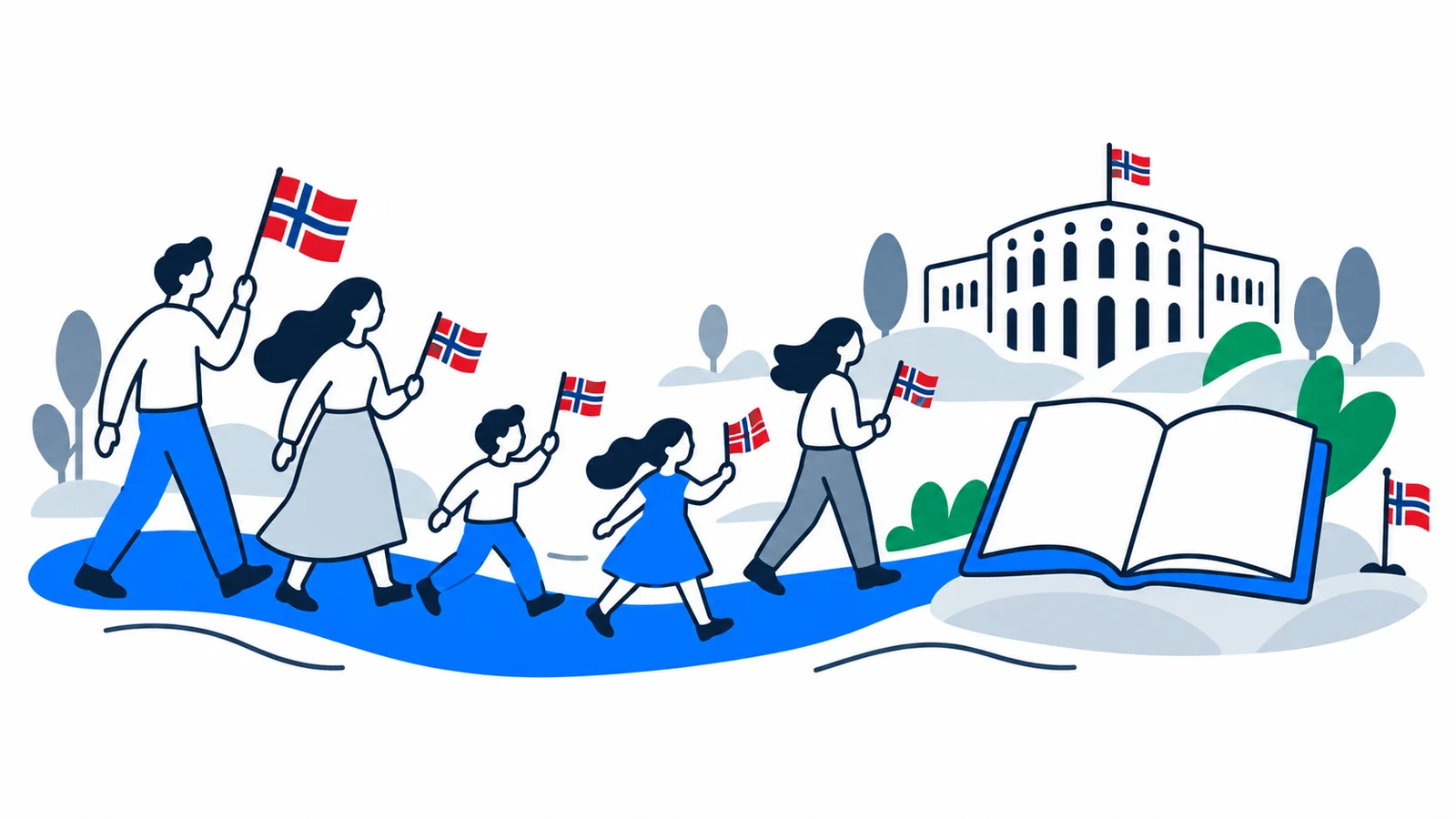

The Constitution was adopted at Eidsvoll on May 17, 1814. It is the world's second-oldest constitution still in use. This is why May 17 is Norway's national day – a peaceful festival with children's parades, flags and "hurrah" that everyone can participate in.
What is the Constitution?
The Constitution is Norway's most important law. It was adopted at Eidsvoll on May 17, 1814, and still applies today.
The Constitution stands above all other laws. No other law or rule is allowed to conflict with it. It was written by 112 men – the Eidsvoll representatives – at the Eidsvoll estate in spring 1814.
The Constitution is the world's second-oldest constitution still in use. Only the United States Constitution from 1787 is older. This is confirmed by the Storting.
The Constitution is based on three ideas: popular rule (democracy), separation of powers, and rights for people. When it was written, it was one of the most liberal constitutions in Europe.
The Constitution has been amended many times since 1814. The content has evolved with the times and people's views on what rights we should have. But the fundamental idea is the same: the people shall govern, and power shall be divided.
What happened in 1814?
In 1814, Norway went from being under Denmark to a brief independence, and then into a union with Sweden. In the midst of this, the country got its own constitution.
For over 400 years, Norway had been in a union with Denmark. After the Napoleonic Wars, Denmark had to give Norway to Sweden in early 1814.
The Norwegians did not want to simply be handed over to a new country. Representatives from large parts of the country met at Eidsvoll. They agreed that Norway should be an independent country with a king, popular rule, and separation of powers.
On May 16, 1814, the text was completed. The next day, May 17, the Constitution was dated and signed. Norway ended up in a looser union with Sweden later that autumn – but was allowed to keep its own constitution. The union with Sweden was peacefully dissolved in 1905.
Why is May 17 Norway's National Day?
May 17 is the national day because the Constitution was signed on exactly this date in 1814. The day celebrates Norwegian democracy and the freedom people gained.
The celebration does not mark a war or a military victory. It marks a law – and the right people gained to govern their own country.
This is why May 17 is a peaceful and happy day. It surprises many who are new to Norway: the national day is about children and community, not weapons and soldiers.
How May 17 is Celebrated: Children's Parades, Bunad, and "Hurrah"
May 17 is celebrated with children's parades, flags, bunad, brass bands, and lots of ice cream. It is a family festival, not a military parade.
The most important thing is the children's parade. Children from schools march in processions through the city or village. They wave small flags and shout "hurrah". The first children's parade was in Christiania (today's Oslo) in 1870, and the poet Bjørnstjerne Bjørnson was an important driving force.
Here is what a typical May 17 looks like:
- Children's parade – schoolchildren march in procession, often behind a school brass band playing music.
- Bunad – many wear the traditional festive costume, but regular nice clothes are perfectly fine.
- Flags and "hurrah" – people wave the Norwegian flag and shout "hurrah" three times.
- "Ja, vi elsker" – the national anthem is sung in many places.
- Russ – students in their final year of upper secondary school celebrate in red or blue clothes. Russ celebrations have been part of the day since 1905.
- Ice cream and sausages – children usually get to eat as much ice cream as they want.
In Oslo, the Royal Family waves to the children's parade from the palace balcony. They have been doing this since 1906.
What Does the Constitution Protect?
The Constitution divides power into three branches and protects fundamental rights such as freedom of expression, freedom of religion, and equality before the law.
Separation of powers means that no one gets all the power alone. Power is divided between three parts of the state:
| Power | Who | Task |
|---|---|---|
| Legislative | The Storting | Passes laws |
| Executive | The Government | Governs the country and implements the laws |
| Judicial | The Courts | Judges according to the laws |
The Constitution also gives people important rights. Some of the most central are:
- Freedom of expression (§ 100): you have the right to say and believe what you want. This right was in the Constitution already in 1814.
- Freedom of religion (§ 16): everyone who lives in the country can believe what they want and practice their religion freely.
- Equality before the law (§ 98): everyone is equal before the law, and no one shall be subjected to unfair discrimination.
The Constitution also protects national minorities and indigenous peoples. In § 108, the state has a duty to arrange for the Sámi to take care of their language, culture, and community life. You can read more about this in the article on the Sámi as indigenous people in Norway.
These values are a living part of Norwegian society today. You can read more about what these rights mean in the article on human rights in Norway. If you want to understand how you can be involved in decision-making yourself, we explain it in democratic participation in Norway.
Is May 17 a Festival for Everyone – Also for Me Who Are New?
Yes. May 17 is an open and inclusive festival. Everyone who lives in Norway can celebrate, regardless of background or how long they have been here.
You don't need a bunad, and you don't need to be born in Norway. Many newcomers to Norway march in the children's parade with their children, wave flags, and shout "hurrah".
The celebration is about children, family, and community. Schools, kindergartens, and neighborhoods arrange parades and events where everyone is welcome. There is no entrance fee and no requirement to participate.
If you want to learn more about the country you are celebrating, you can read facts about Norway. If you are brand new to the country, the guide for your first week gives you a simple start.
The Constitution and May 17 in the Civic Knowledge Exam
The Constitution and May 17 are part of the curriculum for the civic knowledge exam. You should know the year 1814, understand what separation of powers means, and understand why May 17 is the national day.
Briefly summarized:
- The Constitution was adopted at Eidsvoll on May 17, 1814.
- It is the world's second-oldest constitution still in use.
- May 17 is the national day and is celebrated with children's parades, not a military parade.
- The Constitution divides power into three branches and protects freedom of expression, freedom of religion, and equality.
The facts above are based on the Storting, Lovdata, and Store norske leksikon as of July 8, 2026.
Ready to practice? Try SamfunnPrep for free and become confident with the Constitution, May 17, and the rest of the curriculum for the civic knowledge exam.