
You can change your legal gender in Norway by applying to the Tax Authority yourself. For everyone over 6 years old, the law requires no diagnosis, no hormones and no surgery. The requirement is that you are registered as a resident of Norway. You will receive a new national identification number, and some documents you must update yourself.
What the law requires to change legal gender
Legal gender is "the gender a person is registered with in the National Registry". This is stated in § 1 in the Act on Change of Legal Gender (LOV-2016-06-17-46), which came into force on 1 July 2016.
The law has no medical requirements for people over 6 years old. You do not need a diagnosis, hormone treatment, surgery or sterilization. You apply based on your own experience of gender. Before 2016, sterilization was a requirement — an important part of LGBTQ+ rights and history in Norway.
Norway has only two legal genders. Bufdir (the Norwegian Directorate for Children, Youth and Family Affairs) states that no other category can be registered.
Do I need to be a Norwegian citizen to change legal gender?
No. Section 2 of the law gives "persons who are resident in Norway" the right to change legal gender. The Tax Authority states: "You must be a Norwegian citizen or registered as resident in Norway ..." No specific residence permit is required and no language skills, but you must be registered as a resident.
"Resident in Norway" is a registry term. The National Registry Act § 4-1 states that anyone who stays lawfully in a Norwegian municipality for at least six months is registered as resident. Then you have a national identification number of 11 digits. Section 2-2 states that "for other persons a d-number can be assigned".
From this it follows that a d-number does not meet the requirement in § 2. No source states it directly, but it follows from the law texts, and the police use the same distinction for a national ID card: "A d-number with 11 digits does not meet the requirement." If you only have a d-number, ask the Tax Authority directly before sending anything in. Also read about the difference between a national identification number and a d-number.
- Can apply: you who are registered as resident in Norway with a national identification number, regardless of citizenship
- Can apply: Norwegian citizens abroad with a national identification number, according to separate regulations effective from 2017
- Do not meet the requirement: you who only have a d-number, meaning you are not registered as resident
How to apply to the Tax Authority, step by step
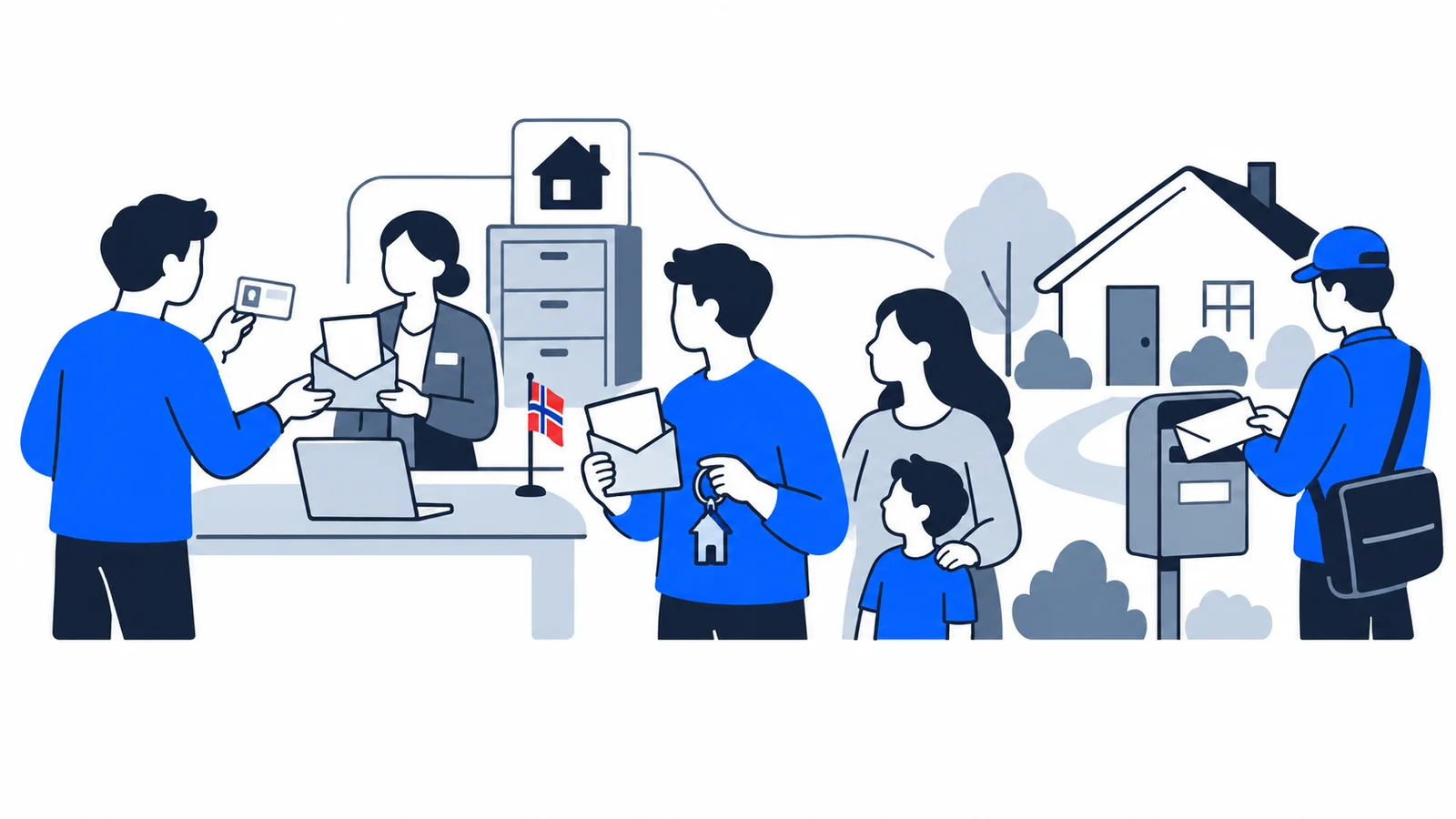
There is no digital application button. The form must be ordered, and it comes by mail.
- Request the form via the Tax Authority's contact form "Write to us", or send a letter to the Tax Authority, PO Box 9200 Grønland, 0134 Oslo. Provide your full name and national identification number.
- The Tax Authority sends the form to your registered address.
- Fill out the application form and send it in.
- You receive a confirmation slip back and confirm the application by sending it in. There is no deadline for this.
- After confirmation you receive a letter with your new national identification number.
The Tax Authority does not publish processing times. Helsenorge states 2 to 3 weeks from confirmation until the letter arrives, while the patient organization HBRS states 4 to 6 weeks. The Tax Authority also does not state a fee for the change itself; it is the documents afterwards that cost. Name change is a separate matter, governed by the Name Act.
Age limits: 16 years, 6–16 years and under 6 years
The age rules are in § 4.
| Age | Who applies | Who decides |
|---|---|---|
| 16 years and older | The applicant | Tax office |
| 6–16 years, all with parental responsibility apply | The child and the parents | Tax office |
| 6–16 years, only one with parental responsibility applies | The child and one parent | County Governor in Østfold, Buskerud, Oslo and Akershus |
| Under 6 years | Those with parental responsibility | Tax office |
If parents have joint parental responsibility but only one applies with the child, the gender can still be changed if it is in the child's best interest (§ 4 second paragraph). For children under 6 years old, it is a requirement that the child has a documented congenital uncertain somatic sex development, documented by health personnel (§ 4 third paragraph).
The tax office's decision can be appealed to the County Governor in Østfold, Buskerud, Oslo and Akershus. Where the County Governor decides the case themselves, appeals go to the National Appeals Body for Health Services. This is stated in § 5, amended 1 July 2025.
You get a new national identification number — this stops working
The national identification number changes when legal gender changes. The reason is that the third digit from the end encodes gender: women have even numbers and men have odd numbers as the last individual digit. The five last digits are called the personal number. The legal authority is the National Registry Act § 2-2. Old and new numbers are linked together in the registry.
Your old profile in ID-porten is automatically closed. If you have BankID, you must ask your bank to issue a new one. If you use Commfides or Buypass, you contact them. See how you get new BankID and digital identity.
| Updated automatically | You must arrange yourself |
|---|---|
| Nav (the Norwegian Labour and Welfare Administration) | Bank and bank card |
| Helfo (the Health Economics Administration) | BankID and other eID |
| UDI (the Directorate of Immigration) | Insurance |
| Hospitals and the police | Your employer's records |
| ID-porten (old profile closes) | Membership registers and some educational institutions |
More practical steps are in the checklist for your first weeks in Norway on SamfunnPrep.
The University of Oslo states that you cannot "get another name on transcripts, diplomas or access cards", but that all who "have changed national identification number in the National Registry are automatically updated in the student system ...". The number is thus updated automatically, while the old name remains. Other educational institutions may have different practices.
Passport, ID card and driving licence: what it costs in 2026
The register change itself has no published fee, but ID documents must be issued anew.
| Document | Price in 2026 | Effective from |
|---|---|---|
| Passport from age 16 | 840 kroner | 1 January 2026 |
| National ID card from age 10 | 840 kroner | 1 January 2026 |
| Passport and ID card together, from age 16 | 1340 kroner | 1 January 2026 |
| Driving licence at driving licensing authority | 270 kroner | 1 February 2026 |
| New photograph at driving licensing authority | 100 kroner | 1 February 2026 |
If you have also changed your name, you must go to a driving licensing authority at Statens vegvesen and take a new photograph. You cannot order online. The police issue passports and national ID cards — see how you apply for a new passport and national ID card.
For third-country nationals the situation is different. A Norwegian passport requires Norwegian citizenship, and a national ID card for foreign citizens is currently offered only to citizens of EEA or EFTA countries with a Norwegian national identification number: "Over time the service will also be offered to third-country nationals, but it is not yet clear when this will happen", the police state. You may therefore be without any Norwegian ID document showing your new gender, while your home country's passport retains the old gender marker.
Treatment is a different matter from the documents
Change of legal gender is a registry matter, not a health matter. It does not in itself give you the right to hormones or surgery.
Gender-affirming treatment follows a separate path, described in the Norwegian Health Authority's national clinical guideline "Gender Incongruence". You speak with your GP, who can refer you to a regional centre for gender incongruence in your health region. Some are referred further to the National Treatment Service for Gender Incongruence at Oslo University Hospital.
Invitations to mammography screening and cervical cancer screening are sent only to those registered as a legal woman.
If you experience discrimination
Gender identity and gender expression are protected grounds for discrimination in the Equality and Anti-discrimination Act § 6. The protection covers also "existing, assumed, previous or future" circumstances, and someone discriminated against on the basis of association with another person.
- The Equality and Anti-discrimination Ombud (LDO) provides free legal advice. You can be anonymous, and they arrange an interpreter if needed. Telephone 40 02 33 50.
- The Discrimination Board decides cases of discrimination and harassment. It is free, you do not need a lawyer, and everything can be done digitally. The Board can dismiss cases older than three years.
Rights and equality are among the topics you encounter in the society test. On SamfunnPrep you can practise these topics for free while you arrange your documents.