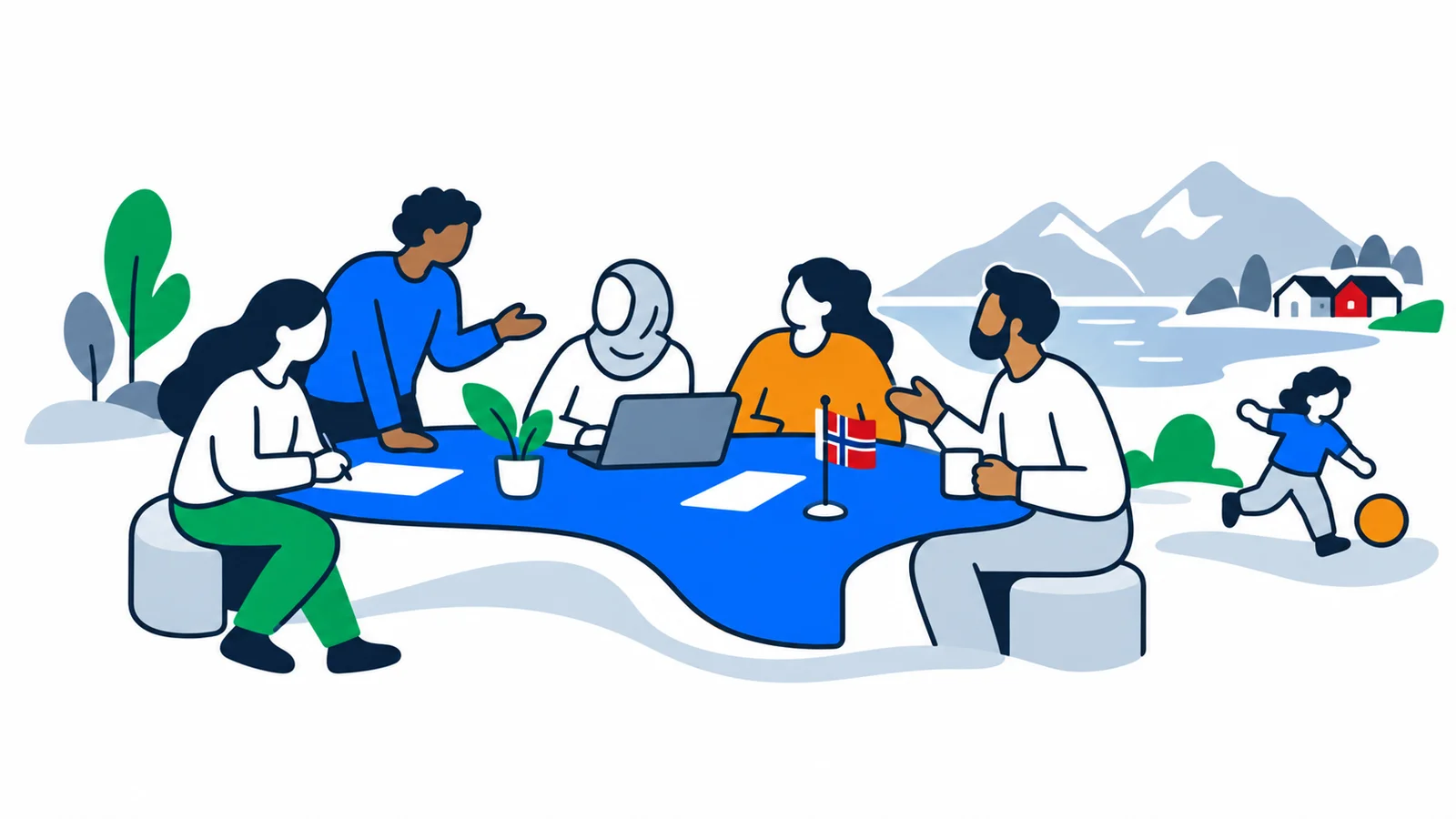

Multicultural Norway means that people from many countries, cultures and religions live here together. As of 1.1.2026, 17.5 percent of the population had an immigrant background. The goal of integration is that everyone participates in work and society, while maintaining their own identity.
What does multicultural Norway mean?
Multicultural Norway is a society where people of different backgrounds live side by side. They have different languages, religions and traditions, but share the same laws and rights.
A multicultural society is not new for Norway. The country has always had contact with other peoples through trade and work. But over the last 50 years, diversity has become much greater.
This topic is an important part of Samfunnskunnskapsprøven. You should know the difference between majority (the most people) and minority (the smallest number), and understand what integration means. On SamfunnPrep you can find practice questions on this. Also read our overview of attitudes toward immigrants.
How did Norway become multicultural?
Norway became a diverse country through four main ways: work, flight, family and EEA. Immigration picked up in the 1960s and 1970s.
- Work immigration: In the late 1960s, the first work immigrants came, including from Pakistan, Turkey and Morocco. They filled empty jobs in industry.
- Refugees: From the 1970s onwards, people fleeing war and persecution arrived, for example from Vietnam, Somalia, Iraq, Syria and Ukraine.
- Family reunification: Many later received permission to move to be with their family in Norway.
- EEA agreement: After the EU expanded in 2004, many workers came from countries like Poland and Lithuania. The EEA gives citizens from EU countries the right to work in Norway.
Immigration has changed over time. Previously, mostly men came to work. Today, people come for many reasons, and the groups are more diverse than before.
Statistics Norway (SSB) is the public agency that produces statistics about Norway. The figures below are taken from there.
How many immigrants live in Norway?
As of 1.1.2026, there were 987,120 immigrants in Norway, according to SSB. That is 17.5 percent of the population.
In addition, 238,507 people were born in Norway to immigrant parents. They make up 4.2 percent. Altogether, more than one in five people in Norway have an immigrant background.
The largest groups come from Europe and Asia. The table shows the five largest origin countries among immigrants as of 1.1.2025 (SSB):
| Country | Number of immigrants |
|---|---|
| Poland | 111,000 |
| Ukraine | 80,000 |
| Lithuania | 43,000 |
| Syria | 40,700 |
| Sweden | 37,200 |
An immigrant is a person who was born abroad to two foreign-born parents, and who has moved to Norway. Their children, born in Norway, are not immigrants. They are counted as Norway-born with immigrant parents.
Immigrants live throughout the country, but most live in and around the large cities. Oslo has the highest share. The immigrant population is also younger than the rest of the population.
What is integration?
Integration means that immigrants become part of society, while they are allowed to keep their own culture and identity. It is a two-way process: both immigrants and the broader society must contribute.
Integration is about both rights and duties. You have the right to school, health and work. At the same time, you have a duty to follow Norwegian law, learn Norwegian and participate in society. The goal is that everyone participates in work and community.
It is important to distinguish integration from assimilation. In assimilation, the minority must give up their own culture completely and become like the majority. Norwegian policy is based on integration, not assimilation. You can therefore speak your own mother language at home, celebrate your own holidays and believe in your own religion. At the same time, you participate in Norwegian society.
What institutions work with integration?
The most important body is IMDi (Integration and Diversity Directorate). IMDi is a government agency responsible for integration policy and produces statistics on integration.
A central scheme is the introduction program. It is a free full-time program for newly arrived refugees. There you learn Norwegian and civic knowledge, and get help finding work or education. The program usually lasts up to two years, and you receive a fixed allowance while you participate. Read more about the introduction program and who is eligible for it.
Are the Sámi part of the diversity?
Yes. Diversity in Norway is not just about immigrants. The Sámi are Norway's indigenous people and have lived here long before today's borders were drawn.
Norway also has five recognized national minorities: Jews, Kvens/Norwegian Finns, Roma/Tatars, Romani and Forest Finns. These groups have their own rights and a long history in the country. Sámi is also an official language in several municipalities. You can read more about the Sámi, Norway's indigenous people.
What values hold a diverse society together?
A multicultural society needs shared values that everyone follows. In Norway, the most important are equality, trust, freedom of expression, freedom of religion and rule of law.
- Equality: Women and men have equal rights. See more about equality in Norway.
- Trust: People trust each other and in authorities.
- Freedom of religion: You can believe what you want, or not believe.
- Rule of law: Everyone is equal before the law, and the same rules apply to everyone.
These values allow people of different backgrounds to live well together. They are the core of integration policy and part of belonging to Norwegian society. The values do not mean everyone must be the same. They mean everyone follows the same basic rules, regardless of where they come from.
Multicultural Norway is thus a society in development, built on both diversity and shared rules. Understanding this helps you both on the exam and in everyday life. With SamfunnPrep you can practice these topics.
Ready to practice? Try SamfunnPrep for free.