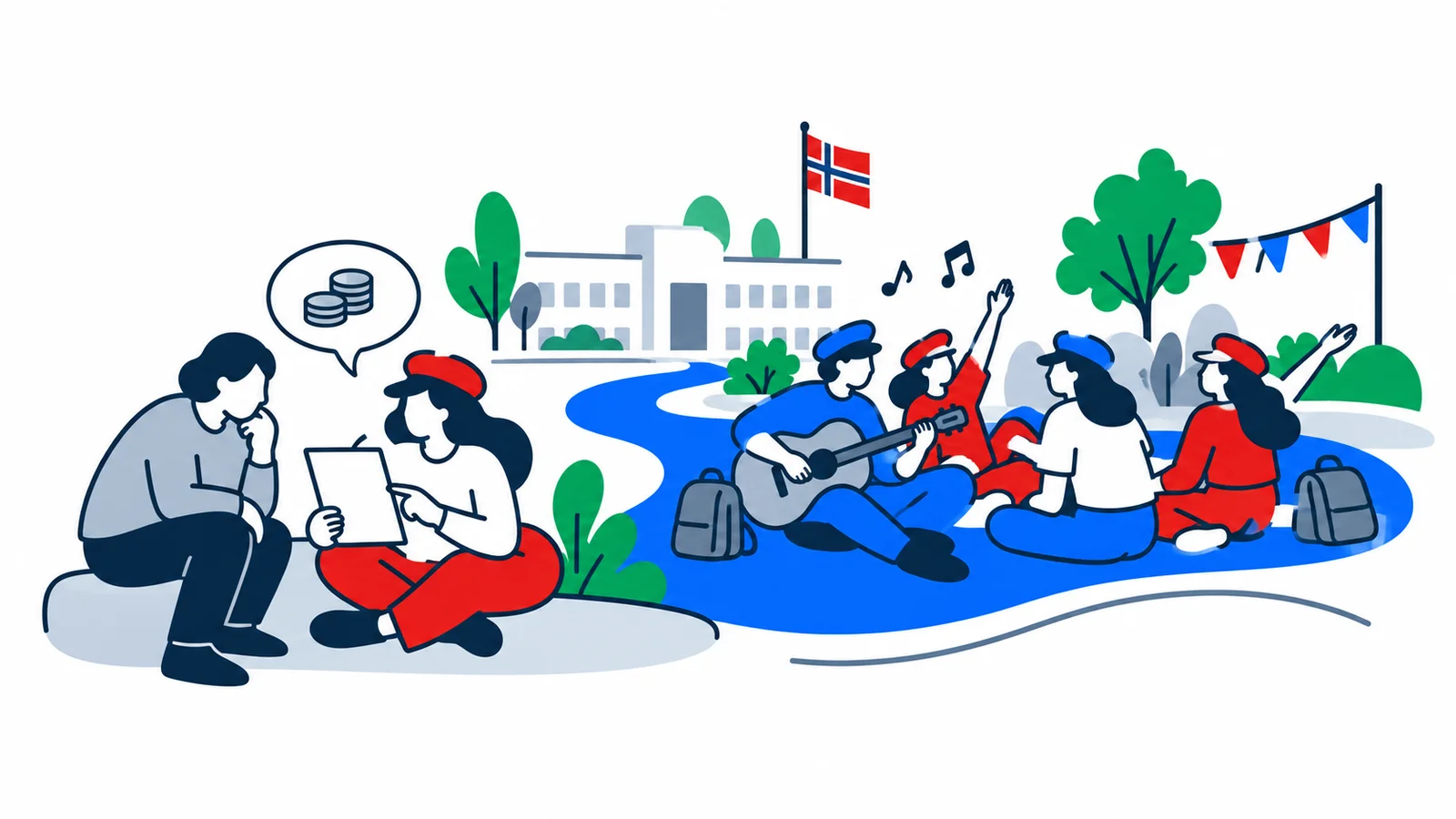

The class fund is a voluntary gift, not a bill. Primary school in Norway must be free, and this is stated in the Education Act (opplæringslova) § 2-5. Birthday rules and gift amounts are instead a matter of custom: something the class agrees on together, not something anyone can require of you.
Class fund, birthdays, and volunteering: what is law and what is custom
Everything related to education is free by law: the municipality cannot require you to pay for primary school education. The social aspects of the class — class fund, birthday celebrations, gifts, and parent chats — are instead custom that parents agree on together, not rules anyone can enforce.
| What | Can anyone require payment from you? | Legal basis or source |
|---|---|---|
| Books, computers, equipment, and transport during school time | No — the municipality pays | Education Act (opplæringslova) § 2-5 |
| School trip and residential school trip organized by the school | No — the municipality pays for meals and accommodation | Education Act (opplæringslova) §§ 2-5 and 4-6 |
| Class fund | No — voluntary and anonymous gift | Udir guidance, updated 4 April 2025 |
| Volunteering in the school's organization | No — must be genuinely voluntary | Udir guidance |
| Birthday gift and birthday celebration | No — no rule exists | custom, agreed in the class |
| After-school program (SFO/AKS), packed lunch, and school milk | Partly — 12 hours free after-school program per week for grades 1–3 from 1 August 2026, and three co-payment schemes. Otherwise you pay yourself | Education Act (opplæringslova) § 4-5, Udir guidance |
| Membership fees in a sports club or band | Yes — the organization decides | its own bylaws |
On SamfunnPrep you will find more tools for newcomers to Norway.
Class fund: do I have to pay?
No. No one can require you to pay. The Norwegian Directorate for Education and Training (Udir) accepts class fund as a form of gift, but writes: "However, gifts and effort must be voluntary."
A legal class fund must meet four conditions:
- The contribution is voluntary — no one should feel pressure to give.
- The contribution is anonymous.
- The money benefits the entire class.
- All students take part in the same activities, regardless of whether parents have given anything.
The anonymity requirement is easy to break without realizing it. Udir writes: "For this reason, records cannot be kept of who has given and how much each person has given." A Vipps list, a spreadsheet, or a message in the parent chat saying "X hasn't paid yet" therefore violates this requirement.
The Norwegian Parents' Association for Primary and Secondary Education (FUG) is equally clear: "It is not permitted to require payment or send reminders for outstanding payments." Parents contribute according to their ability.
The money in the class fund belongs to the class, not the individual parent. If your child moves to another class or school, you cannot demand "your share" back. FUG recommends that one of the parents serves as treasurer, and that the teacher has no responsibility for the money.
The principle of free education is now in § 2-5 — no longer in § 2-15
The principle of free education was given a new section number when the new Education Act came into force on 1 August 2024. The correct reference is now Education Act (opplæringslova) § 2-5, not § 2-15 from the 1998 law. Many Norwegian websites still use the old number.
The law states: "Primary school education shall be free. The municipality shall not require that pupils or parents cover expenses related to primary school education, for example expenses for teaching materials, transport during school time, residential school trips, or other school trips."
The responsibility lies with the municipality, not the teacher or principal. The municipality shall cover textbooks, digital learning materials, stationery, calculators, rulers, and tablets or computers. Students who do not participate in a school trip that is part of the curriculum shall receive alternative instruction at school.
School trips should not be funded by bake sales
The municipality shall offer students a school trip with overnight accommodation: Education Act (opplæringslova) § 4-6 requires at least three nights in a row.
Udir is direct: "The school cannot require payment for meals and accommodation from students. This shall be covered by the municipality." And further: "Pupils and parents therefore do not need to raise money for the trip through, for example, bake sales and volunteering."
This is often broken. In 2023, the county governors conducted eight inspections of the principle of free education, and six of them uncovered breaches. In one inspection, the county governor found that the volunteering tasks were not genuinely voluntary.
Volunteering cannot be made mandatory
No one can require you to volunteer in the school's organization. The school is responsible for ensuring that money-raising activities comply with the law and that "contributions are anonymous and genuinely voluntary."
Outside school, different regulations apply. The Norwegian Sports Confederation writes in its guidelines that a sports club cannot:
- impose "fines" or require members to pay "volunteering fees" for not participating in volunteering
- require non-members, for example parents, to participate in volunteering
This is the Norwegian Sports Confederation's internal guidelines and applies only to sports clubs. Bands, scout groups, and other organizations are governed by their own bylaws — ask the board what has been decided. See also the article on volunteering in Norway.
Parent council and class contact: what the law requires from 1.8.2024
The law now requires only one parent body. Education Act (opplæringslova) § 10-5 states: "Each primary school shall have a working committee elected by parents at the school. Parents may choose to organize themselves in other ways."
This is the entire legal basis for the parents' council working committee (FAU) today. From 1 August 2024, parents' council, cooperation committee (SU), and school environment committee (SMU) are no longer legally required, according to FUG. The municipality now decides for itself what other cooperation bodies the schools shall have, through local regulations under § 10-7. However, § 10-5 requires that the municipality establish this, and that "Pupils and parents shall be represented in bodies at primary schools". In many places, SU and SMU have been continued anyway.
Class contact is not mentioned in the law at all. FUG describes that parents choose one or two class contacts at the start of the school year. The tasks are to be a link to the class teacher, plan parent meetings, arrange something social, and welcome new families. Usually there are a few meetings per year.
According to FUG, class contacts and FAU members have a duty of confidentiality regarding personal matters under the Public Administration Act § 13. FAU cannot require mandatory payments from parents, but can take initiatives for voluntary fundraising, volunteering, and bazaars.
The school shall hold a parent meeting at the start of the school year and invite you to a conversation with the class teacher at least twice a year (Education Regulations (opplæringsforskrifta) § 11-1). Read more about parent meetings and school–home cooperation.
Birthday: who must you invite?
There is no law in Norway about who your child must invite to a birthday party. A private celebration at home is not regulated by the Education Act.
What can be regulated is the distribution of invitations at school. The municipality can issue regulations about order and conduct under Education Act (opplæringslova) § 10-7. But the rules you most often encounter are not regulations — they are agreements the school or parents have decided on together. Fuglenes School in Hammerfest municipality writes, for example, in its handbook for 2025–2026: "Regarding private celebrations, no birthday invitations should be handed out at school, except if all boys/girls or the entire year group are invited." At Lakselv Primary School in Porsanger municipality, it is the FAU — the parents themselves — who have decided on a similar guideline. Neither a handbook nor an FAU decision is law: check what applies at your own school.
There is also no rule for how much a birthday gift should cost. The same applies to bedtimes and screen time: these are "ground rules" that parents in the class agree on together, not something anyone can impose on you. Ask your class contact what your class has agreed on.
But here the line to the law is crossed: if the exclusion occurs at school, it is no longer just custom. Education Act (opplæringslova) § 12-2 gives all students the right to "a safe and good school environment", and § 12-4 requires the school to intervene and document what it does. Read more about the child's right to a safe and good school environment.
When you cannot afford it — and when the school is wrong
Complain in writing to the school first. If you do not receive a favorable response, the municipality sends your complaint to the county governor — for example, Bergen municipality describes this as the complaint process. The inspections in 2023 show that the school can be wrong.
If the family has a low income, there are support schemes for activities and equipment.
Family, school, and everyday life are among the topics you will encounter on the civics exam. On SamfunnPrep you can practice for free.