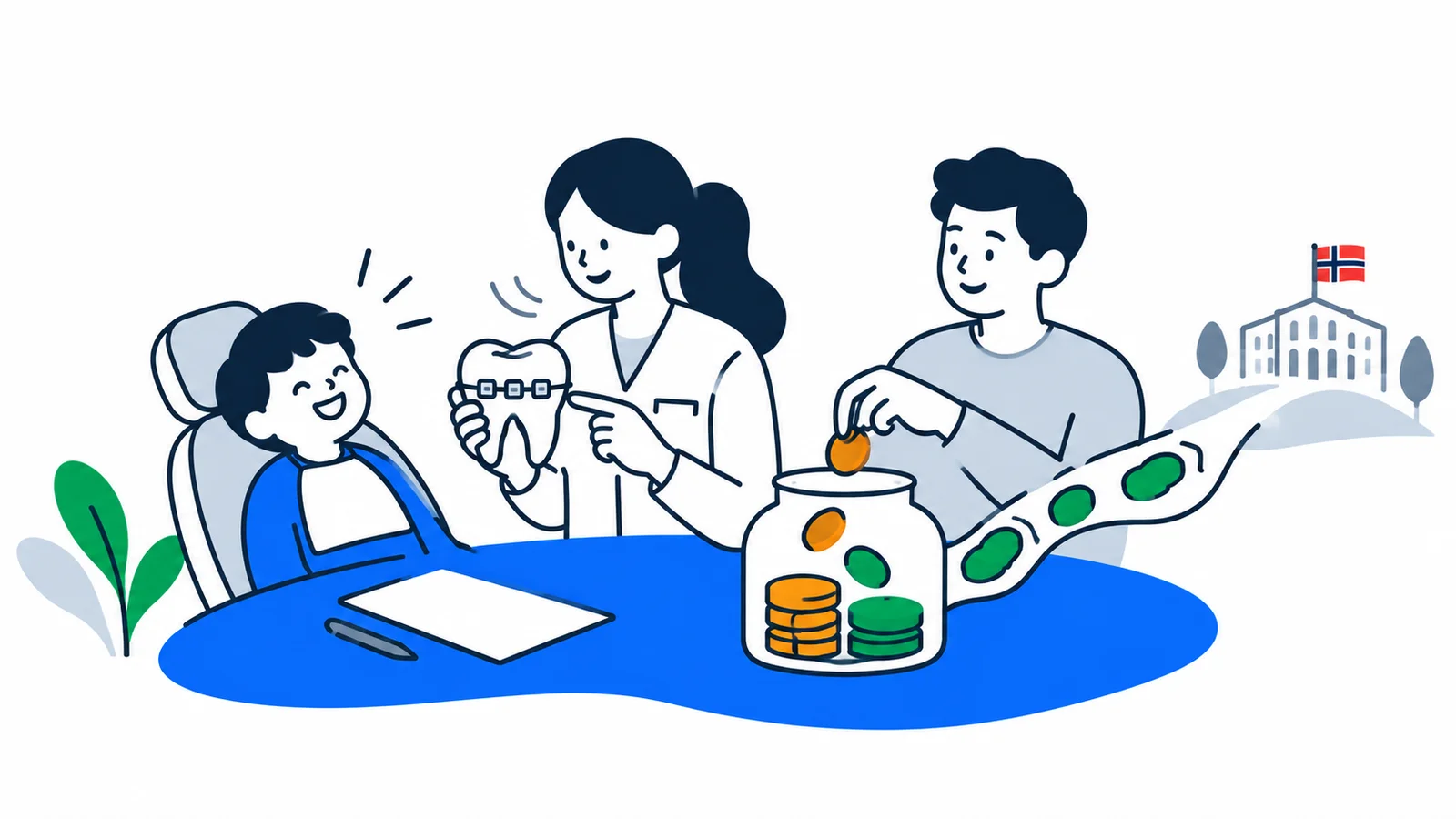

No — the state does not pay for all of your child's teeth straightening. Teeth straightening (orthodontics) is only partially covered, and how much you receive depends on how great the need is. There are three groups that cover 100, 75, or 40 percent. You pay the rest.
Is teeth straightening free for children?
No. Regular dental care is free for children up to and including the year they turn 18, and at a discount up to age 21. But teeth straightening is a completely separate scheme. Free dental care covers examination, cavities, and routine treatment — not straightening.
This is a common misunderstanding. Many people think that because dental care is free for children, teeth straightening is also free. Read more about what is actually covered in our guide to free dental care for children and young people. For adults it is even more expensive, as we explain in the article about dentists in Norway.
Support for straightening instead comes from HELFO (the Norwegian Health Economics Administration), through the national insurance system (folketrygden). At SamfunnPrep we explain how such Norwegian support schemes work in practice.
How much does HELFO cover? The three groups
HELFO covers a share of the teeth straightening based on how great the need is. An orthodontist (specialist in teeth straightening) examines the child and determines which group the treatment belongs to. It is need, not desire, that determines eligibility.
| Group | Need | HELFO covers (as of 1.1.2026) |
|---|---|---|
| a | Very large need | 100 % of the fee schedule |
| b | Large need | 75 % of the fee schedule |
| c | Clear need | 40 % of the fee schedule |
Group a applies to the most severe cases, such as cleft lip and palate or large bite problems that also require jaw surgery. Groups b and c apply to various bite irregularities with a clear treatment need. If the irregularity is minor or merely a cosmetic desire, it falls outside the scheme and gives no support.
If the family has several children needing straightening, there is sibling moderation. From the second child onwards, coverage in group b increases from 75 to 90 percent, and in group c from 40 to 60 percent. You must be able to document that treatment of the first child resulted in real costs for the family.
The percentages in the table have been the same for many years. For 2026 the Storting (Norwegian parliament) approved an additional increase in the fee schedule itself of 10 percent, but the coverage percentages in groups a, b, and c remain unchanged.
Why do you have to pay the remainder?
Even with support, most parents pay a remainder — often several thousand kroner. The reason is important to understand: HELFO covers a percentage of the state's fee schedule, not the price the orthodontist actually charges.
Orthodontists set their own prices, and they typically charge more than the fee schedule. So for example, 40 percent in group c only covers 40 percent of the fee schedule. The difference between the fee schedule and the actual price you pay as a remainder.
For example: a full teeth straightening treatment often costs between 18 000 and 45 000 kroner, averaging around 30 000 kroner (as of 2026). If the child is in group c, you may end up paying around 18 000–21 000 kroner yourself. In group b (75 percent) the remainder is smaller, but still several thousand kroner. Even in group a (100 percent) there may be a small remainder because the price may exceed the fee schedule.
The point is this: the percentage does not tell you how much you get back in kroner. Two families in the same group may pay different remainders because clinics charge different prices. Therefore it is worth asking for quotes from several orthodontists before you choose.
Note that expenses for teeth straightening do not count towards free-choice cards and patient fees. Straightening is a separate scheme, so you do not get a free-choice card for this money.
How to get support: from referral to reimbursement
You always start with your regular dentist. Without a referral you get no support from HELFO, even if the need is large.
Here's how you proceed:
- Go to your regular dentist. The dentist examines the bite and writes a referral to an orthodontist if there is a need.
- The orthodontist examines the child. The specialist determines which group (a, b, or c) the treatment belongs to.
- Ask for a cost estimate. You should receive a written price quote before treatment begins, showing what HELFO covers and what you must pay yourself.
- HELFO pays its share. Many orthodontists have direct settlement with HELFO. Then the support is deducted immediately, and you only pay the remainder to the clinic.
- Without direct settlement you pay the full amount yourself and apply for reimbursement from HELFO afterwards.
Age limits: when must treatment start?
For groups b and c, treatment must have started no later than the year the child turns 20. If you start too late, the support is forfeited. Therefore you should not wait if the dentist sees a need.
Treatment typically begins around age 12–13, when most permanent teeth are in place. If the young person is older, it may still be possible – see what applies to dentists for young adults (19–28 years).
How to plan for the remainder
Always ask for a written cost estimate before you agree. Then you will know in advance what HELFO covers and how much you must pay yourself. The surprise often comes when the family thinks everything is free.
Some tips before you begin:
- Ask if the clinic has direct settlement with HELFO, so you do not have to pay the full amount upfront.
- Ask if payment can be split. Many orthodontists offer installment plans over the course of treatment.
- Compare prices from several orthodontists, as they set their own prices.
- Remember sibling moderation if more than one child in the family needs straightening.
Understanding how the healthcare system, patient fees, and support schemes work is useful knowledge about Norway — this same topic appears in the citizenship knowledge test and citizenship test. On SamfunnPrep you can practice the citizenship knowledge test for free and become more confident about how the system fits together.