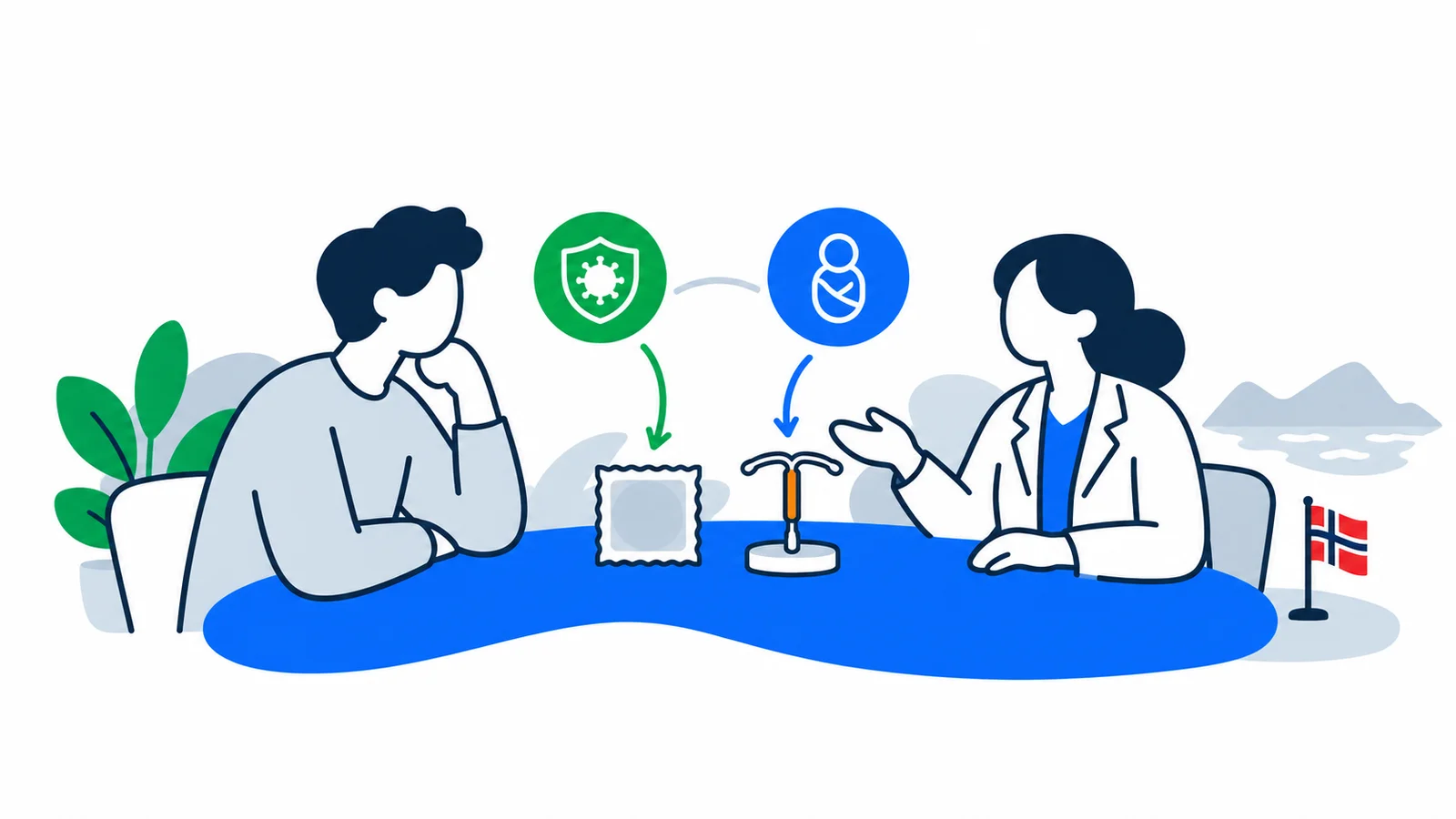

Condoms are the only contraceptive method that protects against both pregnancy and sexually transmitted infections (STIs). An IUD is inserted into the uterus by health personnel and is very reliable against pregnancy, but it does not protect against infection. As of 28 June 2026, people under 22 receive financial support for several contraceptive methods.
Condom: the only contraceptive method that protects against infection
A condom is the contraceptive used on the penis. For the social studies test, two facts are especially important: a condom is the man's contraceptive method, and a condom is the only contraceptive method that protects against STIs.
Helsenorge states that condoms protect against both sexually transmitted infections and pregnancy. This only applies when the condom is used correctly and stays on during all vaginal, anal or oral sex. If it breaks or slips off, you are no longer protected against infection or pregnancy.
Condoms can be bought without a prescription at pharmacies, grocery stores, kiosks and petrol stations. There is also a public service where you can order free condoms anonymously. This is useful if you are new in Norway and do not know where to start.
Remember the difference: the pill, implant, hormonal IUD and copper IUD can protect well against pregnancy, but they do not protect against STIs. To understand where to get help, see the guide to the health system in Norway.
IUD: long-acting contraception inserted into the uterus
An IUD is a small T-shaped device inserted into the uterine cavity by a doctor, midwife or public health nurse. Many people go to a GP, midwife, gynaecologist or youth health clinic. Read more in the guide to GPs and specialists.
There are two main types of IUD:
- Hormonal IUD releases progestogen locally in the uterus and can last for several years, depending on the type.
- Copper IUD contains no hormones. It prevents sperm from fertilising the egg and reduces the chance that a fertilised egg attaches in the uterus.
Both types are very reliable against pregnancy. Helsenorge describes IUDs and implants as long-acting methods with high reliability because you cannot forget them in daily life. An IUD can be removed by health personnel if you want to change method or try to become pregnant.
An IUD does not protect against sexually transmitted infections. This is the common misunderstanding: an IUD can be more reliable than a condom against pregnancy, but a condom is needed if you also need infection protection.
Other common contraceptive methods
Contraception means methods intended to prevent pregnancy. In Norway you can get advice from a GP, youth health clinic, midwife or some sexual health clinics. The right method depends on age, health, medicines, menstruation, breastfeeding and your own preference.
Common methods include:
- The pill: hormonal tablets taken regularly. They require a prescription.
- Implant: a small hormonal rod inserted under the skin of the upper arm and effective for several years.
- Vaginal ring and patch: hormonal methods used at fixed intervals.
- Emergency contraception: emergency pills can be bought without prescription. They work best when taken quickly after unprotected sex. Some types can be used up to 5 days, and a copper IUD can be inserted as emergency contraception within 5 days.
- Sterilisation: a permanent method for adults who are sure they do not want more children.
None of these methods protects against STIs. If you have a new partner, several partners, or are unsure whether your partner has been tested, condom use is the important extra layer of protection.
Sexually transmitted infections: symptoms and testing
STI means sexually transmitted infection. In Norwegian people may also say kjønnssykdommer, and SOI is often used. Examples are chlamydia, gonorrhoea, syphilis, herpes, HPV and HIV.
Chlamydia is the most frequently reported STI in Norway. FHI reported 22,297 notified chlamydia cases in 2025, and 65 percent were among people under 25. Gonorrhoea, syphilis and HIV also occur in Norway, but the numbers are lower than for chlamydia. Some infections cause burning, discharge, sores or pain. Others have no clear symptoms.
That is why testing matters. Helsenorge recommends that young people and young adults test every time they have had unprotected sex with a new partner, including when a condom broke or slipped off. Testing can be done through a GP, youth health clinic, student health service or sexual health clinic. GPs, health clinics and student health services offer free testing and treatment for sexually transmitted diseases.
Youth health clinics are free municipal services, usually up to age 20. Some municipalities offer services up to age 25. See also our guide to youth health clinics.
Free and cheaper contraception for young people
As of 28 June 2026, the national support scheme for contraception is linked to age under 22, not under 25. Helsenorge and Helfo state that people under 22 receive financial support to cover all or part of the cost of the pill, patch, vaginal ring, injection, implant, hormonal IUD or copper IUD. There is no lower age limit, and the scheme lasts through the month before you turn 22.
From 1 January 2026, the support is:
| Period | Support |
|---|---|
| 3 months | 143 kroner |
| 6 months | 286 kroner |
| 1 year | 572 kroner |
The pharmacy calculates the discount when you collect the contraception. Some methods become free, while others become cheaper. Long-acting methods such as IUDs and implants may cost more on the first day, but last for several years.
Condoms are different: they do not require a prescription, can be bought in many places, and can also be ordered free through the public condom service. If you pay user fees for doctors or treatment, the guide to exemption card and user fees may help.
Your rights: confidentiality, interpreter and safe help
You have the right to seek sexual health help without shame. Health personnel have a duty of confidentiality. This means that GPs, health clinics, midwives, psychologists and clinics cannot tell others what you asked about or chose, unless you consent or there is a serious legal exception.
Young people can also contact a youth health clinic without parental permission. Helsenorge explains that young people over 16 generally decide themselves whether information is shared with parents. Between ages 12 and 16, it may sometimes be possible to ask that parents are not contacted.
If you do not understand Norwegian well enough in a health consultation, the health service must assess the need for a qualified interpreter. You should not have to use children, a partner or friends as interpreters in sensitive health matters.
Sexual health is also linked to self-determination over your own body. If you need information about pregnancy and choices, read about abortion and self-determination. This article is general health information, not personal medical advice. Contact a GP, health clinic or emergency clinic if you need advice for your situation.