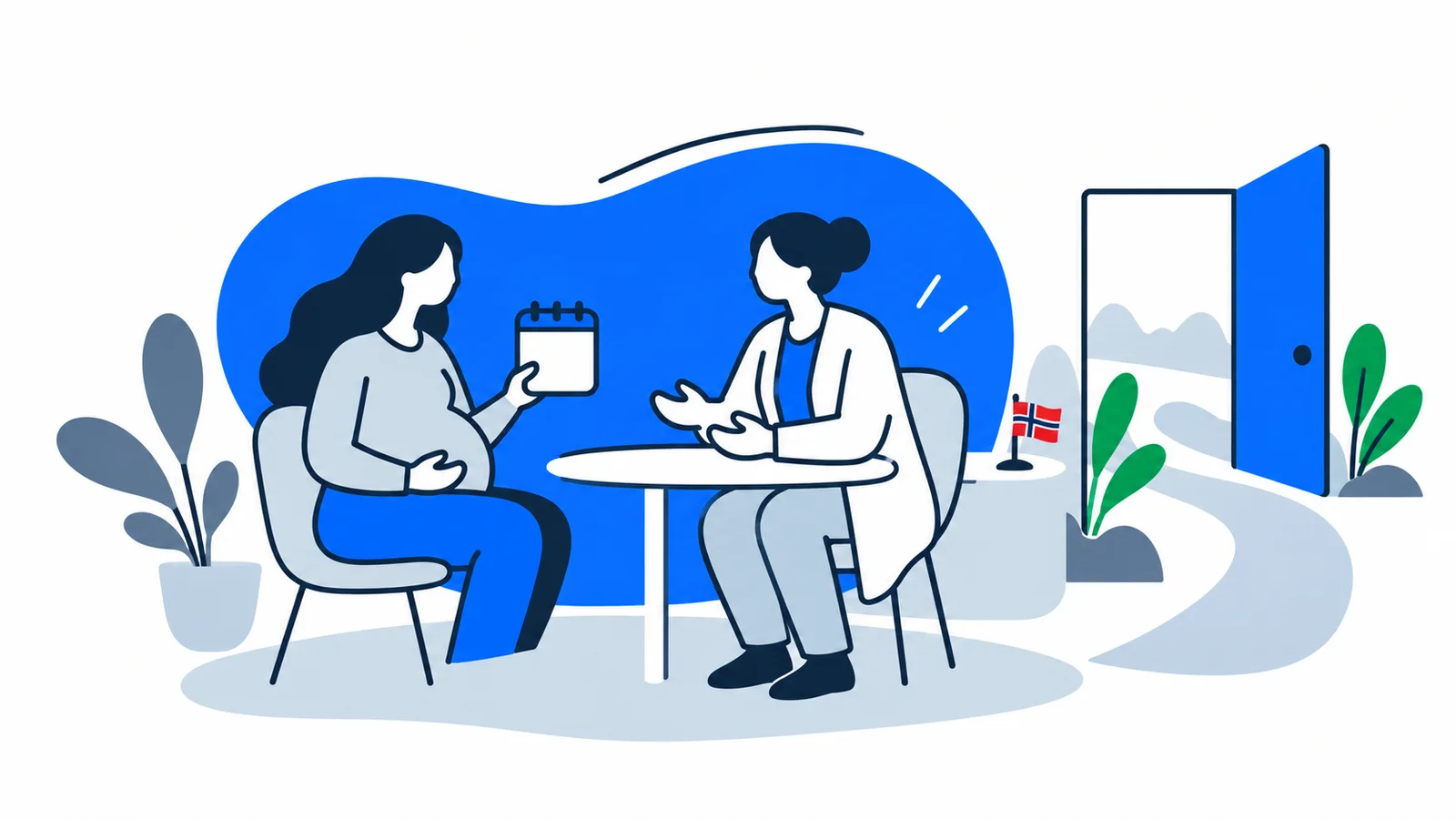

In Norway, pregnant people have the right to self-determined abortion until the end of the 18th week of pregnancy. You do not need to give reasons, and health personnel have confidentiality. Abortion is free for people who are resident in Norway.
Self-determination: your right to choose
Abortion is a sensitive topic for many people. This article only explains what the rules in Norway say, and how you can get help. It does not judge what is the right choice for you.
As of 28 June 2026, the Abortion Act says that pregnant people have the right to self-determined abortion until the end of the 18th week of pregnancy. This means 17 weeks and 6 days. This is also the important number for the social studies test: in Norway, the pregnant person decides whether to have an abortion during the first 18 weeks of pregnancy.
You do not need to explain your choice to a doctor, partner, family or employer. No one else must approve the abortion before week 18. Health personnel must give information and guidance in a way you understand, but the choice is yours.
The right applies to everyone staying in Norway under the Abortion Act. Helsenorge also states that abortion is free for people who are resident in Norway. People from the EU/EEA who work in Norway but do not live here can generally also have abortion expenses covered. People without legal residence have the right to abortion as long as they are in Norway.
If you are new in the country, it may help to read more about the health system in Norway and who you can contact first.
The limit at week 18
The limit for self-determined abortion changed from week 12 to week 18 when the new Abortion Act entered into force on 1 June 2025. The current law is Act 20 December 2024 no. 96 on abortion. In the new law, the main rule is in section 3, not in the old 1975 law.
Pregnancy weeks are usually counted from the first day of the last menstrual period. At the hospital, a doctor, midwife or other health personnel can use ultrasound to assess how far the pregnancy has progressed. Helsenorge says you do not have to look at the ultrasound image yourself.
You can contact the health service in two ways:
- Call your GP, youth health clinic or midwife and ask for help contacting a hospital.
- Contact the hospital’s gynaecology outpatient clinic directly. You do not need a referral to request an abortion.
The Norwegian Directorate of Health says requests for abortion must be handled as quickly as possible. If you make the request before the limit, but the hospital must postpone the procedure briefly for medical or practical reasons, the case does not automatically have to go to a board.
If you are unsure about the difference between GP, out-of-hours clinic and hospital, read the guide to GPs and specialists.
Abortion after week 18: board and exceptions
After the end of the 18th week of pregnancy, the automatic right to self-determination no longer applies. An abortion board must then give permission before an abortion can be performed, except in acute situations where serious danger to the pregnant person’s life or health makes rapid treatment necessary.
An abortion board is not a court and not a trial. It is a medical, social and legal assessment. Under the new law, the board has three members: a doctor, a lawyer and a person with health or social work competence. You have the right to meet the board if you want, but you do not have to attend. You may also bring someone with you.
Section 3 of the Abortion Act says the board must grant permission if the conditions are met. Examples include danger to the pregnant person’s physical or mental health, pregnancy after rape, incest or other sexual offences, a serious condition in the fetus, or an overall life situation that makes pregnancy, birth or care especially difficult. The board must give significant weight to the pregnant person’s own assessment.
After the end of the 22nd week of pregnancy, abortion can only be performed if it is clear that the fetus will die during pregnancy or shortly after birth.
How to contact the health service
You can start with the part of the health service that feels safest: GP, youth health clinic, midwife or hospital. Health personnel must help you further. You can also ask for information about method, pain, bleeding, practical steps and follow-up.
You have the right to an interpreter if you need one to understand information about health and treatment. Interpreters in the health service are free for patients, with some exceptions for dental care. Children must not be used as interpreters, and family members should not replace qualified interpreters.
Health personnel have confidentiality. They cannot tell a partner, parents, employer, school, UDI or others about an abortion without your consent, unless there is a specific legal basis for sharing information. For people over 16, confidentiality is strict. If you are under 16, parents are usually informed, but Helsenorge says this must not happen if you have good reasons that should be respected. It is still the pregnant person who decides whether to have an abortion.
For pregnant people already in pregnancy follow-up, the article on health clinics and pregnancy care explains more about midwives and municipal services.
Contraception and support afterwards
After an abortion, you can get advice about contraception, bleeding, pain and when to contact a doctor. Your GP, midwife, youth health clinic and hospital can guide you. Many people want contraception quickly afterwards, because it is possible to become pregnant again soon after an abortion. Read more in the guide to contraception in Norway.
The new Abortion Act also gives a right to a follow-up conversation after abortion. The Government states that from 1 June 2025, up to two follow-up conversations without user fee are provided. The conversations can take place in the specialist health service, at a health clinic or with a GP.
Some feel relief, others grief, worry or mixed feelings. All reactions can be normal. There is no mandatory counselling before abortion, but you can ask for a conversation if you want. Helsenorge refers, among others, to Amathea as a low-threshold service for people who need someone to talk to about pregnancy, abortion and mental health.
Your rights in an equal society
The abortion rules are also about self-determination, privacy and equality. In Norway, no one may be pressured into abortion, and no one may be pressured to continue a pregnancy. Helsenorge clearly says that no one is allowed to force you to have an abortion, and that an abortion cannot be carried out unless you want it yourself.
Family, partner, religious communities or employer may have opinions, but they cannot make the decision for you. An employer also has no right to health information about abortion. If you experience pressure, violence or threats, contact health personnel, a crisis centre, the police or another safe service.
For the social studies test, the short rule is: the pregnant person has the right to self-determination for abortion until week 18. After week 18, the case must be assessed by an abortion board under the law. This is linked to broader rules on equality in Norway, patient rights and the right to health care.