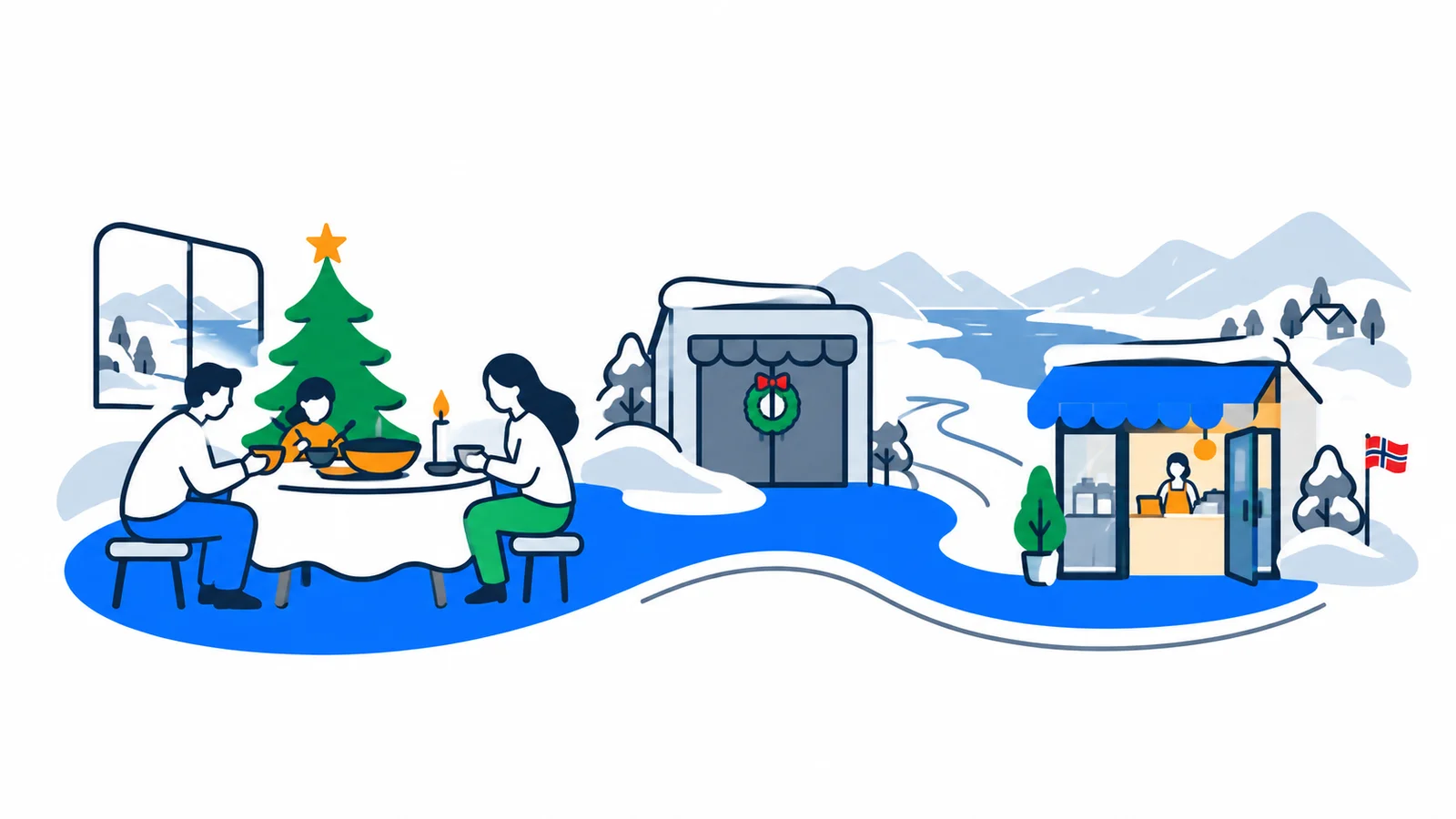

Christmas in Norway is celebrated with Christmas Eve on 24 December as the most important evening, three official public holidays (25, 26 December and 1 January), and a quiet period between Christmas and New Year when most shops are open again.
When are the important days in Christmas?
The most important dates in Norwegian Christmas are easy to remember. Christmas Eve is 24 December, and the official public holidays are 25 December (Christmas Day), 26 December (Boxing Day) and 1 January (New Year's Day). You can read more about all Norwegian public holidays throughout the year, not just at Christmas.
Between Christmas and New Year, we have a period known as between Christmas and New Year. These are the days from 27 to 31 December. This period is not a public holiday, so most people work and shops are open as usual.
| Date | What happens | Open or closed |
|---|---|---|
| 24 December | Christmas Eve – the main celebration evening | Shops must close by 4:00 PM |
| 25 December | Christmas Day (public holiday) | Closed |
| 26 December | Boxing Day (public holiday) | Closed |
| 27–31 December | Between Christmas and New Year | Open, but some places with shorter opening hours |
| 1 January | New Year's Day (public holiday) | Closed |
What is open during Christmas?
The answer is simple: on public holidays almost everything is closed, while during the Christmas-New Year period most things are open again. This applies to shops, shopping centres and many other services.
On 25, 26 December and 1 January, most shops are completely closed. This follows the Norwegian Holiday Law, which states that shops should as a rule be closed on public holidays, and that they should close no later than 4:00 PM on Christmas Eve. The exception is a few kiosks and petrol stations, which often have their own limited opening hours.
Vinmonopolet, the state-owned shop that sells wine and spirits, follows similar rules. Vinmonopolet is closed on all public holidays and closes early on Christmas Eve. If you want to understand alcohol regulations and how Vinmonopolet works better, it is a good idea to read about it before you plan your Christmas shopping.
Public transport, such as buses, trams and trains, often runs with reduced schedules during Christmas, especially on Christmas Eve and the three public holidays. Always check the timetable of your local transport company before you travel during the Christmas-New Year period or on Christmas Eve.
Christmas Eve: the main evening
For most Norwegians, Christmas Eve, 24 December, is the highlight of Christmas – not 25 December, as many other countries celebrate most.
In the evening, families gather for Christmas dinner, often at 5:00 PM when church bells ring in Christmas. Many also attend a Christmas service in church earlier in the day, often in the afternoon. After the meal, most families open their Christmas presents together, often around a decorated Christmas tree with lit candles.
Children often enjoy an Advent calendar, a calendar with 24 doors from 1 to 24 December, where you open one door each day leading up to Christmas Eve. Many Norwegian families also follow a Christmas calendar on TV or radio in December.
The next day, 25 December, is a quiet public holiday that many use to relax or visit family. For newcomers to Norway, it can be a good opportunity to get to know neighbours or colleagues who are celebrating, if you are invited.
Norwegian Christmas traditions: food, Christmas parties and the Christmas gnome
Norway has many established Christmas traditions that are good to know about before your first Christmas here.
Some of the most well-known are:
- Julebord – a Christmas party with colleagues, often in November or December, with good food and socialising.
- Ribbe – pork ribs, the most popular Christmas dinner in large parts of the country.
- Pinnekjøtt – salted and dried lamb ribs, especially common on the west coast.
- Lutefisk – dried fish treated with lye, a traditional but controversial Christmas dish.
- Nisse – a small, bearded figure in a red cap who in Norwegian folklore brings Christmas presents.
- Risgrøt – a warm and sweet rice pudding, often served as breakfast or dessert at Christmas, often with a hidden almond that wins a small prize.
Christmas is also a time for peace and preparation. Many families bake gingerbread and other Christmas biscuits well before Christmas, and decorate the Christmas tree together. It is also common to light Advent candles each Sunday during the four weeks before Christmas Eve, a period called Advent.
Not everyone celebrates Christmas – and that is fine
Norway is a country with many religions and worldviews, and not all inhabitants celebrate Christmas.
Some have a different religion, such as Islam or Judaism, and celebrate their own holidays instead. Others have no religion and choose not to celebrate at all. This is fully accepted in Norway, and you never need to participate in Christmas celebrations if it does not fit your beliefs or values.
At the same time, it can be useful to understand Christmas celebrations, since they affect opening hours, working life and school routines for everyone who lives here – regardless of whether you celebrate or not. Understanding Christmas is also part of understanding Norwegian values and unwritten rules in Norwegian society.
Practical tips for Christmas
Here are some simple tips that can make planning easier:
- Shop for food and gifts before 24 December, as many shops close early that day.
- Do not forget Vinmonopolet if you need alcohol for your celebration – check the opening hours in advance, as they close earlier before public holidays.
- Check the public transport timetable, especially if you are travelling on Christmas Eve or New Year's Eve.
- Ask your workplace which days are public holidays, as this can vary slightly between sectors.
- Schools and nurseries usually have Christmas holidays from mid-December to early January.
- It is dark and often cold in December, so remember warm clothes and preferably reflective gear when you are out during the Christmas-New Year period.
Christmas and citizenship knowledge in Norway
Knowing about holidays such as Christmas is part of understanding Norwegian society, and the topic is also relevant for the citizenship exam. Questions about Norwegian traditions, public holidays and values can come up in the exam, so it is worth knowing about them well before exam day.
With SamfunnPrep you can practise exactly such questions, at your own pace, and become more confident in Norwegian society knowledge before your next exam. SamfunnPrep covers topics such as holidays, values and community life in a simple and clear way. Try for free and see how it works today.