
Children's glasses can receive support from Nav when the child is under 18, is registered as resident in Norway and meets the prescription requirement. Support covers buying up to one pair per calendar year. The optician can often deduct it directly from the price.
Who can get support for glasses?
Children under 18 can receive support when their prescription meets Nav's conditions. The glasses must be ordered before the child turns 18, and the child must be registered as resident in Norway.
Nav, the Norwegian Labour and Welfare Administration, requires a prescription of at least 1.00 dioptre in at least one lens. The requirement can also be met through a cylinder power of at least 1.00 dioptre in at least one lens. Cylinder power corrects astigmatism.
A dioptre, abbreviated D, is the unit of power in spectacle lenses. Power may be shown with a plus or minus sign. Let the optician check the condition using the child's prescription. You do not need to calculate the correct support rate yourself.
The rules and rates in this guide were checked on 4 October 2026 against Nav's information on children's glasses. This is a separate support scheme. Entitlement does not automatically follow from the rules on free doctor visits for children and young people.
How much support does a child get in 2026?
Support ranges from 800 to 5,165 kroner, depending on the prescription. You cannot receive more than the actual cost of the glasses. You pay any amount above the support yourself.
Nav's rates for opticians apply from 1 January 2026, checked on 4 October 2026:
| Rate | Amount |
|---|---|
| Rate 1 | 800 kroner |
| Rate 2 | 2,075 kroner |
| Rate 3 | 2,820 kroner |
| Rate 4 | 3,355 kroner |
| Rate 5 | 5,165 kroner |
The optician uses the prescription to find the correct rate. A more expensive brand or frame does not in itself give higher support.
Calculation example: The child's correct rate is 800 kroner and the glasses cost 1,600 kroner. You pay the remaining 800 kroner. The example only shows payment after the rate has been established. It does not determine your child's rate.
Ask for the total price and support amount before ordering. You can then compare two offers using what you will actually pay, rather than just the price before support.
What does the scheme cover, and what do you pay yourself?
Support can cover lenses, frames and fitting within the rate. It does not cover an eye examination, repairs or ongoing rental of glasses.
The order must include lenses. You cannot get this support just for a new frame without lenses. Ask the optician how each part appears on the order.
| Expense | This scheme |
|---|---|
| Lenses with frames and fitting | Can be covered within the correct rate and actual price. |
| Eye examination | Not covered. Ask the price before the examination. |
| Repairs | Not covered. |
| Glasses subscription with ongoing rental | Does not give entitlement to support under this purchase scheme. |
A subscription with a low monthly price is therefore different from buying glasses with support. Ask for an explanation of whether the agreement is a purchase or rental. Do not use the monthly price as proof of the total purchase price of the glasses.
How do you receive support directly at the optician?
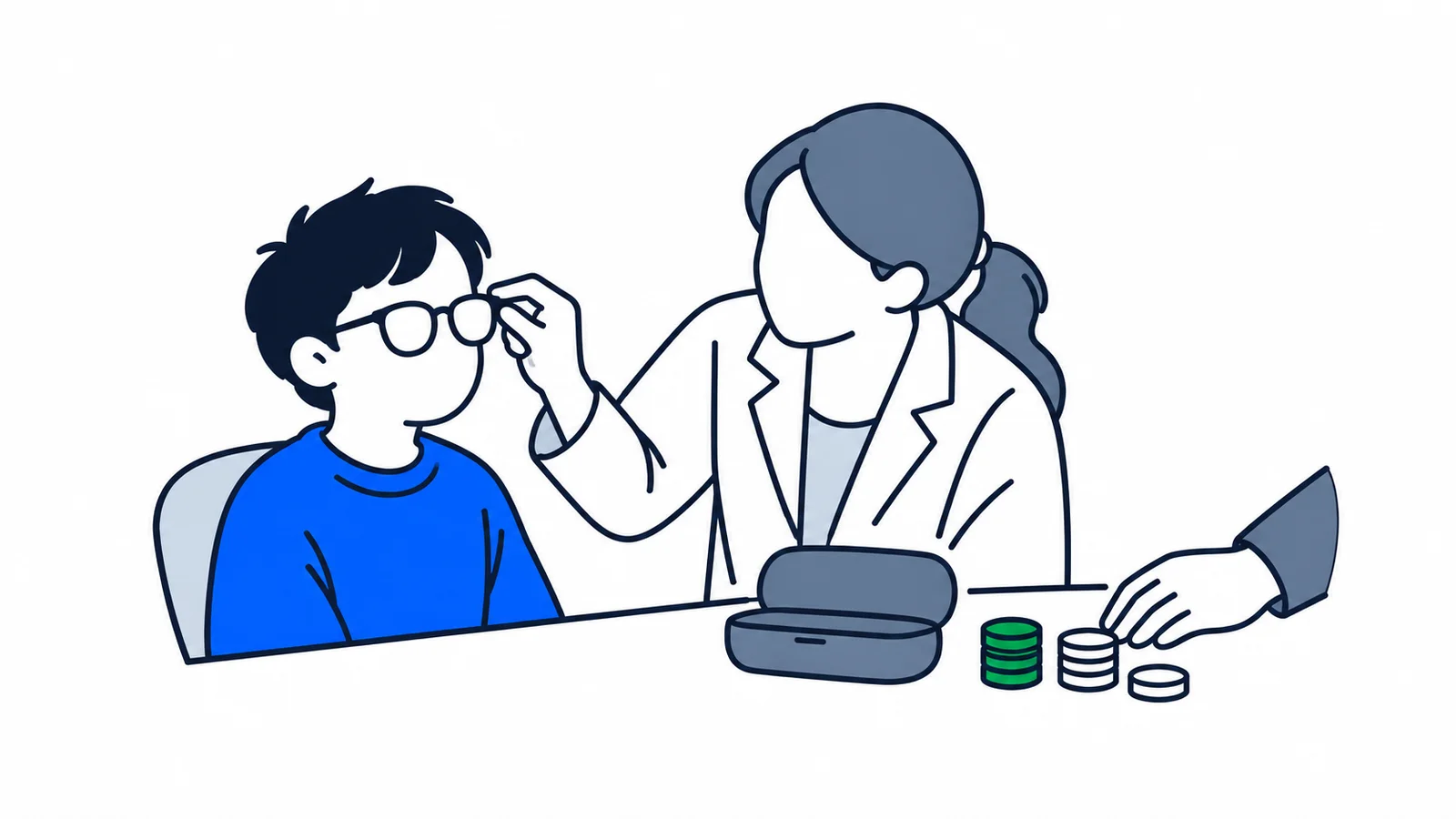
An optician with a direct settlement agreement with Nav can apply for you and deduct support from the price. You pay the difference when the glasses cost more than the rate.
Direct settlement means Nav pays the support to the optician. When this arrangement is used, you usually do not need to pay the full amount up front and apply for reimbursement later.
Do this before ordering:
- Ask whether the optician offers direct settlement for children's glasses.
- Let the optician check the child's prescription and the conditions.
- Ask for the total price, Nav support and the amount you must pay.
- Check that the order is registered before the 18th birthday if it is approaching.
- Keep the order documents and proof of payment.
If the digital system rejects the case, this does not always mean a caseworker has assessed all the information. Nav explains that you can then submit an application yourself and have the case assessed. Ask the optician to explain what happened and which documents you need.
Which documents do you need if you apply yourself?
You need a prescription and documentation of the order from the optician. Nav must be able to see the child's prescription and the total, actual cost of the glasses.
The prescription must come from an optician or ophthalmologist. The order documentation must include:
- the child's name
- the order date
- the type of lenses and frames
- the total cost, including lenses, lens grinding, frames, VAT and fitting
- the shop's name
- the optician's signature
Nav cannot approve the application when the cost is stated only as an ongoing monthly amount. Ask for the application document before leaving the shop.
Use the application entry point on Nav's page. If you submit the application yourself, support is paid to the person who submitted it. Keep a copy of what you send and watch for requests from Nav for further information.
What if the glasses break in the same year?
The regular scheme gives support for up to one pair per calendar year. You do not receive another supported pair in the same year just because the first pair breaks.
Repairs are not covered by this scheme either. Ask the optician about repair prices and any warranty. Assess the conditions and cost if you are offered insurance.
Tell the optician if the child has already received support earlier in the year. This avoids basing a new quote on support that cannot be used again.
Are there other vision support schemes?
Yes. Glasses for treating amblyopia and aids for visual impairment have separate conditions. Do not use the regular glasses support rules as a complete overview of these offers.
Amblyopia means reduced development of vision, often called a “lazy eye”. Nav has a separate scheme for treating and preventing amblyopia. Ask the optician or ophthalmologist which scheme suits the child's needs.
A child can receive support through different schemes in the same year, but cannot receive double support for the same pair. The optician can help distinguish between the schemes and their documentation.
For questions about vision itself, contact an optician or doctor. Helsenorge explains who treats vision. On SamfunnPrep, you can also find guides and tools for Norwegian services and an explanation of access to your own Nav case.