
A foster home is an ordinary home that takes in and cares for a child who cannot live with their parents. You do not need special education to become a foster parent – you must be a safe and stable adult with the time, space and capacity for a child. Singles, couples and families can all apply. You start by contacting Bufetat (the state child, youth and family agency) or the kommune (the municipality), attend an information meeting and complete basic training before the kommune approves you. Throughout the whole process, barnevernet (the child welfare service) keeps responsibility for the child.
What is a foster home?
A foster home is a private home that takes on the care of a child following a decision by barnevernet. This is set out in the barnevernsloven (the Child Welfare Act), which was renewed on 1 January 2023: “A foster home means a private home that provides care for a child on the basis of a decision made under this Act.”
As a foster parent, you have the day-to-day care of the child. But you do not take over the child. Barnevernstjenesten in the kommune (the municipal service responsible for helping children and families) keeps the responsibility. The parents remain the child's parents. A foster home arrangement is normally meant to be a solution for a period of time, and barnevernet works to make it possible for the child to move back home again when that is in the child's best interest. Bufdir is the directorate (the state agency) responsible for foster care work in Norway.
Foster home, emergency home (beredskapshjem) and institution – what is the difference?
Most children who cannot live at home move to an ordinary foster home. Barnevernet always looks first within the child's own family and network, because it is often safer for the child to live with someone they already know.
A beredskapshjem (emergency home) is something different. It is a temporary solution for children and young people who need to move quickly, while barnevernet works out what should happen next. An emergency home is often a full-time job, and requirements such as relevant education may apply here.
Some children live at a barnevernsinstitusjon (child welfare institution) instead of in a foster home. An institution is not a home with a family, but a residence with staff. This guide is about ordinary foster homes.
Who can become a foster parent?
Ordinary people can become foster parents. You do not need a specific education for an ordinary foster home. Bufdir emphasises that you should be a safe and stable adult with warmth and understanding for others. These are the most important requirements:
- Stable life situation: You should have a calm and predictable everyday life. Singles, couples, cohabitants, same-sex couples and families can all apply. If you are a couple, it is an advantage to have lived together for a while.
- Good enough health: Your physical and mental health must be good enough to take care of a child. A chronic illness or reduced functional ability does not automatically rule you out.
- Secure finances: Your finances must be stable. You do not need a high income.
- Time and capacity: You must have the time, space and energy for a child. The home should be of an ordinary standard and have a separate room for the child.
- Suitability: Barnevernet assesses whether you are suited to the task, among other things through conversations and home visits.
- Police certificate: Everyone over 18 år in the household must provide an exhaustive and extended police certificate (politiattest). Violence or abuse means you cannot become a foster home.
The age is usually between 25 and 67 år, but there is no absolute limit.
How to become a foster home, step by step
The process is designed so that you get to know well what the task involves before you decide. Making contact or attending a meeting does not commit you to anything.
- Make contact. Contact the foster care service (fosterhjemstjenesten) at Bufetat in your region, or the kommune. If you live in Oslo, you contact Oslo kommune.
- Attend an information meeting. Here you learn more about what it means to be a foster home.
- Fill in a self-presentation. You fill in a form telling about yourself and your family.
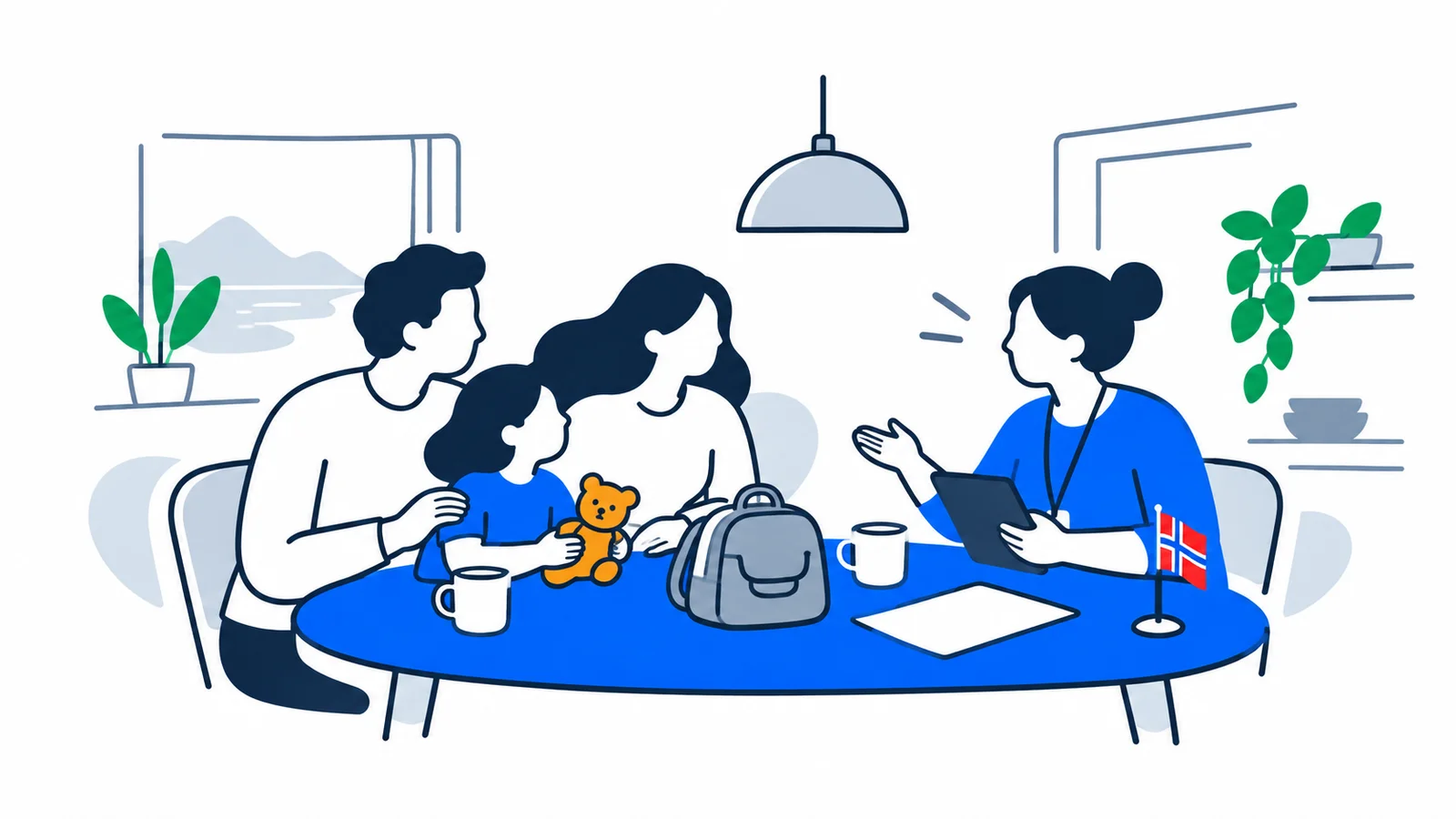
- Conversation and home visit. Barnevernet talks with you and comes to visit your home.
- Basic training. You complete the basic training programme, called Solid. It consists of e-learning and in-person gatherings.
- Assessment and approval. Finally, a professional assessment is made, and the kommune approves you as a foster home.
The basic training and assessment take on average around three months. How long it takes before a specific child moves in varies.
Follow-up and payment
You are not alone. The kommune is responsible for following up and guiding you for as long as you are a foster home, adapted to your needs and the child's needs.
Being a foster parent is also paid. The payment from the kommune has two parts. One is a work allowance (arbeidsgodtgjøring, also called grunnstøtte, or basic support). This is payment for the task itself, it is taxable, and it counts towards your pension entitlement in folketrygden (the National Insurance Scheme). The other is an expense allowance that is meant to cover the running costs of having the child living with you, such as food, clothes, housing and leisure activities. The expense allowance is tax-free.
In the vast majority of cases, the payment is based on the guideline rates set by KS (the Norwegian Association of Local and Regional Authorities). The rates change every year from 1 July. How much you receive depends, among other things, on the child's age and needs, and the kommune sets the amount in each individual case. If you disagree with a decision, you have the right to appeal. Ask the kommune or Bufetat about the specific rates that currently apply.
Norway needs foster homes with multicultural backgrounds
Norway needs more foster homes, and homes with diverse and multicultural backgrounds are especially in demand. Bufdir encourages people with multicultural backgrounds to apply. One important reason is that this makes it easier for children to keep their language and culture when they move to a new home. You must know Norwegian well enough to support the child at school and in society, but your background can be a strength, not an obstacle.
How to get in touch
Contact the foster care service at Bufetat in your region, or barnevernstjenesten in the kommune, to arrange an information meeting. You can read more about parents' rights when barnevernet is involved and about child welfare and immigrants. If you are considering taking on long-term care of a child in another way, you can also read about adoption in Norway.