

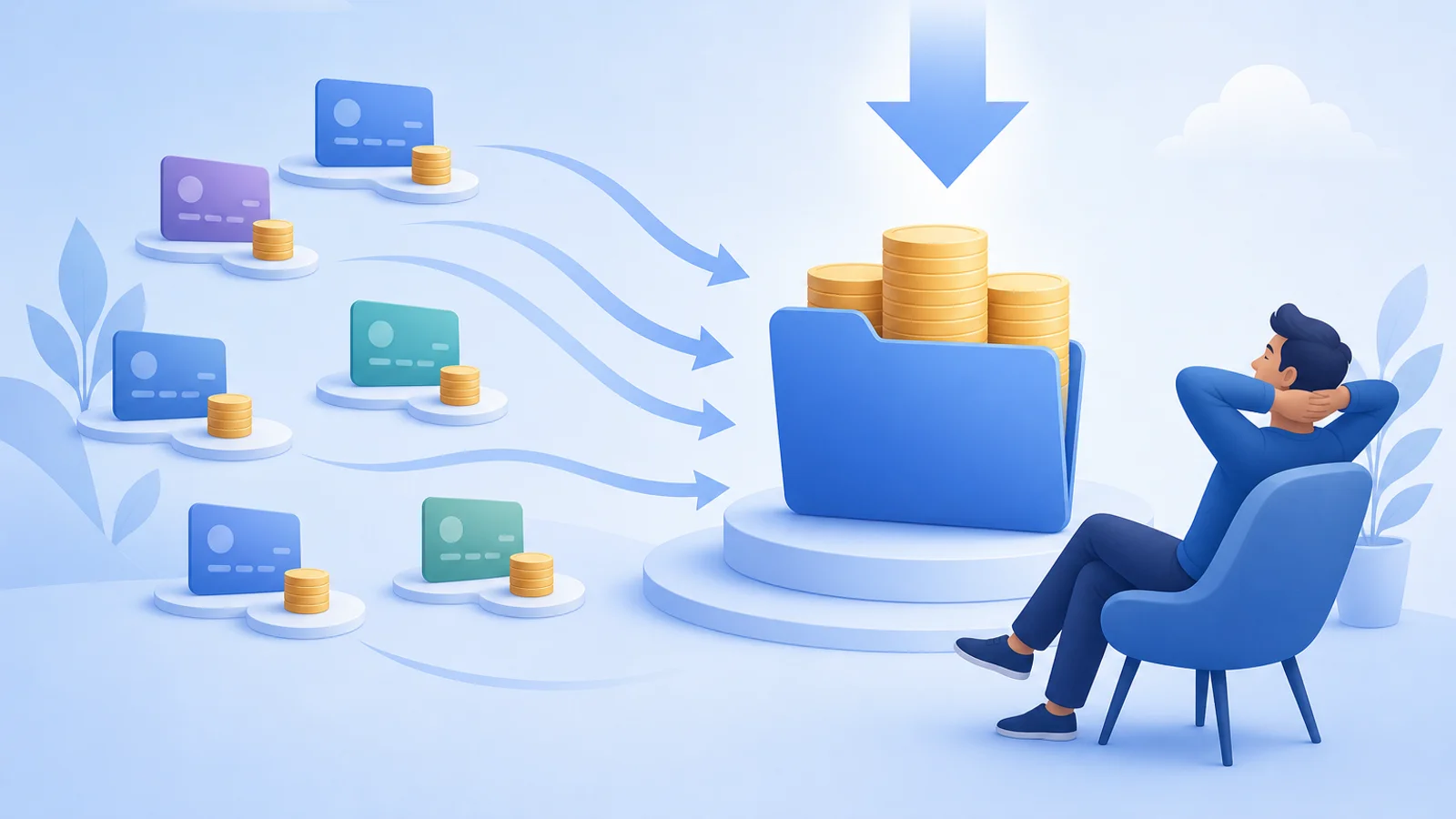

Refinancing means you consolidate several expensive loans and credit cards into one new loan with a lower interest rate. You get lower interest costs and one bill instead of many. But it only makes sense if you actually get a lower effective interest rate – not just a longer repayment period.
What is refinancing, and when is it worth it?
Refinancing is taking out one new loan that pays off several old ones. The goal is a lower effective interest rate – the total price of the loan when both interest and fees are included. Refinancing is worth it when the old loans, such as expensive credit cards and consumer loans, have much higher interest rates than the new loan.
A typical credit card in Norway has an average effective interest rate of around 23 percent (per March 13, 2026). A good consumer loan or refinancing loan can be closer to 12–13 percent (per May 2026). If you can almost halve the interest rate, you save a lot of money every single month.
Unsecured or secured refinancing?
There are two main types of refinancing. Unsecured refinancing is an ordinary consumer loan without security. Secured refinancing means you pledge collateral – usually in your home – so the bank can take your home if you don't pay.
Collateral gives a lower interest rate because the bank takes less risk. But the risk shifts to you: you could lose your home. So choose secured refinancing carefully, and only if you are confident you can pay.
| Feature | Unsecured refinancing | Secured refinancing (collateral in home) |
|---|---|---|
| Interest rate | Higher | Lower |
| Requirements | Income and repayment ability | You must own a home with value |
| Risk | No collateral in home | You could lose your home |
| Suits | Smaller debt, no home | Larger debt, you own a home |
How to compare the offers
Always compare on effective interest rate, never just nominal interest rate. Effective interest rate includes establishment fee (a one-time cost when the loan is created) and payment fee (a fixed amount you pay on each bill). Two loans with the same nominal rate can cost very differently.
Use Finansportalen – a free service from Forbrukerrådet (the public consumer interest organization) at finansportalen.no. There you compare prices from many banks in one place. Always ask for a concrete offer with effective interest rate before you sign anything.
Check these four points in each offer:
- Effective interest rate – the most important number of all.
- Establishment fee – what does it cost to create the loan?
- Payment fee – what does each monthly bill cost?
- Repayment period – a shorter time gives lower total cost.
The Debt Register: this is what the bank sees
The Debt Register was established in 2019. It gives banks a complete overview of all your unsecured debt – that is, consumer loans, credit cards, and other credit without collateral.
This means a lender sees the full picture of you before offering you a loan. It's actually an advantage for you: it prevents you from getting more expensive debt than you can afford to carry. You can yourself check your own total debt for free on gjeldsregisteret.no before you apply.
Calculation example: consolidating credit card debt
Say you have 150 000 kroner in credit card debt at 23 percent effective interest rate. You refinance it all into one consolidated loan at 13 percent.
| Situation | Before (credit card) | After (consolidated loan) |
|---|---|---|
| Debt | 150 000 kr | 150 000 kr |
| Effective interest rate | ~23 % | ~13 % |
| Interest approx. first year | ~34 500 kr | ~19 500 kr |
Just the interest drops by around 15 000 kroner in the first year. Then more of what you pay goes to eliminating the debt itself, instead of to the bank. Always calculate for your own situation before you decide.
The big trap: lower payment can mean higher total cost
Many are tempted by a low monthly payment. But a low monthly payment often comes from extending the repayment period. Then you pay interest for many more years, and the total cost can be higher than before – even with a lower interest rate.
Two other traps are worth mentioning. One is fees that eat up the whole gain. The other is using up the credit cards again after you've consolidated them, so you end up with both the new loan and new credit card debt. Lower your credit limit or cut up the card. A consolidated loan only helps if you at the same time change the habits that created the debt.
What do you do if you don't get refinancing?
If you have a payment notice – a registered notation of unpaid debt – you will probably be rejected for refinancing. But all is not lost, and you have several rights.
You have the right to free financial advice. Call NAV (the Labor and Welfare Administration) their financial and debt helpline at 55 55 33 39. The service is free, and all staff have a duty of confidentiality. If you also have too little to live on, you may also be eligible for financial social assistance.
If that doesn't help, you have the right to debt arrangement under the debt arrangement law. It is an agreement, managed by the bailiff (the public collection authority), where you pay what you can for usually five years. After that you are generally debt-free. Read more about debt arrangement and about how debt collection works in the meantime.
Take control – and build your knowledge further
Refinancing is one tool to gain control. Understanding your own rights is an equally important tool. At SamfunnPrep you find simple explanations about finance, debt, and society in Norway – useful both in everyday life and for the Norwegian language test and the civics test. With SamfunnPrep you learn both the language and the system. Try free and get started.