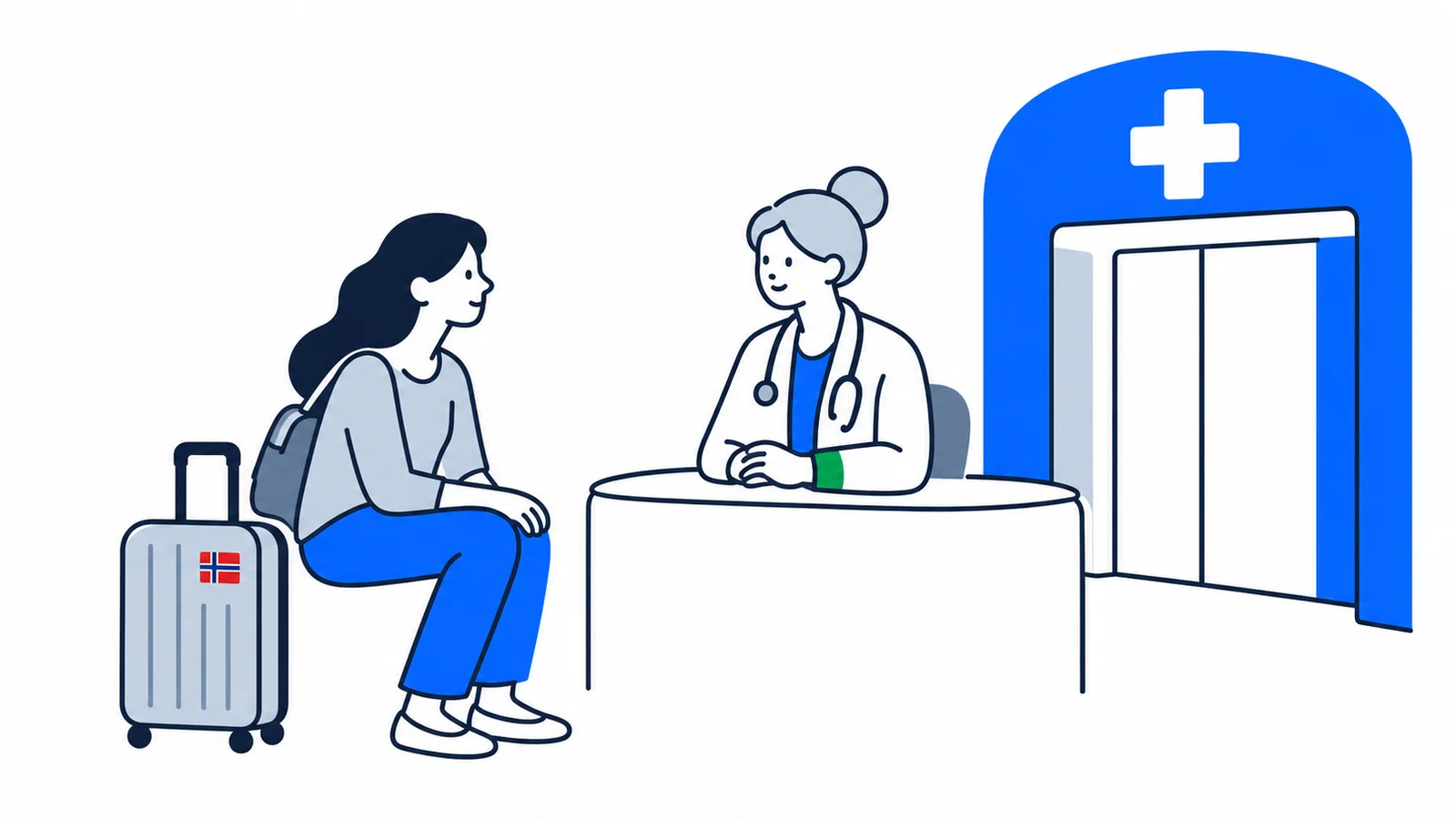

Planned treatment in another EU/EEA country may qualify for reimbursement from Helfo if the conditions are met. The treatment must correspond to specialist health care that would be publicly funded in Norway. You normally pay first. An advance decision can clarify coverage before you travel.
Does the European Health Insurance Card cover a planned operation?
No. The European Health Insurance Card does not apply to a trip whose purpose is to receive treatment. Planned treatment must be considered under another scheme.
EU means the European Union. EEA means the European Economic Area. Helfo, the Norwegian Health Economics Administration, processes applications for reimbursement of certain healthcare expenses.
This guide mainly covers the scheme where you choose a provider abroad and apply for reimbursement. It was checked on 3 October 2026 against Helfo’s guide on Helsenorge.
SamfunnPrep explains the other situation in its guide to the European Health Insurance Card for temporary trips.
Who can get reimbursement from Helfo?
You must be a member of the Norwegian National Insurance Scheme, and the treatment must correspond to healthcare that would be publicly funded in Norway. Under this scheme, you cannot receive reimbursement for treatment in the country where Helfo considers you resident.
The National Insurance Scheme is Norway’s public social security system. Membership alone does not mean that every treatment abroad is covered. The treatment and your circumstances must also meet the requirements.
This reimbursement scheme applies in other EU/EEA countries. It does not apply in Switzerland or the United Kingdom, although other healthcare schemes may apply there. Do not assume that a shared application-form name proves every scheme applies in every country.
What if you are treated in your home country?
What matters is where you are considered resident, not just which passport you hold. Helfo assesses residence individually in each case.
For example, you may work in Norway but have a spouse or children in another EEA country. Helfo may then consider you resident in that country. A longer stay abroad or spending much of the year outside Norway may also matter.
Helsenorge explains these limits on its page about people who can receive planned treatment in the EU/EEA. Ask Helfo before booking if your family or daily life is split between two countries.
S1 is a document that can give you healthcare rights in your country of residence. If you have an S1 for the country where you plan treatment, contact that country’s social security authorities. S1 is a different route from the reimbursement scheme in this guide.
What should you do before travelling?
Get a referral from a healthcare professional in Norway and a specific offer from a provider in the other country. You are responsible for finding the provider.
Check that the provider has valid public authorisation in that country. Helfo does not have a complete list of approved providers. The national contact point for healthcare in the country of treatment may be able to provide information about services.
Ask for a written offer stating:
- what treatment will be provided
- the method and expected course of treatment
- the estimated price and any additional charges
- who will provide the treatment
- what happens in case of complications and for follow-up.
Take the offer to your doctor in Norway. Clarify whether the treatment is comparable to what you would receive with public funding at home.
What is an advance decision?
An advance decision is a binding decision from Helfo about the described treatment and possible reimbursement. Applying is optional, but a decision may reduce financial uncertainty.
To receive one, you must be a patient with a right to necessary healthcare. This means the Norwegian specialist health service has assessed that you are entitled to necessary healthcare.
Attach the letter confirming this right, the offer from abroad and relevant specialist assessments. For treatment outside a hospital, you must also document the provider’s authorisation and specialist approval.
The decision applies only to what it describes. Approval for assessment does not automatically cover later treatment. Additional treatment discovered during the process is not automatically covered either.
Do you have to pay the full bill first?
Yes. Under this scheme, you pay first and apply for reimbursement afterwards, including when you have an advance decision.
Reimbursement cannot exceed the calculated cost of comparable treatment in Norway. If your bill is lower, reimbursement cannot exceed your actual expenses. Helfo may also calculate a patient user fee under the applicable rules.
A foreign hospital may register you as a private patient even if it also treats publicly funded patients. Additional charges for extra doctor fees or a better room may be outside the coverage.
Make a budget for treatment, possible extras, travel, accommodation and the time before reimbursement arrives. Be prepared for the final reimbursement to be lower than the bill.
Are an advance decision and S2 the same?
No. Prior authorisation using S2 is a different scheme, including for cases where waiting in Norway is medically indefensible. It has its own eligibility and treatment-location requirements.
| Scheme | Important difference |
|---|---|
| European Health Insurance Card | Necessary public healthcare during a temporary trip; not a treatment trip |
| Reimbursement with a possible advance decision | You pay first and claim reimbursement for comparable treatment |
| Prior authorisation using S2 | If approved, you do not have to pay the full treatment cost upfront; local user fees may apply |
Wanting a shorter wait is not by itself S2 approval. Read Helsenorge’s rules for medically indefensible waiting times and confirm which scheme applies.
What documents should you keep?
You need a referral, medical information, an itemised invoice and proof that you paid. The documents must show what treatment you actually received.
Ask for a medical record or discharge summary, a summary of the assessment and treatment. The invoice must show the price of each treatment. A payment receipt that does not describe the treatment is not sufficient on its own.
Documents must generally be in Norwegian, Danish, Swedish or English. Helfo may ask for a translation from other languages. You pay for the translation and must also attach the original.
Clarify this with the clinic before travelling. It is easier to get the right documents while you are still at the treatment centre.
When must you send the application?
You must send the application and documentation to Helfo within six months of the treatment date. If you did not pay at the treatment centre and received an invoice later, the deadline runs from the date of the first invoice.
The deadline is described in step 8 of Helfo’s application guide. Do not calculate it from a later reminder.
You can use the digital form or a paper form if you cannot apply digitally. Keep copies and send attachments through the correct channel.
What about travel costs and follow-up in Norway?
Travel costs are covered only to a limited extent. Reimbursement for treatment does not automatically mean your flight, hotel or companion will be covered.
Travel support is assessed against what you would have received to the nearest relevant treatment centre in Norway. Follow-up at home normally goes through the regular healthcare queue.
Ask your doctor and the foreign clinic to clarify follow-up before travelling. If you are injured after choosing treatment abroad, compensation is normally governed by the treatment country’s rules. SamfunnPrep collects tools for everyday life in Norway to help you keep track of documents and public services.