
Deposit returns and waste sorting in Norway are about more than keeping the home tidy. They are part of environmental policy, municipal services and the everyday duties residents meet in shops, housing cooperatives, return points and recycling centres. For the Samfunnskunnskapsprøven, the main point is simple: bottles and cans with a Norwegian deposit mark are returned to a reverse vending machine or shop, while other waste is sorted according to local rules so that as much as possible can be reused or recycled as material.
Deposit returns: a deposit on bottles and cans
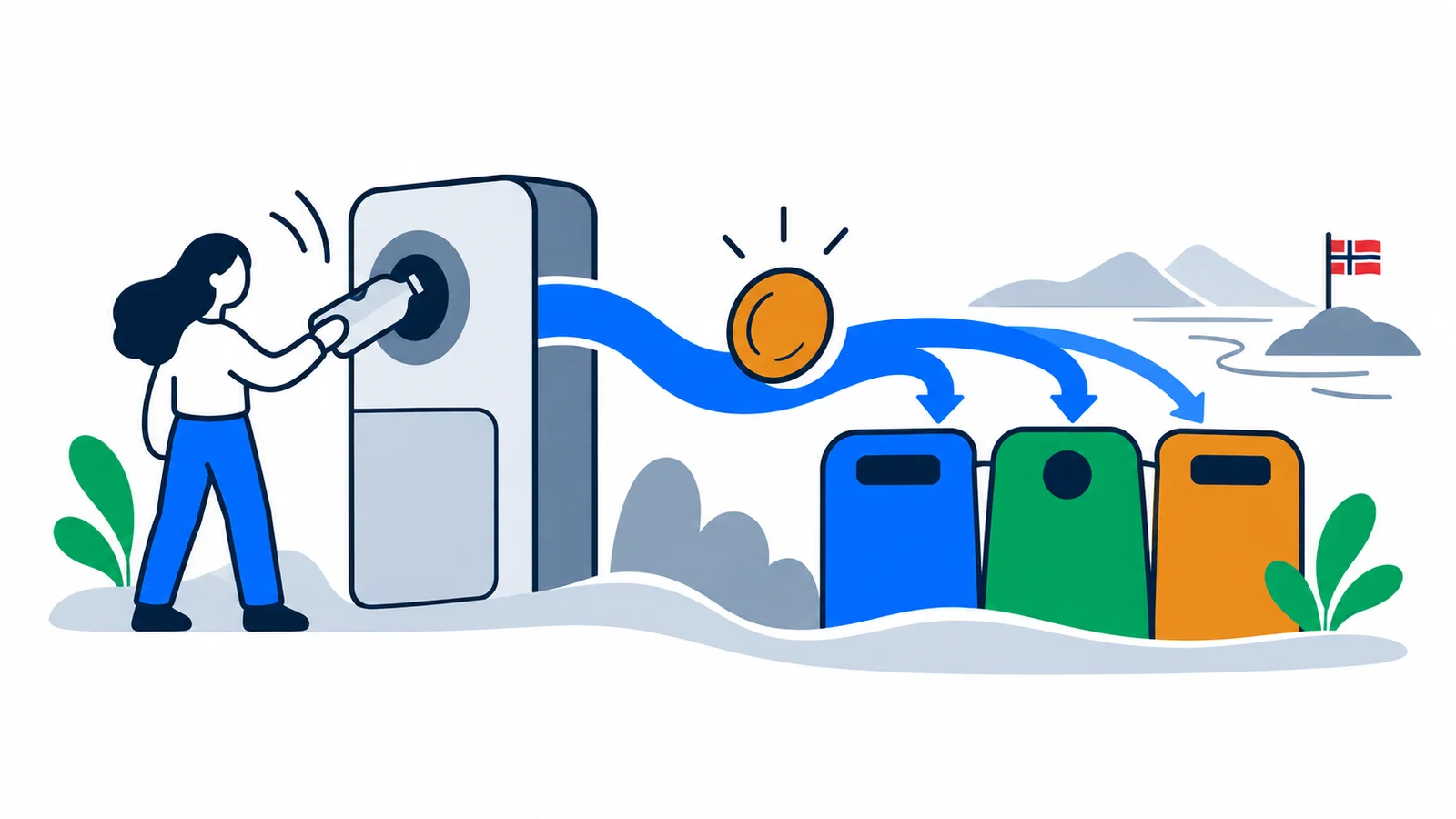
When you buy a drink in a plastic bottle or aluminium can with a Norwegian deposit mark, you pay a small deposit in addition to the price of the drink. You get the deposit back when the packaging is delivered to a reverse vending machine or to a sales outlet that accepts deposit returns. Infinitum operates the Norwegian deposit system for beverage packaging, and the system is designed to make it easy to return empty containers. Most grocery stores have reverse vending machines, and in some places larger amounts of containers can be returned through separate collection arrangements.
The deposit rates are NOK 2 for small bottles and cans up to 0.5 litres and NOK 3 for bottles over 0.5 litres. It is mainly beverage packaging made of plastic and aluminium that can be returned for a deposit. Look for the deposit mark on the label or can. Glass bottles, milk cartons, food tins, plastic bottles for soap or oil and packaging without a deposit mark must not go into the reverse vending machine. Plastic bottles from Vinmonopolet can be returned when they have a deposit mark.
The packaging does not need to be washed, but it should be empty. The barcode must be readable. A slightly dented can or bottle is often accepted, but badly damaged packaging may be rejected. Some foreign cans can be read by the system and sent for recycling without paying a Norwegian deposit refund. When the machine accepts the packaging, you normally receive a receipt that you can use in the shop, exchange for cash where that is offered, or donate through the machine's donation button.
The deposit system works because the packaging gets a value. Infinitum reports a very high total collection rate for both aluminium cans and plastic bottles, and more than 15,000 sales outlets are part of the system. Still, deposit returns are not a reason to buy more than you need. The best waste policy is still to prevent waste: use up what you buy, choose durable products and avoid unnecessary single-use packaging.
Source sorting: sorting where waste is created
Source sorting means separating waste where it is created: in the kitchen, bathroom, office or storage room. Instead of putting everything into residual waste, you sort food waste, plastic packaging, cardboard and paper, glass and metal packaging, textiles, electrical waste and hazardous waste separately. This allows more materials to be used again and gives the municipality better control over waste that can harm people, animals or the environment.
The Norwegian Environment Agency describes the municipality's duty as follows: all municipalities must make sure private households can source-sort food waste, garden waste, plastic waste, glass and metal packaging, cardboard, paper and textile waste. The waste must be collected separately and delivered for preparation for reuse or material recycling. Some requirements were introduced from 2023, and more requirements apply from 2025, including textile waste. This is why many municipalities have changed bags, bins, collection calendars and return points in recent years.
The principles are the same, but the solutions may look different. Oslo, for example, uses green bags for food waste and purple bags for plastic packaging, while other municipalities use separate bins, paper bags, coloured lids or central sorting. The most important thing is therefore to check the municipality where you live. Sortere.no and the Sortere app let you search by waste type, municipality, return point and recycling centre.
What goes where?
Food waste is food leftovers, peels, coffee grounds and other organic waste from the kitchen. It should normally go in its own bag or bin. Drinks should not be poured into the food-waste bag. When food waste is sorted correctly, it can become biogas, compost or biofertiliser, depending on the municipality's solution.
Plastic is an area where many people make mistakes. Plastic packaging should often be sorted separately, but plastic products that are not packaging may have other solutions. The Norwegian Environment Agency points out that municipalities must at least facilitate sorting of several plastic fractions, but practical rules can vary. Packaging should be empty. Sortere uses the rule of thumb that packaging is clean enough when it is empty of residues; sometimes a quick rinse and shake is enough. If food residues are stuck firmly, residual waste may be correct.
Cardboard and paper must be dry and free of food residues. Newspapers, cardboard boxes, paper bags and beverage cartons can often be sorted together, but wet or dirty paper usually goes into residual waste. Glass and metal packaging means packaging, not everything made of glass or metal. Jam jars, bottles without deposit, food tins and aluminium trays often belong here. Drinking glasses, ceramics, porcelain, mirrors, frying pans and paint tins must not be put with glass and metal packaging.
Textiles received more attention from 2025. Whole, clean and dry clothes that can be used again should be delivered for reuse, for example to charitable collectors or second-hand shops. Damaged or worn-out, but dry, textiles can be delivered as textile waste where the municipality has a solution for it. Damp, mouldy or contaminated textiles can ruin the rest of the collection and should often go into residual waste, or as hazardous waste if they are full of oil, paint or chemicals.
Hazardous waste, electrical waste and large items
Hazardous waste must never go into residual waste. It may include paint, varnish, glue, solvents, oil, spray cans, some cleaning products, batteries and other products that can harm health or the environment. The municipality must have a reception service for hazardous waste from households, often at a recycling centre, environmental station or mobile collection point. Electrical and electronic waste, such as mobile phones, chargers, battery-powered toys, light bulbs and small appliances, must be delivered separately. Many shops accept similar products free of charge.
Larger items such as furniture, mattresses, timber, garden waste, metal objects and construction waste are usually delivered to a recycling centre. Some municipalities have collection services, reuse stations or swap days. Usable items should be sold, given away or delivered for reuse before they become waste. Reuse often gives a greater climate and environmental benefit than material recycling, because the product lasts longer and a new one does not have to be produced.
The municipality's responsibility and your responsibility
The municipality is responsible for collecting household waste and for providing reception of hazardous waste from households. It can do the work itself, use an inter-municipal company or buy services, but the responsibility remains with the municipality. Waste collection is financed through a waste fee based on the self-cost principle: the fee must cover the municipality's costs for legally required handling of household waste, not function as an ordinary tax.
The resident's responsibility is to use the arrangements correctly. This means sorting according to the municipality's guidance, tying bags where required, not leaving waste outside full containers, not mixing hazardous waste with residual waste and delivering large items to the right place. In housing cooperatives and condominiums, it is also important that residents follow shared routines, because incorrect sorting can lead to a poorer working environment, extra costs and lower material quality.
Statistics Norway's household waste statistics show that Norway still throws away large amounts of waste. In 2025, around 2.13 million tonnes of household waste were collected, about 379 kilos per inhabitant. This shows why source sorting is not just a small kitchen habit, but part of how society uses resources.
What to remember for the test
Deposit returns apply to marked drink bottles and cans, and you get the money back when you return them. Source sorting applies to many other types of waste, and the municipality must give residents practical solutions. Residual waste is what remains after items that can be returned for deposit, reused, recycled as material or delivered separately have been taken out. If you are unsure, check the municipality's website or Sortere before throwing something away. In Norway, residents are expected to take part in these systems because waste is both a practical everyday responsibility and a shared environmental responsibility.