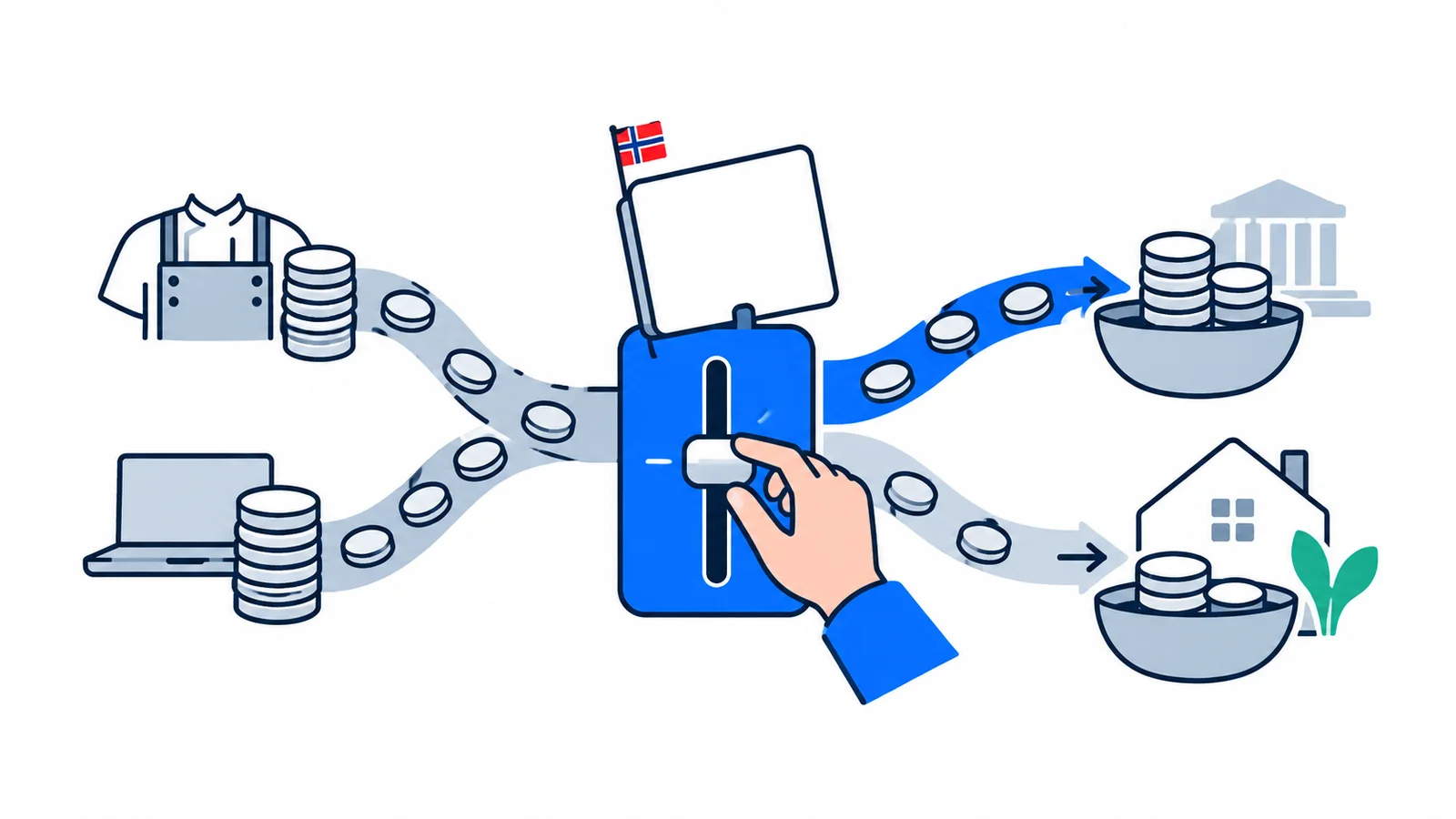


Are you a foreigner planning to work in Norway? Then PAYE (Pay As You Earn / kildeskatt) might be a simple tax scheme for you. This guide explains the PAYE scheme for 2026: who can choose it, the 25% rate, the threshold of NOK 725 050, advantages and disadvantages, and how to switch to a standard tax return if PAYE doesn't suit you.
What is PAYE / kildeskatt and who can choose it?
PAYE (Pay As You Earn), also called kildeskatt, is a simplified tax scheme for foreign workers with limited tax liability to Norway. Instead of filing a standard tax return, you pay a flat rate of 25% of your gross salary.
The scheme is established in the Tax Act § 2-3 first paragraph letter h and came into force on 1 January 2019 to simplify the tax settlement for short-term workers. The Tax Administration estimates that around 100 000 foreign workers use PAYE every year.
Who can choose PAYE?
You qualify if:
- You are a foreign national without tax residence in Norway — normally the first 4 years, before you become «tax resident» under the Tax Act § 2-1
- Your gross annual salary is below NOK 725 050 (2026 threshold)
- You work in Norway (not just board positions or capital income)
Who CANNOT use PAYE?
- Norwegian citizens
- Persons with tax residence in Norway (after 4 years or 183 days of residence in a single year / 270 days over three years)
- Seafarers and foreign workers on the continental shelf (special rules)
- Self-employed / sole proprietors — see freelancer or sole proprietor
- Persons with income over NOK 725 050 (2026 threshold)
- Persons who choose to receive social security benefits from NAV (sick pay, unemployment benefits)
2026 Threshold: NOK 725 050 — what does it mean?
Gross annual salary exceeds NOK 725 050 = you can no longer use PAYE.
The threshold is adjusted annually by Parliament. History:
| Year | Threshold |
|---|---|
| 2023 | NOK 642 950 |
| 2024 | NOK 670 000 |
| 2025 | NOK 700 000 |
| 2026 | NOK 725 050 |
What happens if you exceed the threshold?
If your income crosses the threshold during the year:
- The Tax Administration notifies you (via Digipost or Altinn)
- You receive a standard tax return for the entire year
- PAYE deductions from previous months are counted as advance tax
- You file a tax return in April the following year — normally you either receive a tax refund or owe additional tax
What is included in the calculation?
- Base salary and hourly wages
- Bonuses, commissions, fees
- Benefits in kind (car, housing)
- Foreign service allowances and travel allowances above the statutory rate
Not included: Pensions from abroad, unemployment benefits from your home country, capital income.
Advantages and disadvantages: PAYE vs. standard tax return
Advantages of PAYE
- No tax return to file — save time and administrative costs
- Automatic final settlement — no surprise tax liability
- Simpler for short-term stays (1–3 years)
- 25% may be lower than marginal tax for income in the bracket NOK 686 500–725 050 (where marginal tax is approx. 41%)
- Tax card does not need updating with salary changes
- Suitable if you live in employer-provided housing (free accommodation)
Disadvantages of PAYE
- No deductions — you cannot deduct:
- Commuting allowance (accommodation and meals)
- Interest deduction on mortgage
- Childcare / after-school program deduction
- Deduction for donations to voluntary organizations
- Trade union membership fee deduction
- Travel to/from work
- No tax refund for low income or many deductions
- Not suitable if you own a Norwegian property or have family in Norway
- 25% is often higher than marginal tax for income below NOK 292 850 (where marginal tax is approx. 27%)
- Can create challenges with application for permanent residence because a standard tax return provides better documentation of finances
Concrete comparison: example with NOK 500 000 gross income
Under PAYE 25%:
- Tax: NOK 500 000 × 25% = NOK 125 000
- Net income: NOK 375 000
Under standard tax return (only basic deduction/personal allowance):
- General tax (22%): NOK 500 000 – (NOK 104 450 basic deduction) – (NOK 108 550 personal allowance) = NOK 287 000 × 22% = NOK 63 140
- Progressive tax: approx. NOK 12 000
- Social security contribution (7.8%): NOK 500 000 × 7.8% = NOK 39 000
- Total: approx. NOK 114 140
In this example, a standard tax return is approx. NOK 10 000 lower. If you have more deductions (commuting allowance, interest, trade union), the difference increases further.
Conclusion: Always calculate both alternatives before you choose.
Tax card and employer: how PAYE works
How do you choose PAYE?
- Upon first arrival in Norway you apply for a tax card from the Tax Administration at skatteetaten.no/skattekort
- When applying for a tax card you get the choice between PAYE and standard taxation
- If you choose PAYE, you receive a tax card with deduction rate of 25%
How is the tax deducted?
- The employer deducts 25% of gross salary each pay period
- The tax is sent directly to the Tax Administration via the A-message
- You receive a pay slip showing the PAYE deduction
- No additional paperwork at year-end — the scheme is self-settling
What about social security contribution?
The 25% rate includes the social security contribution (7.8%). You have the right to social security benefits such as:
- Sick pay
- Maternity/paternity pay
- Unemployment benefits (with longer stay)
Note: If you want to apply for unemployment benefits from NAV, you may lose the right to PAYE and must switch to standard taxation.
Foreign identification
Even though you are not tax resident, you must have a D-number or Norwegian national ID number to work legally. You get a D-number from the Tax Administration by appointment. Remember to bring:
- Passport
- Employment contract
- Proof of legal residence (work permit or EEA registration)
Switching from PAYE to standard taxation: when and how
Voluntary switch
You can switch from PAYE to standard taxation at any time:
- Go to skatteetaten.no → «Change tax card»
- Select «Standard taxation»
- A new tax card is issued within 1–2 weeks
- The employer deducts tax according to the new card from the next salary
Note: The switch applies to the entire calendar year retroactively. If you have had PAYE the first months, you must file a tax return in April where the PAYE deduction is counted as advance tax.
Automatic switch to standard taxation
You must switch to standard taxation when:
- You have tax residence in Norway (183 days in the year or 270 days over 3 years)
- You exceed the NOK 725 050 threshold (2026)
- You become self-employed / sole proprietor
- You apply for unemployment benefits from NAV
- You receive Norwegian pension income or other forms of Norwegian taxation that don't fit PAYE
After 4 years
After 4 years in Norway (and continuing to work here) you become tax resident under the Tax Act § 2-1. Then you must:
- File a standard tax return from the year you become tax resident
- Pay tax on all income from around the world (not just from Norway)
- Report foreign assets (bank accounts, shares, property)
- Check tax agreements between Norway and your home country to avoid double taxation
Practical advice and pitfalls
Always calculate both alternatives
Use the Tax Administration's calculator at skatteetaten.no/kalkulator to compare PAYE vs. standard taxation. Enter your expected income, commuting allowance, interest deduction and other deductions.
Foreign tax treaty
Does Norway have a tax treaty with your home country? Check regjeringen.no. Tax treaties can provide:
- Relief from double taxation
- Reduced rates on capital income
- Credit for tax paid in your home country
Tax residence test
183 days in one calendar year or 270 days over three calendar years makes you tax resident. After that:
- Worldwide tax liability to Norway
- No longer entitled to PAYE
- Must file a standard tax return
Final settlement when leaving
If you leave Norway during the year:
- Report moving to the Population Register (see report moving)
- Switch to standard taxation for the year
- Final settlement after Norwegian tax return in April the following year
What does NAV and social security contribution say?
As a PAYE worker you are insured in the Norwegian social security system if you:
- Are employed by a Norwegian employer
- Have work lasting at least 7 days in Norway
This gives you the right to:
- Sick pay from NAV (after employer period)
- Maternity/paternity pay (with qualification)
- Unemployment benefits (with longer stay)
- Accident insurance through your employer
EEA citizens: Norway has an A1-certificate scheme that lets you maintain social security coverage from your home country while working temporarily in Norway. Check with NAV.
Summary
PAYE (kildeskatt) 2026 is a flat 25% tax scheme for foreign workers with gross income below NOK 725 050 who are not tax resident in Norway. Advantage: no tax return, automatic final settlement, simple for short-term stays. Disadvantage: no deductions (commuting, interest, dependents) and can be more expensive than standard taxation with low income or many deductions. Always calculate both alternatives using the Tax Administration's calculator before you choose. You can switch to standard taxation at any time via skatteetaten.no. After 4 years in Norway you automatically become tax resident and must file a standard tax return.